Mosquitoes are small flying insects that are commonly found around homes, farms, gardens, drains, ponds and other places where water can collect. Although mosquitoes are known mainly for their bites, they also have an interesting reproductive process. Their reproduction depends strongly on water because the young stages of the mosquito develop in water before becoming flying adults.
Mosquitoes reproduce sexually, which means that reproduction involves a male mosquito and a female mosquito. After mating, the female produces eggs and lays them in or near suitable water. The eggs hatch into larvae, which are commonly called wrigglers. The larvae later develop into pupae, also called tumblers, and finally emerge as adult mosquitoes.
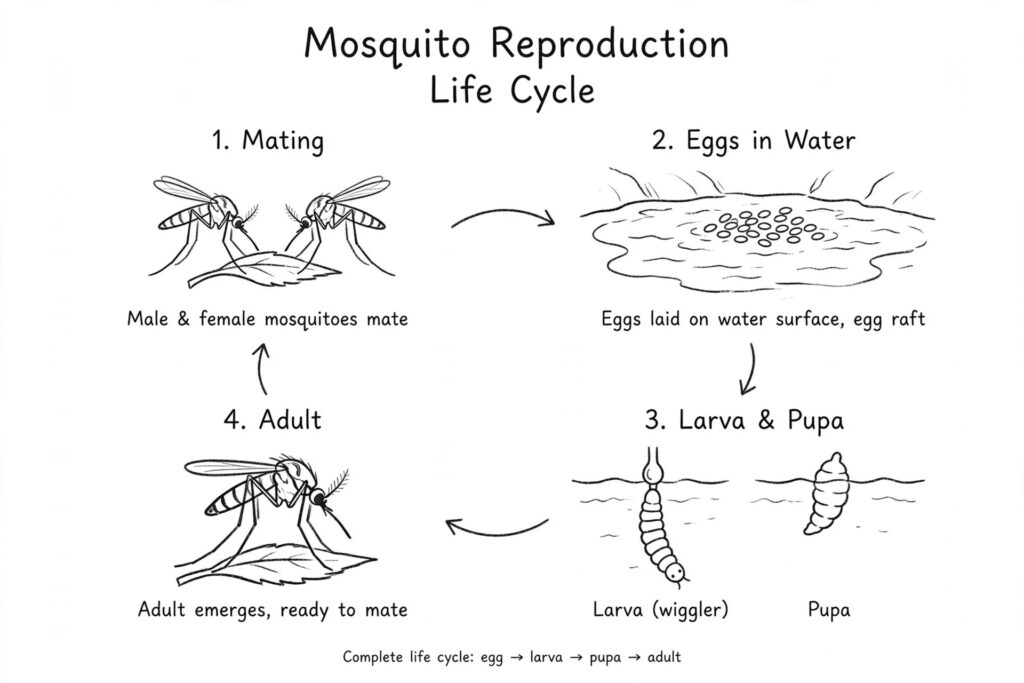
The complete development from egg to adult is called metamorphosis. Mosquitoes undergo complete metamorphosis because their life cycle has four clearly different stages: egg, larva, pupa and adult.
Understanding reproduction in mosquito is important because it explains how mosquito populations increase and why stagnant water around homes can become a breeding place.
The Male and Female Mosquito
Male and female mosquitoes look similar at first, but there are differences between them. The male mosquito usually has feathery antennae that help it detect sounds and movements from the wings of female mosquitoes. The female generally has less bushy antennae.
Another important difference is their feeding habit. Male mosquitoes feed mainly on plant juices and nectar. They do not normally take blood meals. Female mosquitoes also feed on plant juices and nectar for energy, but many species of female mosquitoes need a blood meal to obtain proteins needed for producing eggs.
This does not mean that every mosquito species behaves in exactly the same way. Feeding habits can vary among mosquito species. However, the need for a blood meal by females of many species is an important part of mosquito reproduction.
How Mosquitoes Mate
Mating takes place when adult male and female mosquitoes meet. In many mosquito species, males gather in groups or swarms, especially around particular locations. A female may enter such a swarm and mate with a male.
The male transfers sperm to the female during mating. The sperm can then be stored inside the female’s body and used to fertilize eggs as they are produced.
A female mosquito may mate only once but can store sperm for later use. This allows her to fertilize eggs over more than one egg-laying period, depending on the species.
After mating, the female’s attention turns to finding the conditions needed for producing and laying eggs.
Why the Female Mosquito Needs Blood
One of the most interesting parts of mosquito reproduction is the blood-feeding habit of many female mosquitoes.
A female mosquito may take nectar or plant fluids for energy, but a blood meal provides nutrients, especially proteins, that can be used in the development of eggs. After obtaining a suitable blood meal, the female can digest it and use the nutrients to develop her eggs.
This is why female mosquitoes are often more closely associated with biting humans and other animals. The bite is connected to reproduction because the nutrients obtained from blood can support egg development in many mosquito species.
However, not every mosquito species depends on human blood. Some feed on other animals, and mosquito feeding behaviour differs from one species to another.
Where Mosquitoes Lay Their Eggs
A female mosquito must find a suitable place to lay her eggs. The exact location depends on the mosquito species.
Some mosquitoes lay their eggs directly on the surface of standing water. Others place eggs on the sides of containers just above the water line, where the eggs may later become flooded. Some species prefer natural water collections such as tree holes, while others can use artificial containers around homes.
Common places that can provide suitable breeding conditions include:
- Buckets and containers holding water
- Old tyres containing rainwater
- Blocked gutters
- Open water tanks
- Flower pots and trays
- Discarded containers
- Drains with stagnant water
- Tree holes
- Ponds and other slow-moving or standing water
The important point is that mosquitoes do not need a large body of water to reproduce. Some species can use surprisingly small amounts of collected water.
Egg Laying in Mosquito
After the eggs have developed, the female mosquito lays them in a suitable location. The number and arrangement of eggs vary among mosquito species.
Some females lay eggs individually, while others lay several eggs together. In some species, eggs are placed directly on water, while in others they are placed on damp surfaces that may later become flooded.
The female’s choice of a breeding site is important because mosquito eggs and young stages cannot develop successfully in every environment. Temperature, water availability, food, predators and other conditions can affect whether the young mosquitoes survive.
Under suitable conditions, the eggs hatch and release mosquito larvae.
Stage One: Egg
The egg stage is the first stage in the mosquito life cycle.
Mosquito eggs are very small, so they may be difficult to notice without looking closely. Their appearance and arrangement differ among species.
Once the eggs are exposed to suitable conditions, they can hatch into larvae. The length of the egg stage depends on factors such as temperature, moisture and mosquito species.
The egg is therefore more than just the beginning of the life cycle. It is the stage in which the developing mosquito remains protected until the conditions are suitable for hatching.
Stage Two: Larva
After hatching, the mosquito enters the larval stage. The larva is commonly called a wriggler because of the way it moves through water.
The larva lives in water and spends much of its time feeding and growing. It does not look like an adult mosquito. Instead, it has a simple elongated body and moves by making wriggling movements.
Mosquito larvae need food for growth. They may feed on microorganisms, organic particles and other small materials found in the water, depending on the species.
Many mosquito larvae come to the water surface to obtain air. This makes them easier to recognize in some breeding sites because they may repeatedly move between the water surface and deeper parts of the water.
Growth of the Larva
The larva does not remain the same size throughout the stage. As it grows, it sheds its outer covering several times. These changes allow the larva to increase in size.
The larval stage is important because much of the mosquito’s growth occurs during this period. If the water dries up or conditions become unsuitable, many larvae may die before reaching the next stage.
After completing larval development, the mosquito changes into a pupa.
Stage Three: Pupa
The pupal stage is the third stage in the mosquito life cycle. It is commonly called a tumbler because of its characteristic movement in water.
The pupa is quite different from the larva. It does not feed like the larva does. Instead, major changes take place inside its body as it develops into an adult mosquito.
During this stage, structures needed by the adult mosquito, such as wings and adult body parts, develop further.
The pupal stage is therefore a period of transformation. The mosquito is still associated with water, but it is preparing to become a flying adult.
When development is complete, the adult mosquito emerges from the pupal case.
Stage Four: Adult Mosquito
The final stage is the adult mosquito. The adult emerges from the pupal stage and eventually becomes capable of flying.
At first, the newly emerged mosquito needs time for its body and wings to become ready for normal activity. Once mature, it can fly, feed, mate and continue the reproductive cycle.
Adult mosquitoes are the stage that people commonly recognize. They have three major body regions:
- Head
- Thorax
- Abdomen
They also have wings and three pairs of legs.
The adult male and female have different roles in reproduction. Males mainly feed on plant fluids and seek females for mating, while females of many species require additional nutrients for egg production.
The Complete Mosquito Life Cycle
The mosquito life cycle can be represented simply as:
Egg → Larva → Pupa → Adult
The adult female can then mate and produce another generation of eggs.
This cycle shows why mosquitoes can increase in number when suitable breeding sites remain available. A small amount of water can support the early stages of development, and several generations may occur when environmental conditions remain favourable.
The exact time required to complete the life cycle varies with mosquito species and environmental conditions. Warm temperatures and suitable water conditions can speed up development, while unfavourable conditions can slow it down or prevent successful development.
Why Water Is So Important to Mosquito Reproduction
Water plays a major role in mosquito reproduction because the egg, larval and pupal stages of many mosquito species are associated with water.
This is why removing unnecessary standing water can reduce potential breeding sites. Water that remains in containers for several days can provide an opportunity for mosquitoes to lay eggs and for larvae to develop.
However, mosquitoes are not all attracted to exactly the same types of water. Some prefer clean water in containers, while others can develop in polluted or dirty water. Therefore, it is important not to assume that only dirty water can support mosquitoes.
Even clear water can become a breeding site if the conditions are suitable.
Factors That Affect Mosquito Reproduction
Mosquito reproduction is affected by several environmental factors. These factors determine whether mosquitoes can successfully mate, lay eggs and raise the next generation.
Temperature: Temperature affects the speed of development. In suitable warm conditions, the different stages may develop more quickly. Extremely high or low temperatures can reduce survival.
Water: Water is essential for the immature stages of many mosquitoes. A lack of suitable water can prevent eggs from hatching or larvae from completing development.
Food: Larvae require food materials in the water for growth. Adult mosquitoes also need energy sources such as plant nectar, while females of many species require a blood meal for egg production.
Shelter: Adult mosquitoes often rest in protected, cool or shaded places. Suitable shelter can improve their chances of surviving long enough to reproduce.
Predators: Mosquito larvae can be eaten by aquatic insects, fish and other organisms. Predators can therefore reduce the number of mosquitoes that survive to adulthood.
Rainfall: Rain can create new breeding sites by filling containers, holes and other depressions with water. Heavy rainfall can sometimes wash larvae away, but regular rainfall may create many new places for mosquitoes to breed.
Mosquito Reproduction and the Rainy Season
In many areas, mosquito numbers can increase during periods when rainfall creates more suitable water collections. Containers, blocked drainage systems, tyres and other objects can collect rainwater.
This does not mean that mosquitoes only reproduce during the rainy season. Some species can reproduce throughout the year if suitable breeding conditions are available.
The rainy season simply provides more opportunities for water to collect in different places. This is one reason why checking the surroundings after rainfall is useful for reducing mosquito breeding sites.
How Mosquitoes Find Suitable Breeding Places
Female mosquitoes do not simply lay eggs anywhere. They respond to environmental signals that can help them locate suitable places.
They may detect moisture, water, smells and other chemical or physical signals associated with potential breeding sites. The exact behaviour varies among species.
For example, one mosquito species may prefer small containers around homes, while another may prefer larger natural water bodies. This difference in breeding preference helps explain why different mosquito species are found in different environments.
Mosquitoes and Human Health
Mosquito reproduction is important to human health because some mosquito species can transmit disease-causing organisms. Diseases associated with mosquitoes include malaria, dengue, yellow fever and some forms of encephalitis, depending on the mosquito species and geographical area.
The mosquito itself does not create these diseases. Instead, certain mosquitoes can act as vectors by carrying disease-causing organisms from one host to another.
Reducing mosquito breeding can therefore be part of broader mosquito-control efforts.
It is also important to remember that not every mosquito carries or transmits every disease. Different mosquito species have different feeding habits and abilities to transmit particular pathogens.
Ways to Reduce Mosquito Breeding
Controlling mosquito breeding begins with reducing places where mosquitoes can reproduce.
Some useful measures include:
- Emptying containers that have collected unnecessary water.
- Keeping water storage containers properly covered.
- Clearing blocked gutters and drainage areas.
- Avoiding the careless disposal of containers and tyres where they can collect rainwater.
- Changing or managing water in places where mosquitoes may breed.
- Keeping the surroundings clean and checking for small collections of standing water.
- Following local public-health advice on mosquito control.
The goal is not simply to kill adult mosquitoes. Reducing breeding sites can help reduce the number of mosquitoes that develop into adults in the first place.
Why Mosquitoes Produce Many Eggs
Mosquito reproduction can result in many offspring because mosquitoes can produce numerous eggs during their reproductive lives. However, producing many eggs does not mean that every egg will become an adult mosquito.
Many eggs, larvae and pupae die because of drying water, predators, unsuitable temperature, lack of food and other environmental conditions.
This is common in nature. Organisms that produce many young often experience significant losses before the young reach adulthood.
Mosquito Reproduction Compared With Other Insects
Mosquitoes share some reproductive features with other insects, but their life cycle has a special connection with water.
Like many insects, mosquitoes reproduce sexually and undergo complete metamorphosis. Their four stages are egg, larva, pupa and adult.
The major difference is that the immature mosquito stages are strongly associated with aquatic environments. A mosquito larva does not look like a small adult mosquito. It has a different body form and lifestyle.
This is why the mosquito life cycle is a good example of complete metamorphosis.
A Simple Example of the Mosquito Life Cycle
Imagine that a female mosquito finds a small container containing rainwater near a house. If the location is suitable, she may lay eggs there.
The eggs remain in the environment until they hatch. The young mosquitoes then enter the larval stage and live in the water, feeding and growing.
After completing larval development, they become pupae. During the pupal stage, the mosquito undergoes major changes and develops into an adult.
The adult mosquito eventually leaves the water. If it is a female, it can later mate, feed according to the needs of its species, develop eggs and find another suitable breeding site.
The cycle then begins again.
Importance of Studying Reproduction in Mosquito
Studying mosquito reproduction helps us understand how mosquito populations develop and why certain environments support large numbers of mosquitoes.
It is useful in biology because mosquitoes provide a clear example of sexual reproduction, complete metamorphosis and the relationship between an insect and its environment.
It is also important in public health. Knowing where mosquitoes lay eggs and how their young develop helps communities identify and reduce potential breeding sites.
For students, the mosquito is therefore a useful example when learning about reproduction, insect development, metamorphosis and disease vectors.
Key Points to Remember on Reproduction in Mosquito
The most important facts about reproduction in mosquito are:
- Mosquitoes reproduce sexually.
- Male and female mosquitoes are involved in reproduction.
- In many species, the female requires a blood meal to support egg development.
- The female lays eggs in or near suitable water, depending on the species.
- Mosquitoes undergo complete metamorphosis.
- The four main stages are egg, larva, pupa and adult.
- The larva is commonly called a wriggler.
- The pupa is commonly called a tumbler.
- The larva feeds and grows in water.
- The pupa undergoes major changes before becoming an adult.
- Adult mosquitoes can fly, mate and reproduce.
- Water availability is an important factor in mosquito reproduction.
- Removing unnecessary standing water can reduce possible breeding sites.
Conclusion on Reproduction in Mosquito
Reproduction in mosquito is a continuous process that begins when adult mosquitoes mate and ends with the production of a new generation. The female lays eggs in suitable places, and the eggs develop through the larval and pupal stages before becoming adult mosquitoes.
The mosquito life cycle is especially interesting because the young mosquito does not look like the adult. It passes through four distinct stages: egg, larva, pupa and adult. This type of development is known as complete metamorphosis.
Water is one of the most important environmental requirements for the early stages of many mosquitoes. This explains why containers, blocked drains, tyres, ponds and other places that hold water can become breeding sites. Understanding these stages makes it easier to understand mosquito populations and the importance of reducing unnecessary standing water.
Revision Questions on Reproduction in Mosquito
- What are the four stages in the life cycle of a mosquito?
- Why do females of many mosquito species take blood?
- What is the difference between the larval and pupal stages of a mosquito?
- Why is water important in mosquito reproduction?
- What is meant by complete metamorphosis in mosquitoes?
Frequently Asked Questions on Reproduction in Mosquito
1. How do mosquitoes reproduce?
Mosquitoes reproduce sexually through mating between male and female mosquitoes. After mating, the female develops eggs and lays them in suitable places, often in or around water depending on the species.
2. What are the four stages of the mosquito life cycle?
The four stages are egg, larva, pupa and adult. The larva and pupa are immature stages, while the adult is the fully developed flying stage.
3. Why does a female mosquito need blood?
Females of many mosquito species take blood because the nutrients, especially proteins, can help them develop eggs. Male mosquitoes generally feed on plant fluids rather than blood.
4. What is the larva of a mosquito called?
The mosquito larva is commonly called a wriggler because of its characteristic wriggling movement in water.
5. Why is standing water important to mosquitoes?
Many mosquito species use standing or slowly moving water as a place for their eggs, larvae and pupae to develop. Removing unnecessary water collections can therefore reduce potential breeding sites.
Related Articles