Reproduction in Hydra: Hydra is a small freshwater animal that belongs to a group of organisms called cnidarians. It is commonly found attached to aquatic plants, stones and other surfaces in ponds and slow-moving freshwater. Although Hydra is small, it has a simple body structure that makes it useful for studying important biological processes, including reproduction.
One interesting feature of Hydra is its ability to reproduce in more than one way. Under normal and favourable conditions, Hydra commonly reproduces asexually by budding. It can also reproduce sexually, especially when environmental conditions become less favourable.
The ability to reproduce in different ways helps Hydra produce new individuals and continue its species. Its method of reproduction also provides a good example of how organisms with relatively simple body structures can carry out complex life processes.
In this article, we will look at the meaning of reproduction in Hydra, the different methods involved, how budding takes place, sexual reproduction, the conditions that affect reproduction, and the importance of these processes.
What Is Hydra?
Hydra is a small, soft-bodied aquatic animal that lives mainly in freshwater. It has a tubular body with a basal disc at one end, which it uses to attach itself to a surface, and a mouth surrounded by tentacles at the other end.
The tentacles help Hydra capture food. They contain special structures called nematocysts, which can release substances that help the animal capture and immobilise its prey.
Hydra has a simple body plan because it is made up of only a small number of tissue layers and does not have complex organs like those found in larger animals.
Despite its simple structure, Hydra can feed, move, respond to its environment and reproduce.
What Is Reproduction in Hydra?
Reproduction in Hydra is the process by which Hydra produces new individuals of its own kind. Hydra can reproduce both asexually and sexually.
The most common method under favourable conditions is budding. During budding, a small outgrowth develops on the body of the parent Hydra. The outgrowth gradually grows and develops the structures needed to live independently. When it becomes sufficiently developed, it separates from the parent and becomes a new Hydra.
Hydra can also reproduce sexually. In this method, reproductive cells are produced, and male and female gametes are involved in fertilisation.
The two methods are useful under different conditions. Asexual reproduction allows Hydra to produce new individuals without finding a mate, while sexual reproduction allows genetic material from different reproductive cells to combine.
Types of Reproduction in Hydra
Hydra reproduces mainly in two ways:
- Asexual reproduction by budding
- Sexual reproduction
These two methods differ in the way new individuals are produced.
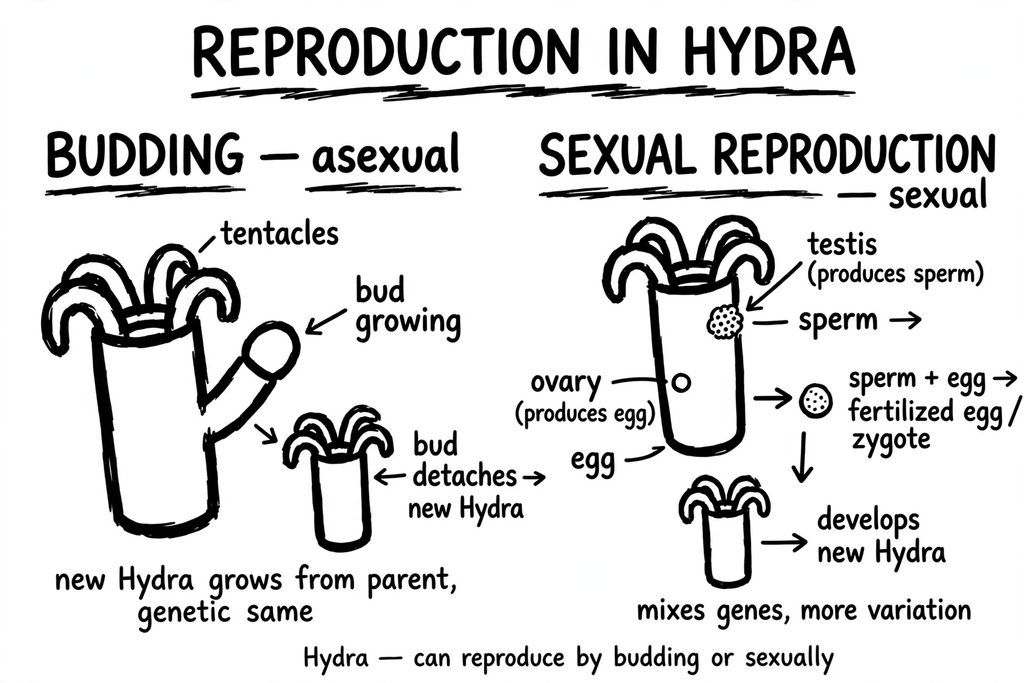
Budding involves only one parent and does not require the fusion of gametes. Sexual reproduction involves reproductive cells and fertilisation.
Asexual Reproduction in Hydra
Asexual reproduction is reproduction in which a new organism is produced from a single parent without the fusion of male and female gametes.
In Hydra, the common form of asexual reproduction is budding.
Budding is possible because Hydra has a strong ability to grow new tissues. A small part of the body can develop into a new individual while still attached to the parent.
This process is particularly common when food is available and environmental conditions are suitable for growth.
What Is Budding in Hydra?
Budding is a form of asexual reproduction in which a new organism develops as a small growth or bud on the body of the parent.
The bud starts as a small swelling on the body wall. As it grows, it becomes more noticeable and begins to develop structures similar to those of the parent Hydra.
Tentacles appear around the developing mouth, and the young Hydra gradually takes on the shape of an adult.
When the young Hydra is fully developed enough to survive independently, it separates from the parent.
The detached young Hydra then lives on its own and continues to grow.
Stages of Budding in Hydra
The process of budding can be explained in several stages.
1. Formation of a Small Outgrowth
When the Hydra is well nourished and conditions are favourable, cells in a particular region of its body begin to divide rapidly.
This cell division produces a small outgrowth on the body wall.
At this early stage, the outgrowth is still attached to the parent and does not live independently.
2. Growth of the Bud
The small outgrowth gradually increases in size as its cells continue to divide and grow.
The developing bud receives nutrients through its connection with the parent. During this period, it remains physically attached to the parent Hydra.
As the bud becomes larger, it begins to look more like a small Hydra.
3. Development of the Mouth and Tentacles
As the bud continues to grow, important body structures begin to develop.
A mouth forms at the free end of the bud, and tentacles develop around the mouth. These structures are necessary because the young Hydra will eventually need to feed independently.
The development of the tentacles is an important stage because it shows that the bud is becoming a complete organism rather than remaining a simple swelling on the parent.
4. Maturation of the Young Hydra
The young Hydra continues to grow while still attached to the parent.
It develops the basic features required for an independent life, including a body column, mouth and tentacles.
At this stage, the young Hydra looks like a smaller version of the parent.
5. Separation From the Parent
Once the young Hydra has developed sufficiently, it separates from the parent.
The detached organism is now an independent Hydra. It can move, feed and continue growing without remaining attached to the parent.
When it reaches reproductive maturity, it can also produce new individuals.
Why Is Budding Called Asexual Reproduction?
Budding in Hydra is called asexual reproduction because only one parent is involved.
There is also no fusion between male and female gametes during the process.
The new Hydra develops from the body of the parent through cell division and growth. Because there is no mixing of genetic material from two parents, the offspring is generally very similar genetically to the parent.
This makes budding different from sexual reproduction.
Advantages of Budding in Hydra
Budding gives Hydra several advantages, particularly when environmental conditions are favourable.
It Does Not Require a Mate
One Hydra can produce a new individual on its own. It does not have to find another Hydra before reproduction can occur.
This can be useful when individuals are spread out in their environment.
It Is a Relatively Simple Process
Budding does not require the formation and fusion of reproductive cells. Instead, a new organism develops from the parent through growth and cell division.
It Can Increase the Number of Hydra
A parent Hydra can produce buds, and those buds can eventually become independent individuals.
When food and other conditions are suitable, this can allow the number of Hydra in an area to increase.
The New Hydra Is Already Adapted to the Same Environment
Because the young Hydra develops from the parent, it generally has genetic characteristics very similar to those of the parent.
If the parent is well suited to the existing environment, those characteristics can continue in the offspring.
Disadvantages of Budding in Hydra
Budding also has limitations.
There Is Little Genetic Variation
Asexual reproduction does not involve the mixing of genetic material from two parents.
As a result, offspring produced by budding are generally genetically similar to their parent.
Environmental Changes May Affect Many Individuals
If the environment changes in a way that is harmful to the parent, genetically similar offspring may also be affected.
Greater genetic variation in a population can sometimes provide more opportunities for some individuals to survive environmental changes.
Harmful Genetic Changes May Be Passed On
If a harmful genetic change occurs in a parent and is passed to offspring, it can continue through asexual reproduction.
Sexual Reproduction in Hydra
Hydra can also reproduce sexually.
Sexual reproduction involves the production of male and female reproductive cells called gametes. The gametes eventually combine during fertilisation to form a zygote.
Unlike budding, sexual reproduction involves genetic material from reproductive cells and therefore produces offspring that are not necessarily genetically identical to the parent.
Sexual reproduction in Hydra is particularly associated with periods when environmental conditions become less favourable.
How Does Sexual Reproduction Occur in Hydra?
During sexual reproduction, special structures called gonads develop on the body of Hydra.
Depending on the species, a Hydra may have male and female reproductive organs on the same individual or the sexes may occur in separate individuals.
The male reproductive structures produce sperm, while the female reproductive structures produce eggs.
The sperm reaches the egg, and fertilisation takes place. A zygote is formed as a result.
The zygote can develop a protective covering that helps it survive unfavourable environmental conditions.
When conditions become suitable again, development can continue and a young Hydra can eventually emerge.
Male Reproductive Structures in Hydra
The male reproductive structures are known as testes.
They develop as small structures on the upper part of the body.
The testes produce sperm cells. These sperm cells are released and can take part in fertilisation.
The sperm is much smaller than the egg and is adapted for movement toward the female reproductive cell.
Female Reproductive Structures in Hydra
The female reproductive structures are called ovaries.
They are usually found toward the lower part of the body.
An ovary contains an egg that becomes larger as it develops.
When the egg is mature, it can take part in fertilisation with a sperm cell.
The fertilised egg becomes a zygote and can develop into a new organism under suitable conditions.
Difference Between Budding and Sexual Reproduction in Hydra
| Feature | Budding | Sexual reproduction |
|---|---|---|
| Number of parents | One parent | Involves male and female reproductive contributions |
| Type | Asexual | Sexual |
| Gametes | Not involved | Involved |
| Fertilisation | Does not occur | Occurs |
| Genetic variation | Generally low | Greater genetic variation |
| Main process | Growth of a bud | Formation and fusion of gametes |
| Common condition | Favourable conditions | Often associated with unfavourable conditions |
| Offspring | Generally very similar to parent | Genetically different from the parent |
When Does Hydra Reproduce by Budding?
Budding is commonly associated with favourable conditions.
When Hydra has enough food and the surrounding environment supports growth, the organism can invest energy in producing buds.
The availability of nutrients is important because producing and developing a new organism requires energy.
This is why budding is often observed when conditions allow Hydra to feed and grow successfully.
When Does Hydra Reproduce Sexually?
Sexual reproduction is often associated with unfavourable conditions, such as changes in the environment that may make active growth more difficult.
The formation of a zygote with a protective covering gives the developing organism a better chance of surviving difficult conditions.
This is an important difference between the two methods. Budding is useful for quickly increasing the number of individuals when conditions are good, while sexual reproduction can help Hydra produce a resistant stage capable of surviving periods of environmental stress.
Importance of Reproduction in Hydra
Reproduction is essential for the continuation of Hydra as a species.
If Hydra did not reproduce, individual organisms would eventually die without producing replacements.
Through budding, Hydra can increase its population under favourable conditions.
Sexual reproduction also contributes to genetic variation because genetic material from different reproductive cells is combined.
Together, these reproductive methods allow Hydra to survive and continue across generations.
How Budding Helps Hydra Increase Its Population
Budding can help a Hydra population increase without requiring individuals to search for mates.
A parent Hydra can develop a bud while continuing to live and feed.
The young Hydra grows while attached to the parent, and once it becomes sufficiently developed, it separates.
The new individual can then grow and eventually reproduce.
If several individuals in the same environment reproduce in this way, the population can increase over time.
Reproduction and Survival in Hydra
The ability to reproduce in different ways gives Hydra an advantage in changing environmental conditions.
During periods of good food supply and suitable environmental conditions, budding allows Hydra to produce new individuals efficiently.
When conditions become less favourable, sexual reproduction can result in a resistant zygote that can remain protected until conditions improve.
This shows that reproduction is not only about producing offspring. The method used can also affect how an organism survives changes in its environment.
Does Hydra Reproduce Only by Budding?
No.
Although budding is the most familiar method of reproduction in Hydra, it can also reproduce sexually.
Budding is an asexual method, while sexual reproduction involves gametes and fertilisation.
Students should therefore remember both methods when answering questions about reproduction in Hydra.
Is Budding in Hydra the Same as Regeneration?
Budding and regeneration are related to Hydra’s ability to grow new tissues, but they are not exactly the same process.
In budding, a new organism develops as an outgrowth from the parent and eventually separates to live independently.
Regeneration refers to the ability of an organism to replace or regrow lost or damaged body parts.
Hydra is well known for its strong regenerative ability, but regeneration should not be confused with ordinary budding.
Role of Cell Division in Hydra Reproduction
Cell division is important during the development of a new Hydra.
In budding, cells in the body of the parent divide and produce the tissues needed for the developing bud.
The cells continue to multiply and organise as the bud grows.
In sexual reproduction, cell division is also necessary after fertilisation because the zygote must divide repeatedly as it develops.
Therefore, cell division is involved in both reproductive processes, although the overall mechanisms are different.
Reproduction in Hydra and Other Simple Organisms
Hydra is not the only organism that can reproduce asexually.
Different organisms have different methods of asexual reproduction.
Amoeba commonly reproduces by binary fission, where one cell divides into two.
Yeast can reproduce by budding, although its structure and reproductive process are different from those of Hydra.
Some plants can reproduce through vegetative propagation, while some organisms reproduce by fragmentation or spore formation.
These examples show that living organisms have developed different ways of producing new individuals.
Key Points to Remember on Reproduction in Hydra
Reproduction in Hydra can be summarised with a few important points.
Hydra reproduces both asexually and sexually. Its common asexual method is budding, where a small outgrowth develops on the parent and eventually separates as a young Hydra.
Budding requires only one parent and does not involve gametes or fertilisation.
Sexual reproduction involves the formation of sperm and eggs. The fusion of these reproductive cells produces a zygote.
Budding is commonly associated with favourable conditions, while sexual reproduction is often associated with unfavourable conditions.
The two methods help Hydra maintain its population and continue from one generation to another.
Frequently Asked Questions
1. What is the main method of asexual reproduction in Hydra?
The main method of asexual reproduction in Hydra is budding. A small outgrowth develops on the body of the parent, grows into a young Hydra and eventually separates.
2. Why is budding in Hydra called asexual reproduction?
Budding is called asexual reproduction because only one parent is involved and there is no fusion of male and female gametes.
3. Does Hydra reproduce sexually?
Yes. Hydra can reproduce sexually by producing male and female gametes. The gametes fuse during fertilisation to form a zygote.
4. What happens to the bud after it develops?
When the bud has developed sufficiently, it separates from the parent Hydra and becomes an independent young Hydra that can feed, grow and eventually reproduce.
5. What is the difference between budding and sexual reproduction in Hydra?
Budding is an asexual process involving one parent and no fertilisation, while sexual reproduction involves gametes and fertilisation and produces greater genetic variation.
Revision Questions On Reproduction in Hydra
- What is reproduction, and why is it important to Hydra?
- Explain the process of budding in Hydra.
- State four differences between budding and sexual reproduction in Hydra.
- Describe how sexual reproduction occurs in Hydra.
- State three advantages of budding in Hydra.
Conclusion On Reproduction in Hydra
Hydra is a simple freshwater animal with an interesting reproductive system. It can produce new individuals through both asexual and sexual reproduction.
The most common asexual method is budding. During budding, a small outgrowth develops on the body of the parent. The bud grows gradually and develops structures such as a mouth and tentacles. When it becomes sufficiently developed, it separates from the parent and begins an independent life.
Hydra can also reproduce sexually. During this process, reproductive structures produce sperm and eggs, and fertilisation results in the formation of a zygote. The zygote can develop a protective covering that helps it survive unfavourable conditions.
The two reproductive methods serve different purposes. Budding allows Hydra to produce new individuals when conditions are favourable, while sexual reproduction introduces genetic variation and can produce a resistant stage capable of surviving difficult conditions.
Therefore, when studying reproduction in Hydra, the most important things to remember are budding, sexual reproduction, gametes, fertilisation, zygote formation, and the conditions under which each method occurs.
Related Articles