About This Lesson
Diffusion is an important process in biology that allows particles to move from an area where they are more concentrated to an area where they are less concentrated. It occurs naturally because particles are always in motion. Diffusion is important in living organisms because it helps substances such as oxygen and carbon dioxide move to where they are needed.
Understanding diffusion also makes it easier to understand related topics such as osmosis, active transport, gaseous exchange and movement of substances across cell membranes.
Learning Objectives
By the end of this lesson, you should be able to:
- Define diffusion in biology.
- Explain how diffusion takes place.
- Describe simple and facilitated diffusion.
- Explain the meaning of concentration gradient.
- State factors that affect the rate of diffusion.
- Give examples of diffusion in plants, animals and everyday life.
- Differentiate between diffusion and osmosis.
Meaning and Definition of Diffusion in Biology
Diffusion is the net movement of particles from a region of higher concentration to a region of lower concentration until the particles become more evenly distributed. The movement occurs because particles are constantly moving randomly.
In simple terms, diffusion can be described as the natural spreading of particles from an area where they are more concentrated to an area where they are less concentrated. It is a passive process, meaning that the cell does not use metabolic energy such as ATP to make the particles move down the concentration gradient.
Diffusion can occur in gases and liquids and can also occur through or within solids under suitable conditions. In biology, however, it is especially important in the movement of substances across cell membranes and during gaseous exchange.
How Does Diffusion Occur?
To understand diffusion, imagine students gathered closely together in one part of a large classroom. As they move around randomly, they are likely to spread into areas where there is more space. Particles behave in a similar way.
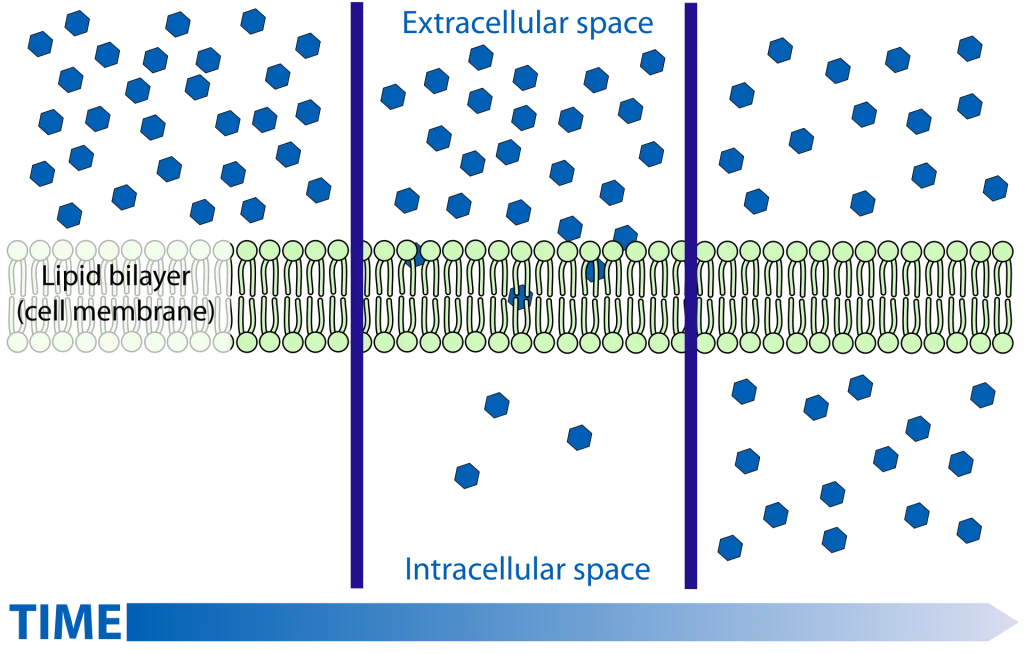
When there is a difference in concentration between two areas, particles move randomly in all directions. However, there is a net movement from the region of higher concentration to the region of lower concentration. This continues until the concentration becomes more evenly distributed.
At equilibrium, particles do not stop moving. They continue to move randomly, but there is no overall net movement from one region to another because the concentrations are balanced.
Concentration Gradient
A concentration gradient is the difference in the concentration of a substance between two regions.
A large concentration gradient generally produces a faster rate of diffusion because there is a greater difference between the two regions. As the difference becomes smaller, the net rate of diffusion decreases.
For example, if a drop of dye is placed into water, the dye is initially highly concentrated around the point where it was added. The dye particles gradually spread into areas where their concentration is lower. Eventually, the colour becomes more evenly distributed throughout the water.
Types of Diffusion
There are two major types of diffusion commonly discussed in cell biology: simple diffusion and facilitated diffusion.
Simple Diffusion
Simple diffusion occurs when small molecules move directly through a membrane or other medium from an area of higher concentration to an area of lower concentration without the assistance of transport proteins.
Some small molecules, especially gases such as oxygen and carbon dioxide, can pass through the lipid part of the cell membrane.
For example, oxygen can diffuse across the respiratory surface of the lungs into the blood when the concentration of oxygen is higher in the air spaces of the lungs than in the blood. Carbon dioxide moves in the opposite direction when its concentration is higher in the blood.
Main features of simple diffusion:
- It does not require cellular energy.
- It does not require transport proteins.
- Movement is down the concentration gradient.
- It is suitable for certain small molecules that can pass through the membrane.
Facilitated Diffusion
Facilitated diffusion occurs when substances move from an area of higher concentration to an area of lower concentration with the help of specific proteins in the cell membrane.
Some substances cannot easily pass through the lipid part of the membrane because of their size, charge or chemical properties. Membrane proteins provide pathways that allow these substances to cross.
Facilitated diffusion may involve channel proteins or carrier proteins, depending on the substance being transported.
For example, some glucose molecules enter cells through specific carrier proteins. Certain ions can also cross cell membranes through ion channels.
Although proteins are involved, facilitated diffusion does not require ATP. The substances still move down their concentration gradient.
Main features of facilitated diffusion:
- It does not require cellular energy.
- It requires specific membrane proteins.
- Movement is down the concentration gradient.
- It can transport substances that cannot easily cross the lipid part of the membrane.
Diffusion in Gases and Liquids
Diffusion occurs in both gases and liquids. It is generally faster in gases because gas particles are farther apart and move freely.
The smell of perfume spreading through a room is a familiar example. Perfume particles move from the area where their concentration is high to areas where their concentration is lower.
Diffusion also occurs in liquids, although it is generally slower than in gases. A drop of dye placed in water gradually spreads throughout the water even when the water is not stirred.
Factors Affecting the Rate of Diffusion
Several factors can affect how quickly diffusion takes place.
1. Concentration Gradient
The greater the difference in concentration between two regions, the faster the net rate of diffusion is generally expected to be. When the concentration difference becomes smaller, diffusion becomes slower.
2. Temperature
Higher temperature usually increases the rate of diffusion because particles gain more kinetic energy and move more rapidly. Lower temperature generally slows particle movement.
3. Surface Area
A larger surface area allows more particles to pass through at the same time. This is one reason the lungs are well adapted for gaseous exchange. The many tiny air sacs called alveoli provide a large surface area for the diffusion of oxygen and carbon dioxide.
4. Distance or Membrane Thickness
Diffusion is generally faster across a short distance. A thin membrane provides a shorter pathway for particles to cross, while a thicker membrane increases the distance they must travel.
5. Size of Particles
Smaller particles generally diffuse more easily and quickly than larger particles under similar conditions.
6. Nature of the Medium
The medium through which particles move also affects diffusion. Particles generally diffuse faster through gases than through liquids, while diffusion through solids is much slower.
Step-by-Step Process of Diffusion in Biology
The basic process of diffusion can be understood in these stages:
- A substance is present at a higher concentration in one region.
- The particles move randomly because they possess kinetic energy.
- Some particles move into an area where their concentration is lower.
- The net movement continues down the concentration gradient.
- The concentration difference gradually becomes smaller.
- A state of equilibrium is eventually reached.
This does not mean that particle movement stops. Random movement continues, but there is no overall net movement in one direction.
Examples of Diffusion in Biology
Diffusion occurs in many parts of living organisms.
Gas Exchange in the Lungs
Oxygen moves from the air in the alveoli into the blood by diffusion because the concentration gradient favours movement into the blood. Carbon dioxide moves from the blood into the alveoli and is then removed from the body during exhalation.
Gas Exchange in Plants
Carbon dioxide diffuses into leaves through tiny openings called stomata. The carbon dioxide can then be used during photosynthesis. Oxygen produced during photosynthesis can diffuse out of the leaf.
Movement of Substances Between Cells and Their Surroundings
Some substances can move across cell membranes by diffusion when a suitable concentration gradient exists. This helps cells obtain certain substances and remove some waste products.
Spreading of Smells
The spreading of perfume or other smells through the air is an everyday example of diffusion. The particles move away from an area where they are highly concentrated.
Dye Spreading in Water
When dye is added to water, its particles gradually spread from the region of high concentration into regions of lower concentration.
Diffusion and Cellular Transport
Diffusion is one of the ways substances move around cells and organisms. It is part of a larger group of processes called passive transport.
Passive transport does not require the cell to supply ATP for the movement of substances. In addition to simple and facilitated diffusion, osmosis is another important passive transport process.
Diffusion should not be confused with active transport. In active transport, substances can be moved against their concentration gradient and the cell uses energy to carry out the process.
Difference Between Simple and Facilitated Diffusion in Biology
| Feature | Simple Diffusion | Facilitated Diffusion |
|---|---|---|
| Movement | From higher to lower concentration | From higher to lower concentration |
| Protein required | No | Yes |
| Energy required | No ATP required | No ATP required |
| Pathway | Directly through suitable parts of the membrane | Through channel or carrier proteins |
| Examples | Oxygen and carbon dioxide | Some glucose and ions |
Difference Between Diffusion and Osmosis
| Feature | Diffusion | Osmosis |
|---|---|---|
| Substance involved | Can involve different types of particles | Involves water molecules |
| Membrane | May or may not require a membrane | Requires a selectively permeable membrane |
| Direction | Net movement down a concentration gradient | Water moves from higher water potential to lower water potential |
| Example | Oxygen moving into the blood | Water entering a plant cell |
A simple way to remember the difference is that diffusion concerns the movement of particles, while osmosis specifically concerns the movement of water across a selectively permeable membrane.
Importance of Diffusion in Living Organisms
Diffusion is important because many substances need to move between different parts of an organism. It plays a major role in gaseous exchange, especially in the lungs of animals and the leaves of plants.
In animals, diffusion helps oxygen enter the blood and carbon dioxide leave the blood. In plants, diffusion allows carbon dioxide to enter leaves for photosynthesis and allows gases to move out of the leaf.
At the cellular level, diffusion also contributes to the movement of suitable substances across cell membranes. Without the movement of substances between cells and their surroundings, normal cell activities would be affected.
Common Mistakes Students Make About Diffusion in Biology
Students often make a few common mistakes when studying diffusion.
One mistake is saying that diffusion requires energy. Diffusion is a passive process and does not require the cell to use ATP for the movement.
Another mistake is saying that particles stop moving when equilibrium is reached. Particles continue their random movement at equilibrium, but there is no overall net movement in one direction.
Students also sometimes confuse diffusion with osmosis. Remember that osmosis specifically involves water moving through a selectively permeable membrane, while diffusion can involve different types of particles.
Another common mistake is thinking that facilitated diffusion is active transport simply because proteins are involved. Facilitated diffusion is still passive because the substance moves down its concentration gradient without ATP.
Applications of Diffusion in Everyday Life
Diffusion is not limited to laboratory experiments or biological cells. It can be observed in many ordinary situations.
The spreading of perfume in a room, the movement of food colouring through water and the gradual mixing of gases are all examples of diffusion.
The process is also important in medicine and biological research because understanding how substances move across membranes helps scientists and health professionals understand processes such as gaseous exchange, drug movement and cellular transport.
Summary – Diffusion in Biology
Diffusion is the net movement of particles from a region of higher concentration to a region of lower concentration. It occurs because particles are constantly moving randomly.
Diffusion is a passive process, so the cell does not use ATP to drive the movement. The rate of diffusion is affected by factors such as concentration gradient, temperature, surface area, distance, particle size and the nature of the medium.
The two main types of diffusion studied in cell biology are simple diffusion and facilitated diffusion. Simple diffusion occurs directly through a suitable membrane, while facilitated diffusion requires membrane proteins. Both processes move substances down their concentration gradient without using cellular energy.
Diffusion is important in plants and animals, particularly during gaseous exchange and the movement of substances across cell membranes.
Revision Questions On Diffusion in Biology
- What is diffusion, and why is it described as a passive process?
- Explain the meaning of concentration gradient and state how it affects diffusion.
- State four factors that affect the rate of diffusion.
- Differentiate between simple diffusion and facilitated diffusion.
- Explain two important roles of diffusion in living organisms.
Frequently Asked Questions On Diffusion in Biology
1. What is diffusion in biology?
Diffusion is the net movement of particles from a region of higher concentration to a region of lower concentration. It is a passive process and does not require ATP from the cell.
2. Does diffusion require energy?
No. Diffusion does not require the cell to use ATP. The movement occurs naturally because particles are constantly moving.
3. What is the difference between diffusion and osmosis?
Diffusion is the movement of particles down a concentration gradient, while osmosis specifically involves the movement of water through a selectively permeable membrane.
4. What factors affect the rate of diffusion?
Important factors include concentration gradient, temperature, surface area, distance or membrane thickness, particle size and the nature of the medium.
5. What are examples of diffusion in living organisms?
Examples include oxygen moving from the alveoli into the blood, carbon dioxide moving from the blood into the alveoli, and carbon dioxide entering plant leaves through the stomata.
Related Articles