Osmosis is one of the most important processes that happens in living cells in Biology. It helps water move in and out of cells in a natural way. Every plant and animal depends on this process to stay alive and function well. Without osmosis, cells will not be able to maintain the right balance of water needed for survival.
Table of Contents
- Meaning of Osmosis
- Key Terms in Osmosis
- Process of Osmosis
- Types of Osmosis (Hypotonic, Hypertonic, Isotonic)
- Osmosis in Plant Cells
- Osmosis in Animal Cells
- Factors Affecting Osmosis
- Differences Between Diffusion and Osmosis
- Examples of Osmosis in Everyday Life
- Importance of Osmosis in Living Organisms
- Simple Osmosis Experiments for Students
- Conclusion
Meaning of Osmosis in Biology
In simple words, osmosis is the movement of water molecules from a region where there is more water (high water concentration) to a region where there is less water (low water concentration) through a partially permeable membrane. This movement continues until there is a balance on both sides. It does not require energy, so it is called a passive process.
To understand osmosis well, you must also understand what a partially permeable membrane means. This type of membrane allows some substances, especially water, to pass through it, but blocks others like large solute particles. The cell membrane in living organisms acts like this type of membrane.
When you look at the process closely, you will see that osmosis depends on the difference in concentration between two solutions. If one side has more dissolved substances (solute), it will have less water. So water will move from the side with more water to the side with less water until both sides become balanced.
Key Terms in Osmosis
Osmosis involves some important terms that students must understand clearly. These terms help you explain what is happening in the process.
- Solvent: This is the liquid that dissolves substances. In most biological cases, water is the solvent.
- Solute: These are substances dissolved in the solvent, like salt or sugar.
- Solution: A mixture of solute and solvent.
- Semi-permeable membrane: A membrane that allows only some substances to pass through.
Each of these terms works together in osmosis. Without a membrane and difference in concentration, osmosis cannot take place.
Process of Osmosis in Biology
The process of osmosis is simple but very important in biology. Water molecules are always moving randomly. When there is a difference in concentration, this movement becomes directional.
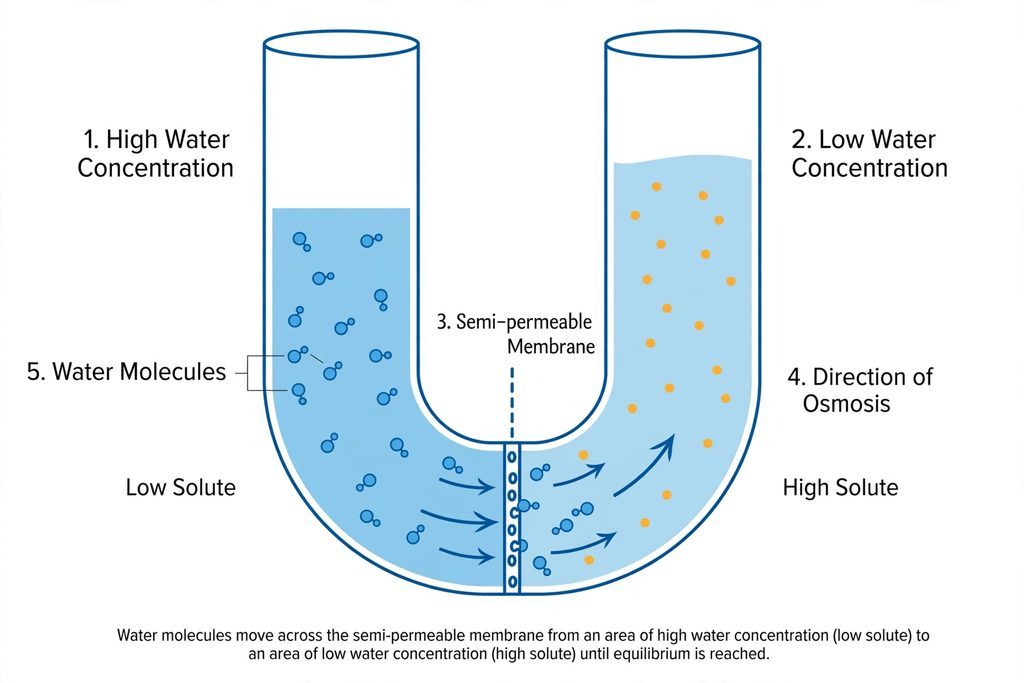
Water moves from:
- High water concentration (dilute solution)
- To low water concentration (concentrated solution)
This movement continues until both sides reach equilibrium. At equilibrium, water still moves, but there is no net movement because both sides are balanced.
Osmosis can happen in living cells as well as in non-living systems like dialysis tubing used in experiments. In cells, it plays a major role in maintaining shape and function.
Types of Osmosis in Biology (Solutions around the Cell)
When studying osmosis, we talk about three main types based on the surrounding solution. These are very important for exams and understanding cell behavior.
- Hypotonic Solution
This is a solution that has less solute and more water compared to the cell. When a cell is placed in this solution, water enters the cell. As a result, the cell swells. In plant cells, this makes the cell turgid, which is good. In animal cells, too much swelling can cause bursting. - Hypertonic Solution
This solution has more solute and less water compared to the cell. Water leaves the cell and moves into the solution. The cell shrinks. In plant cells, this leads to plasmolysis, where the cell membrane pulls away from the cell wall. - Isotonic Solution
In this case, the concentration of solute and water is equal inside and outside the cell. Water moves in and out at the same rate. The cell remains the same size and shape. This condition is ideal for animal cells.
These three conditions help us understand how cells react in different environments.
Osmosis in Plant Cells
Osmosis plays a major role in plants. It helps plants absorb water from the soil through the roots. The root hair cells take in water by osmosis because the soil usually has more water compared to the inside of the root cells.
Water moves from the soil into the root cells, then from cell to cell until it reaches the xylem. From there, it is transported to other parts of the plant.
Osmosis also helps maintain turgor pressure. This pressure keeps plant cells firm and upright. Without enough water, plants lose this pressure and become weak or wilt.
Osmosis in Animal Cells
In animals, osmosis helps maintain the balance of fluids in cells and tissues. Animal cells do not have a cell wall, so they are more sensitive to changes in water balance.
For example:
- In a hypotonic solution, an animal cell may swell and burst.
- In a hypertonic solution, it shrinks and may not function properly.
This is why body fluids must be kept in an isotonic condition. The human body carefully controls water balance through processes like kidney function.
Factors Affecting Osmosis
Several factors can affect how fast osmosis happens. These include:
- Concentration Gradient
The greater the difference in concentration, the faster the rate of osmosis. - Temperature
Higher temperature increases the movement of water molecules, making osmosis faster. - Surface Area
A larger surface area allows more water to pass through, increasing the rate. - Membrane Thickness
Thinner membranes allow faster movement of water. - Pressure
External pressure can slow down or stop osmosis.
Each of these factors plays a role in determining how quickly water moves across a membrane.
Differences Between Diffusion and Osmosis
Although diffusion and osmosis are similar, they are not the same. Diffusion involves movement of any particles, while osmosis only involves water molecules.
- Diffusion can occur without a membrane, but osmosis requires a semi-permeable membrane.
- Osmosis is a special type of diffusion focused only on water movement.
- Both processes move from high concentration to low concentration and do not require energy.
Understanding this difference is very important for exams and practical questions.
Examples of Osmosis in Everyday Life
Osmosis is not only in textbooks. It happens in daily life and simple experiments.
- Soaking dry beans in water makes them swell due to water entering by osmosis.
- Adding salt to vegetables causes them to lose water and shrink.
- Red blood cells change shape depending on the solution they are placed in.
- Plant roots absorb water from the soil through osmosis.
These examples help students see how osmosis works in real situations.
Importance of Osmosis in Living Organisms
Osmosis is very important for survival of living things. It supports many life processes.
- Helps in absorption of water in plants
- Maintains cell shape and structure
- Aids movement of water in tissues
- Helps in removal of waste in some organisms
- Maintains balance of fluids in animals
Without osmosis, cells will not function properly, and life processes will be affected.
Osmosis Experiments for Students
Students can perform simple experiments to understand osmosis better. One common example is using potato strips.
When potato strips are placed in salt solution, they become soft because water leaves the cells. When placed in pure water, they become firm as water enters the cells.
Such experiments make the concept clear and easy to remember.
Conclusion
Osmosis is a simple but very powerful process in biology. It explains how water moves in and out of cells and helps maintain balance in living organisms. From plant roots absorbing water to human cells maintaining fluid balance, osmosis plays a key role everywhere.
Understanding osmosis will also help you understand many other topics in biology like transport systems, cell structure, and plant physiology. When you study it step by step and connect it to real-life examples, it becomes easy and interesting.
Revision Questions on Osmosis in Biology
- Define osmosis and state the condition necessary for it to occur.
- Explain the role of a semi-permeable membrane in osmosis.
- Describe what happens to a plant cell when placed in a hypotonic solution.
- Differentiate between hypertonic, hypotonic, and isotonic solutions.
- State three factors that affect the rate of osmosis.
- Explain the importance of osmosis in plants and animals.
Frequently Asked Questions (FAQs) on Osmosis in Biology
- What is osmosis in simple terms?
Osmosis is the movement of water from where there is plenty of it to where there is less, through a semi-permeable membrane. It happens naturally without using energy. This process continues until both sides have equal concentration of water. - Does osmosis require energy?
No, osmosis does not require energy from the cell. It is a passive process because water molecules move on their own due to concentration differences. - What is a semi-permeable membrane?
A semi-permeable membrane is a type of barrier that allows water to pass through but blocks some substances like large solute particles. The cell membrane is a good example of this type of membrane. - What happens to a cell in a hypotonic solution?
In a hypotonic solution, there is more water outside the cell than inside. Water enters the cell, causing it to swell. Plant cells become firm (turgid), while animal cells may burst if too much water enters. - What happens in a hypertonic solution?
In a hypertonic solution, there is less water outside the cell. Water leaves the cell, causing it to shrink. In plant cells, this leads to plasmolysis. - What is an isotonic solution?
An isotonic solution has equal concentration of water inside and outside the cell. Water moves in and out at the same rate, so the cell remains unchanged in size and shape. - Why is osmosis important in plants?
Osmosis helps plants absorb water from the soil through their roots. It also helps maintain turgor pressure, which keeps plants upright and firm. - Can osmosis happen without a membrane?
No, osmosis cannot occur without a semi-permeable membrane. The membrane is necessary to control what passes through and to allow water movement only.
Related Articles