Cell division is one of the most important processes in biology. Every living organism, whether plant or animal, depends on cell division for growth, repair, and reproduction. From a tiny baby growing into an adult, to healing of wounds, all these happen because cells divide. Without cell division, life cannot continue.
In this blog, you will learn the meaning of cell division, its types, stages, processes, and why it is very important in living organisms. Everything will be explained in a simple and clear way.
Table of Contents
- Meaning of Cell Division
- Types of Cell Division in Biology
- Stages of Mitosis
- Stages of Meiosis
- Differences Between Mitosis and Meiosis
- Importance of Cell Division
- Cell Division in Plants and Animals
- Summary
Meaning of Cell Division in Biology
Cell division is the process by which a parent cell divides to form new cells. These new cells are called daughter cells. The process is controlled and follows a specific pattern so that the genetic material is shared correctly.
Every cell contains genetic material known as DNA, which is organized into structures called chromosomes. During cell division, this DNA must be copied and shared equally so that each new cell can function properly.
Cell division is not just a random process. It happens in a well-organized way through different stages that ensure accuracy and balance in the body.
Why Cell Division is Important
Cell division is necessary for many life processes. Without it, organisms cannot grow or survive.
- Growth: Organisms increase in size because the number of cells increases
- Repair: Damaged or worn-out cells are replaced with new ones
- Reproduction: New organisms are formed through cell division
- Maintenance: Keeps body tissues healthy and functioning
In multicellular organisms like humans, millions of cells divide every day to keep the body active and healthy.
Types of Cell Division in Biology
There are two main types of cell division:
- Mitosis
- Meiosis
Each type has a different function and occurs in different types of cells.
Mitosis (Body Cell Division)
Mitosis is a type of cell division that produces two identical daughter cells from one parent cell. These cells have the same number of chromosomes as the parent cell.
Mitosis occurs in somatic cells, which are body cells such as skin, muscle, and blood cells. It helps in growth and repair.
Key Features of Mitosis
- Produces 2 daughter cells
- Daughter cells are identical
- Chromosome number remains the same
- Occurs in body cells
- No pairing of chromosomes
Stages of Mitosis
Mitosis happens in stages. Each stage has a specific role in ensuring proper division.
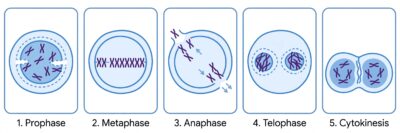
1. Prophase
Chromosomes become visible and condense. Each chromosome consists of two chromatids joined together. The nuclear membrane begins to disappear, and spindle fibers start forming.
2. Metaphase
Chromosomes line up at the center of the cell. Spindle fibers attach to the chromosomes to prepare them for separation.
3. Anaphase
Sister chromatids separate and move to opposite ends of the cell. This ensures equal distribution of genetic material.
4. Telophase
Chromosomes reach the poles, and new nuclear membranes form. The chromosomes begin to relax.
5. Cytokinesis
The cytoplasm divides, forming two separate cells. Each cell is identical to the parent cell.
Meiosis (Reproductive Cell Division)
Meiosis is a type of cell division that produces four daughter cells, each with half the number of chromosomes. These cells are called gametes (sperm and egg cells).
Meiosis occurs in reproductive organs and is important for sexual reproduction.
Key Features of Meiosis
- Produces 4 daughter cells
- Cells are genetically different
- Chromosome number is reduced by half
- Occurs in reproductive cells
- Involves two divisions
Stages of Meiosis
Meiosis occurs in two main stages: Meiosis I and Meiosis II.
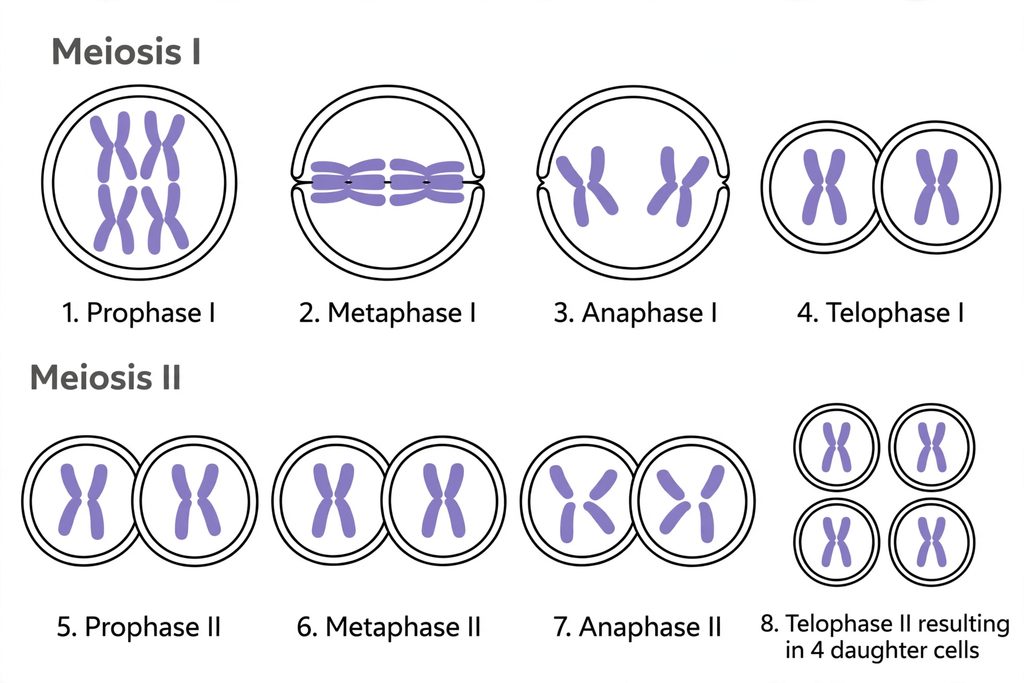
Meiosis I
This is called reduction division because chromosome number is reduced.
- Prophase I: Homologous chromosomes pair and exchange segments (crossing over)
- Metaphase I: Paired chromosomes line up at the center
- Anaphase I: Chromosomes separate
- Telophase I: Two cells are formed
Meiosis II
This stage is similar to mitosis.
- Prophase II: Chromosomes become visible again
- Metaphase II: Chromosomes line up
- Anaphase II: Chromatids separate
- Telophase II: Four cells are formed
Each cell has half the chromosome number and is genetically unique.
Differences Between Mitosis and Meiosis
Even though both are types of cell division, they are different in many ways.
- Mitosis produces 2 identical cells, meiosis produces 4 different cells
- Mitosis maintains chromosome number, meiosis reduces it
- Mitosis occurs in body cells, meiosis occurs in reproductive cells
- Mitosis has one division, meiosis has two
- Crossing over occurs only in meiosis
Similarities Between Mitosis and Meiosis
- Both involve cell division
- Both have stages like prophase, metaphase, anaphase, and telophase
- Both use spindle fibers
- Both ensure distribution of chromosomes
The Cell Cycle
Before a cell divides, it passes through a series of stages called the cell cycle. This cycle ensures that the cell is ready for division.
The cell cycle has two main parts:
1. Interphase
This is the longest stage. The cell grows and prepares for division.
- G1 Phase: Cell grows and performs normal functions
- S Phase: DNA is copied
- G2 Phase: Cell prepares for division
2. Mitotic Phase
This is the stage where the cell actually divides. It includes mitosis and cytokinesis.
Control of Cell Division
Cell division is controlled by signals within the body. These signals ensure that cells divide only when needed.
Special proteins called enzymes and checkpoints regulate the process. If something goes wrong, the cell may stop dividing or repair itself.
Uncontrolled cell division can lead to diseases like cancer, where cells divide too rapidly without control.
Errors in Cell Division
Sometimes mistakes happen during cell division. These errors can affect the organism.
- In mitosis: May cause uncontrolled growth
- In meiosis: May cause abnormal chromosome numbers
These errors can lead to genetic disorders or diseases.
Importance of Cell Division in Living Organisms
Cell division is essential for life. Its importance includes:
- Growth and development of organisms
- Repair of damaged tissues
- Replacement of old cells
- Formation of gametes for reproduction
- Maintenance of chromosome number
In plants, cell division helps in growth of roots and stems. In animals, it helps in healing wounds and replacing dead cells.
Cell Division in Plants and Animals
Cell division occurs in both plants and animals, but the process shows some clear differences because of their cell structures. Both use mitosis for growth and repair, and meiosis for reproduction, but how the cells divide at the end is not the same.
Cell Division in Animal Cells
In animal cells, cell division is usually faster and more flexible. These cells do not have a rigid cell wall, so they divide by pinching inward.
During mitosis, the nucleus divides first, then the cytoplasm divides in a process called cytokinesis. In animal cells, cytokinesis happens by the formation of a cleavage furrow.
- The cell membrane begins to pinch inward at the middle
- The furrow deepens until the cell splits into two
- Each new cell gets equal cytoplasm and organelles
Animal cells also have centrioles, which help in spindle formation during mitosis. These structures organize the spindle fibers that pull chromosomes apart.
Examples of where this happens:
- Growth of tissues like skin
- Repair of damaged cells
- Formation of blood cells
Cell Division in Plant Cells
Plant cells divide differently because they have a rigid cell wall. This makes pinching impossible, so they use another method to divide the cytoplasm.
After nuclear division, plant cells form a structure called a cell plate during cytokinesis.
- Vesicles gather at the center of the cell
- These vesicles fuse to form the cell plate
- The cell plate grows outward until it joins the cell wall
- A new cell wall forms between the two daughter cells
Plant cells do not have centrioles in most cases, but they still form spindle fibers using other structures in the cell.
Examples of where this happens:
- Growth at the root tips
- Growth at shoot tips
- Formation of new leaves and stems
Key Differences Between Plant and Animal Cell Division in Biology
| Feature | Plant Cells | Animal Cells |
|---|---|---|
| Method of cytokinesis | Cell plate formation | Cleavage furrow (pinching) |
| Presence of cell wall | Present (rigid) | Absent |
| How cytoplasm divides | New cell wall forms at center | Cell membrane pinches inward |
| Centrioles | Usually absent | Present |
| Spindle formation | Without centrioles | With centrioles |
| Shape of daughter cells | Regular, box-like shape | Irregular or rounded shape |
| Mode of growth | Occurs at specific regions (root and shoot tips) | Occurs in many parts of the body |
| Flexibility during division | Less flexible due to cell wall | More flexible |
Summary
Cell division is a vital process in all living organisms. It allows organisms to grow, repair damaged parts, and reproduce. There are two main types of cell division: mitosis and meiosis.
Mitosis produces identical cells for growth and repair, while meiosis produces gametes for reproduction and creates variation. The process of cell division follows a well-organized cycle that ensures proper distribution of genetic material.
Understanding cell division helps you understand how life continues, how organisms grow, and how traits are passed from one generation to another.
Revision Questions
- What is cell division in biology?
- State two differences between cell division in plant cells and animal cells.
- What is cytokinesis?
- How does cytokinesis occur in animal cells?
- What is the role of the cell plate in plant cell division?
- Why can plant cells not divide by cleavage furrow?
Related Articles