Fish are aquatic animals that live mainly in water, and they have developed different ways of reproducing that suit life in rivers, lakes, ponds, seas and oceans. Reproduction is important because it allows fish to produce young ones and maintain their populations in their natural habitats. Without reproduction, the number of fish in an environment would gradually decrease as older fish die.
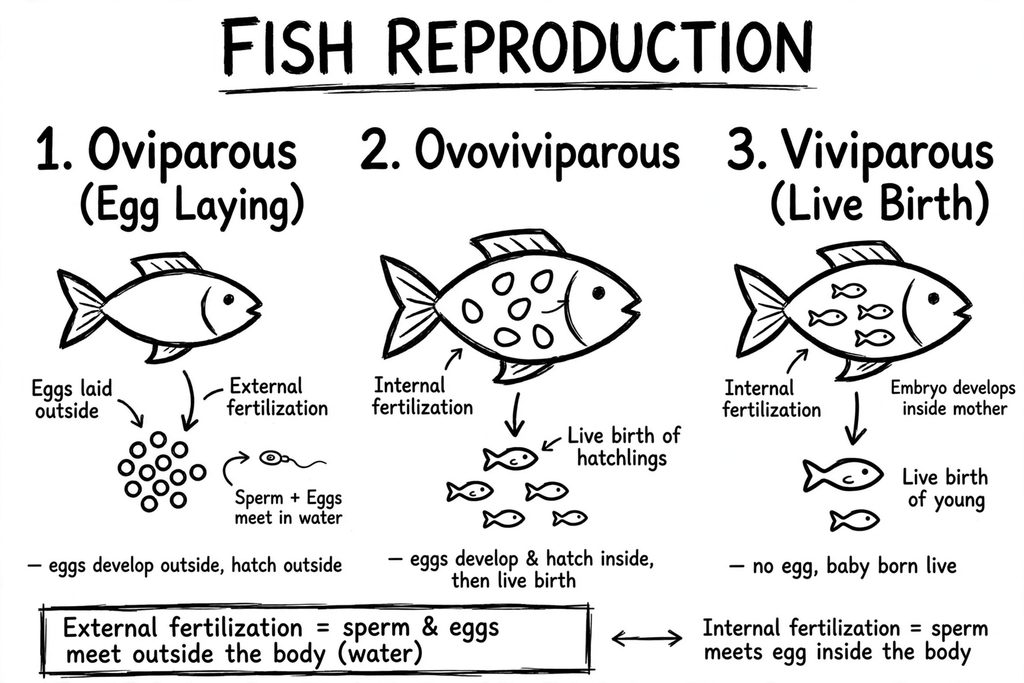
Most fish reproduce sexually, meaning that reproductive cells from a male and a female fish are involved in producing offspring. In many species, the female releases eggs into the water while the male releases sperm over them. This type of fertilization happens outside the body and is known as external fertilization. However, not all fish reproduce in exactly the same way. Some species have internal fertilization, where the sperm is transferred into the female and fertilization takes place inside her body.
Fish also differ in the way they care for their eggs and young ones. Some release thousands or even millions of eggs and provide little or no care afterward, while others protect their eggs or young. These differences make fish reproduction an interesting process and show how different species have adapted to their aquatic environments.
What Does Reproduction in Fish Mean?
Reproduction in fish is the biological process through which male and female fish produce offspring. The male produces sperm, while the female produces eggs. When the sperm successfully joins with an egg, fertilization takes place and a new organism begins to develop.
The reproductive organs of fish are mainly the testes in males and the ovaries in females. The testes produce sperm, while the ovaries produce eggs. During the breeding period, these organs become active and produce the reproductive cells needed for reproduction.
The exact reproductive process depends on the species. Some fish release their reproductive cells directly into the surrounding water, while others use different methods to make sure the sperm reaches the eggs.
Male and Female Reproductive Organs in Fish
The reproductive system of a fish contains organs that produce and release reproductive cells.
In male fish, the testes produce sperm cells. During the breeding season, the testes become active and produce large amounts of sperm. The sperm is released through an opening or reproductive passage into the surrounding water or transferred to the female, depending on the species.
In female fish, the ovaries produce eggs. The eggs develop inside the ovaries until they are mature enough to be released. In species that use external fertilization, the female releases the eggs into the water. In species with internal fertilization, the eggs remain inside the female until fertilization occurs.
The size and appearance of these organs can vary among different fish species, but their basic functions remain the same: producing the reproductive cells needed to create new fish.
How Fish Reproduce
Although fish reproduction differs from one species to another, the process can generally be understood through a series of events.
First, mature male and female fish reach the breeding period. During this time, they may show particular behaviours that help them find or attract a mate.
The female then produces mature eggs, while the male produces sperm. In many species, the female releases her eggs into the water and the male releases sperm over the eggs. The sperm then moves through the water and may reach the eggs.
When a sperm cell successfully joins an egg cell, fertilization occurs. The fertilized egg begins to divide and develop into an embryo. After further development, the young fish eventually hatches from the egg.
The newly hatched fish does not immediately look exactly like an adult fish. It passes through early stages of development before becoming a juvenile and later reaching adulthood.
External Fertilization in Fish
External fertilization is very common among fish. In this method, the egg and sperm meet outside the body of the female.
During spawning, the female releases eggs into the water. The male then releases sperm, often called milt, into the same area. The sperm swim through the water and some may reach the eggs and fertilize them.
External fertilization works particularly well in aquatic environments because water allows the sperm to move toward the eggs. However, there is no guarantee that every egg will be fertilized. Some eggs may be carried away, eaten by other animals or fail to develop.
Because many eggs may be lost, some fish species compensate by producing a very large number of eggs. Even if only a portion survive, enough young fish may develop to maintain the population.
Internal Fertilization in Fish
Not every fish uses external fertilization. Some fish species reproduce through internal fertilization, in which the sperm is transferred into the female and fertilization takes place inside her body.
Internal fertilization provides a different way of protecting the reproductive cells. The sperm does not have to travel freely through the surrounding water before reaching the egg.
Some fish that use internal fertilization have specialised reproductive structures that help transfer sperm to the female. Certain sharks and rays, for example, have structures called claspers that are used during mating.
The development of the young may then occur through different methods depending on the species. Some species lay eggs, while others give birth to live young.
Spawning in Fish
The release of eggs and sperm during reproduction is known as spawning. It is one of the most important events in the reproductive life of many fish.
Before spawning, fish may move to particular areas where conditions are suitable for reproduction. These areas may provide enough food, suitable water conditions and protection for eggs or young fish.
During spawning, the female releases mature eggs while the male releases sperm. In species with external fertilization, this happens in the surrounding water. After fertilization, the eggs remain in the environment and continue their development.
Spawning may happen during particular seasons of the year. Factors such as temperature, rainfall, water level, food availability and length of daylight can influence the timing of breeding in some fish.
Why Do Fish Produce So Many Eggs?
One of the interesting features of fish reproduction is that some fish produce a very large number of eggs. This is especially common among fish that provide little protection for their eggs after spawning.
Many eggs and young fish may not survive because of predators, unsuitable environmental conditions, diseases, lack of food or other factors. Producing many eggs increases the possibility that at least some will survive to adulthood.
However, not every fish produces thousands or millions of eggs. The number depends on the species and its reproductive strategy. Fish that protect their eggs or young may produce fewer eggs because a greater proportion of their offspring may survive.
Development of the Fish Egg
After fertilization, the fertilized egg begins to develop. The first stage is the formation of an embryo inside the egg.
The cells of the embryo divide repeatedly and gradually form different parts of the developing fish. As development continues, structures such as the head, body and other organs begin to form.
The length of development depends on the species and environmental conditions, especially temperature. In many fish, warmer conditions within a suitable range can speed up development, while colder conditions can slow it down.
When the embryo has developed sufficiently, it hatches from the egg and becomes a young fish.
From Egg to Young Fish
The life of a fish begins with the fertilized egg, but the young fish still has a lot of development to complete after hatching.
A newly hatched fish is usually very small and may still depend on nutrients stored in the egg. As it grows, it begins to feed and becomes more active.
The early stages may include:
- Fertilized egg – The egg contains the developing embryo.
- Embryo – The cells divide and the body structures begin to develop.
- Larva – The young fish hatches and begins independent development.
- Juvenile fish – The fish becomes more similar to an adult but has not yet reached reproductive maturity.
- Adult fish – The fish becomes sexually mature and is able to reproduce.
The exact names and features of these stages differ between fish species.
Fish That Give Birth to Live Young
Although many fish lay eggs, some fish give birth to live young. This is particularly common among certain sharks, rays and other fish species.
In these fish, fertilization occurs internally. Depending on the species, the developing young may receive nutrients from the mother in different ways.
Giving birth to live young can provide greater protection to developing offspring compared with simply releasing eggs into the environment. However, different reproductive methods involve different advantages and disadvantages, and each has developed in relation to the lifestyle of the species.
Egg-Laying Fish
Many fish are egg-laying animals. The female produces eggs and releases them into the environment, where they develop after fertilization.
In species with external fertilization, the eggs are usually fertilized after they have been released. The developing embryos remain inside the eggs until they are ready to hatch.
Some fish choose particular locations for laying their eggs. They may deposit them among aquatic plants, on rocks, on the bottom of a water body or in nests prepared by the fish.
The level of protection provided to the eggs varies greatly. Some fish leave the eggs after spawning, while others remain nearby and protect them from predators.
Parental Care in Fish
Parental care means protecting or helping offspring after reproduction. It is not present to the same extent in all fish.
Some fish provide little parental care. They release eggs and sperm and then leave the area. Other fish may guard their eggs, clean them, move water over them or protect the young after they hatch.
Examples of parental care can include:
- Guarding eggs against predators.
- Protecting a nest or breeding area.
- Keeping the eggs clean.
- Providing water movement around the eggs.
- Protecting newly hatched young.
Parental care can improve the chances of survival of offspring, although it requires time and energy from the parent.
Reproductive Behaviour in Fish
Fish may display different behaviours during the breeding period. These behaviours help males and females locate each other and coordinate reproduction.
Some fish move to special breeding grounds during the reproductive season. Others may change their colour or behaviour, build nests or perform movements that attract mates.
In some species, males compete with each other for access to females. In other species, pairs may remain together during the breeding period.
These behaviours are not the same in every fish. Each species has its own reproductive pattern that is suited to its environment.
Factors That Affect Reproduction in Fish
Fish reproduction is influenced by both internal and environmental factors. A fish must reach sexual maturity before it can reproduce, but suitable environmental conditions are also important.
Some major factors include:
Water temperature: Temperature can affect the development of eggs and the timing of spawning. Different species have different temperature requirements.
Availability of food: Fish need enough food and nutrients to grow and produce healthy reproductive cells. Poor food supply can affect breeding success.
Water quality: Polluted water can interfere with fish health, reproduction and the survival of eggs and young fish.
Water level and rainfall: In some fish species, changes in water level or seasonal rainfall can signal the beginning of the breeding period.
Availability of breeding areas: Fish may need particular locations for spawning. The destruction of these areas can reduce successful reproduction.
Reproduction in Freshwater and Marine Fish
Fish live in many types of aquatic environments, and their reproductive strategies can differ depending on where they live.
Freshwater fish reproduce in environments such as rivers, lakes, streams and ponds. Some move to particular parts of a river or lake when it is time to breed.
Marine fish reproduce in seas and oceans. Some release eggs and sperm into open water, while others lay eggs in protected areas such as reefs or the seabed.
The important point is that fish reproduction is not controlled by one single pattern. Different species have developed different methods that suit their particular habitats.
Importance of Reproduction in Fish
Reproduction is essential for maintaining fish populations. It ensures that new fish replace individuals that die naturally or are removed through fishing and other activities.
Fish reproduction is also important for aquatic ecosystems because fish are part of food chains. They may feed on smaller organisms while also serving as food for larger fish, birds, reptiles and other animals.
Fish are also important to humans. They provide food and support the livelihoods of many people involved in fishing and fish farming. Successful reproduction is therefore important for maintaining fish populations in both natural waters and aquaculture systems.
Reproduction in Fish Farming
Fish farming, also called aquaculture, involves raising fish under controlled or partly controlled conditions. Understanding fish reproduction is important because farmers may need to produce young fish for stocking ponds and other farming systems.
Fish farmers may select mature male and female fish and provide suitable conditions for breeding. Depending on the species, breeding may occur naturally or may be assisted using controlled techniques.
After eggs are produced and fertilized, farmers need to provide suitable conditions for the developing eggs and young fish. Good water quality, adequate oxygen, suitable temperature and proper feeding are important for successful development.
Fish farming therefore depends not only on feeding and growing fish but also on understanding their reproductive cycle.
External and Internal Fertilization Compared
| External Fertilization | Internal Fertilization |
|---|---|
| Fertilization occurs outside the female’s body. | Fertilization occurs inside the female’s body. |
| Eggs and sperm are usually released into the environment. | Sperm is transferred into the female. |
| Common in many fish species. | Found in some fish species, including sharks and rays. |
| Many eggs may be produced because some may be lost. | Developing offspring may receive greater protection during fertilization and early development. |
| Strongly depends on the surrounding aquatic environment. | Reproductive cells have less exposure to the external environment before fertilization. |
Common Problems That Affect Fish Reproduction
Human activities can interfere with fish reproduction. Pollution may make water unsuitable for eggs and young fish. When rivers, lakes and coastal areas become polluted, reproductive success may decrease.
Overfishing can also reduce the number of mature fish available for reproduction. If too many breeding fish are removed from a population, fewer eggs and sperm may be produced.
The destruction of breeding habitats is another problem. Building activities, removal of aquatic vegetation and changes to water flow can reduce the availability of suitable places for spawning.
Climate and environmental changes can also affect the temperature and conditions that fish depend on for reproduction. The effect varies between species and environments.
Simple Summary of Reproduction in Fish
The whole process can be remembered in a simple way:
Mature male and female → Production of sperm and eggs → Mating or spawning → Fertilization → Development of embryo → Hatching or birth → Young fish → Juvenile → Adult fish → Reproduction again
This cycle allows fish populations to continue from one generation to another.
Conclusion
Reproduction in fish is an important process that allows fish populations to continue and spread in aquatic environments. Most fish reproduce sexually, with males producing sperm and females producing eggs. In many species, the eggs and sperm are released into the water and fertilization occurs outside the female’s body. This is known as external fertilization.
Some fish, however, use internal fertilization. In these species, sperm is transferred into the female and fertilization takes place inside her body. Some fish lay eggs after internal fertilization, while others give birth to live young.
Fish reproduction is influenced by many factors, including water temperature, food supply, water quality, breeding areas and seasonal changes. Different species have developed different reproductive behaviours and levels of parental care to improve the survival of their offspring.
From the fertilized egg to the larval stage, juvenile stage and finally adulthood, the life cycle of a fish involves several stages. Once the fish becomes sexually mature, it can reproduce and continue the cycle. This makes reproduction essential not only for individual fish but also for the survival of fish populations and the aquatic ecosystems in which they live.
Revision Questions
- What is reproduction in fish, and why is it important?
- Explain the process of external fertilization in fish.
- Differentiate between external and internal fertilization.
- State five factors that can affect reproduction in fish.
- Describe the main stages in the life cycle of a fish.
Frequently Asked Questions
1. How do fish reproduce?
Most fish reproduce sexually. The female produces eggs while the male produces sperm. In many species, the eggs and sperm are released into the water and fertilization takes place outside the female’s body.
2. What is spawning in fish?
Spawning is the process in which fish release their eggs and sperm for reproduction. In many fish species, the female releases eggs into the water while the male releases sperm around them.
3. Do all fish lay eggs?
No. Many fish lay eggs, but some fish give birth to live young. The reproductive method varies among fish species.
4. What is external fertilization in fish?
External fertilization occurs when the sperm and egg meet outside the body of the female. It is common in many fish that release their eggs and sperm into the water.
5. Why do some fish produce many eggs?
Many fish produce large numbers of eggs because a significant number may not survive due to predators, environmental conditions and other factors. Producing many eggs increases the chance that some offspring will survive to adulthood.
Related Articles