Birds reproduce by laying eggs from which their young develop. Although all birds share the basic features of reproduction, different bird species have their own mating behaviours, nesting habits and ways of caring for their young. A chicken, for example, does not raise its young in exactly the same way as an eagle or a penguin, but the basic reproductive process is similar.
Bird reproduction involves both a male and a female. The male produces sperm while the female produces eggs. During mating, sperm from the male enters the reproductive system of the female. Fertilization usually takes place inside the female’s body, after which the fertilized egg continues its development as it passes through the female reproductive tract.
One of the most interesting parts of bird reproduction is the formation of the egg. What we commonly call an egg is much more than just the hard shell that we see. Inside it are several structures that protect the developing embryo and provide it with food and other materials needed for growth. After the egg is laid, the parent birds may incubate it by keeping it warm until the embryo is ready to hatch.
How Birds Reproduce
Birds reproduce sexually. This means that a male and female are involved in producing offspring. The male produces sperm cells, while the female produces egg cells.
When the male and female mate, sperm is transferred from the male to the female. If a sperm cell meets a suitable egg cell, fertilization occurs. The fertilized egg then begins to develop into an embryo.
Unlike mammals, birds do not normally keep the developing embryo inside the mother’s body until birth. Instead, the developing embryo is enclosed in an egg that is eventually laid outside the body. The egg provides protection and contains materials that support the embryo during its development.
The general process can be represented as:
Mating → Fertilization → Egg formation → Egg laying → Incubation → Hatching → Growth of young bird
Male Reproductive System in Birds
The male reproductive system is responsible for producing sperm and transferring it to the female during mating.
The main reproductive organs are the testes. Male birds normally have two testes located inside the body. Unlike the testes of many mammals, they are not normally found in an external scrotum.
The testes produce sperm cells. During the breeding period, reproductive activity increases and the testes become more active in producing sperm.
Birds also have a cloaca, an opening involved in the reproductive, digestive and urinary systems. During mating, sperm is transferred from the male to the female through contact between the cloacal regions.
The male reproductive system therefore has two main functions:
- Producing sperm.
- Delivering sperm to the female.
Female Reproductive System in Birds
The female reproductive system produces eggs and provides the structures through which the egg develops before it is laid.
In most female birds, only the left ovary and left oviduct are fully developed and functional. This is an important adaptation because reducing the weight of the reproductive system helps birds maintain a lighter body, which is useful for flight in many species.
The ovary contains developing egg cells. As an egg matures, it is released from the ovary and enters the oviduct.
The oviduct is a long tube through which the developing egg passes. Different parts of the oviduct add different materials to the egg before it is finally laid.
The Journey of an Egg Through the Oviduct
The formation of a bird’s egg is a gradual process. After the mature egg cell is released from the ovary, it enters the oviduct.
As it moves through the oviduct, different layers and materials are added around it. These include the egg white, membranes and shell.
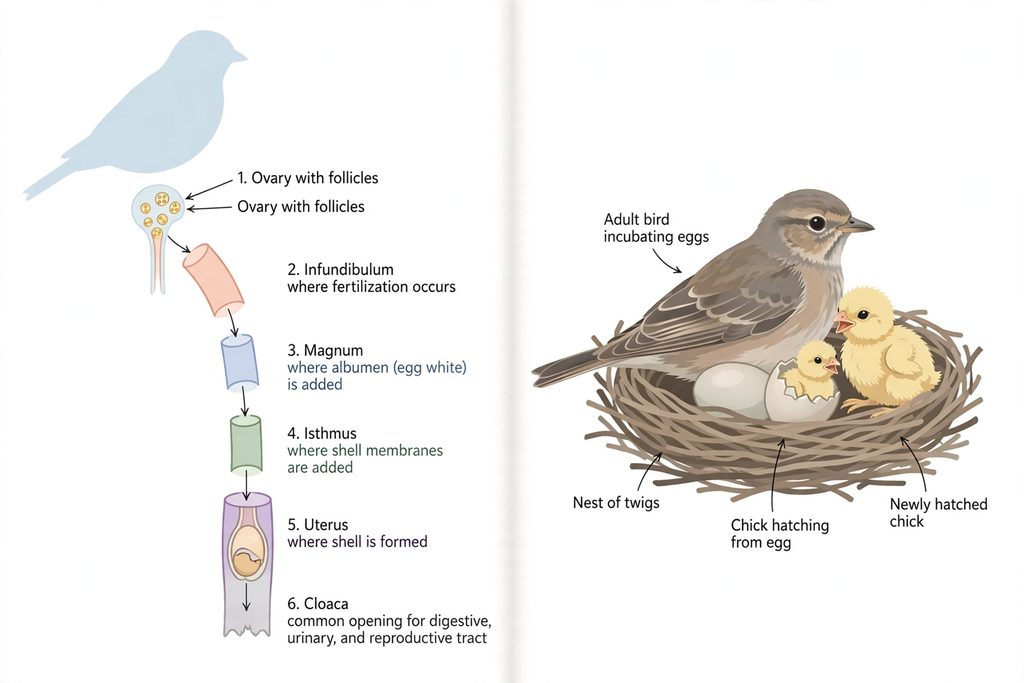
The major stages can be understood in this order:
- Ovary – The egg cell develops and is released.
- Infundibulum – The released egg enters the oviduct; fertilization can occur here if sperm is present.
- Magnum – Most of the egg white, also called albumen, is added.
- Isthmus – The shell membranes are formed around the developing egg.
- Uterus – The hard shell is formed around the egg.
- Vagina and cloaca – The completed egg passes through and is laid.
This process allows the egg to become a protective structure capable of supporting the developing embryo outside the mother’s body.
Fertilization in Birds
Birds have internal fertilization. This means that fertilization occurs inside the female reproductive system rather than outside in the environment.
During mating, sperm from the male enters the female reproductive tract. The sperm can remain viable inside the female for a period of time, which means that an egg released later may still be fertilized.
When the egg cell meets a sperm cell, their genetic material combines. This produces a zygote, which is the first cell of the developing new organism.
The zygote begins dividing as the egg continues moving through the oviduct. By the time the egg is laid, early development of the embryo has already begun.
What Happens During Mating?
Mating in birds is not simply the transfer of sperm. It is often preceded by behaviours that help males and females identify suitable partners.
Depending on the species, a male bird may display its feathers, make special sounds, perform movements or bring food to a female. These behaviours are part of courtship.
Courtship can help bring the male and female together and prepare them for mating. In some bird species, males compete with one another for access to females, while in others a male and female may form a pair.
Once the birds mate successfully, sperm is transferred to the female. Fertilization can then occur when a suitable egg passes through the reproductive tract.
Courtship in Birds
Courtship is an important part of reproduction in many birds. It can involve different behaviours depending on the species.
Some common examples include:
- Singing or calling.
- Displaying brightly coloured feathers.
- Performing special movements or dances.
- Bringing food to a potential mate.
- Building or displaying a nest.
- Defending a particular area.
- Flying in special patterns.
These behaviours do not all occur in every bird species. Each species has its own courtship patterns, and these behaviours can help birds choose partners and coordinate reproduction.
Formation of the Bird Egg
The bird egg is specially designed to protect and nourish the developing embryo. As the egg moves through the oviduct, different parts are added around the developing embryo.
The main parts of a typical bird egg include:
- Shell
- Shell membranes
- Albumen or egg white
- Yolk
- Germinal disc
- Air space
Each part has an important function.
The yolk provides a major source of nutrients for the developing embryo. The albumen contains water and proteins and also provides some protection. The shell protects the contents from physical damage and helps reduce water loss while allowing gases to pass through tiny pores.
The shell membranes provide additional protection around the contents of the egg, while the air space provides a supply of air that becomes important to the embryo during later development.
The Role of the Yolk
The yolk is the yellow part of the egg and serves mainly as a source of nutrients for the developing embryo.
It contains substances such as fats, proteins, vitamins and minerals that support growth. As the embryo develops, it uses nutrients from the yolk.
The yolk is therefore very important because the embryo cannot leave the egg to search for food. Instead, the materials required for development are already stored inside the egg before it is laid.
The Importance of Egg White
The albumen, commonly called egg white, surrounds the yolk and developing embryo. It contains a large amount of water and proteins.
It performs several functions during development:
- It provides water to the developing embryo.
- It supplies proteins.
- It helps cushion the embryo.
- It provides some protection against physical damage.
The albumen therefore contributes to both the nutrition and protection of the developing embryo.
Why Does a Bird Egg Have a Shell?
The shell provides protection for the developing embryo. Without the shell, the soft contents of the egg would be much more exposed to physical damage and water loss.
Although the shell is hard, it is not completely sealed. It contains tiny pores through which gases can move. Oxygen can enter the egg while carbon dioxide produced by the developing embryo can leave.
The shell therefore performs an important balancing role. It protects the embryo while still allowing the exchange of gases needed for development.
Incubation of Bird Eggs
After an egg is laid, it needs suitable conditions for the embryo to continue developing. In many birds, this is achieved through incubation.
Incubation is the process of keeping the eggs warm until the embryos develop sufficiently to hatch. One or both parents may take part in incubation depending on the species.
The parent bird sits on the eggs or positions its body close enough to provide the required warmth. It may also turn the eggs from time to time.
Incubation is important because an embryo can only develop normally when environmental conditions are suitable.
Why Do Birds Sit on Their Eggs?
Birds sit on their eggs mainly to provide warmth. The developing embryo requires a suitable temperature for the cells to divide and the body structures to form properly.
In many species, the parent may also turn the eggs regularly. This helps prevent the developing embryo from remaining in one position for too long and can support normal development.
The parent may leave the nest briefly to feed, but it often returns to continue incubating the eggs.
Development of the Embryo Inside the Egg
After fertilization, the zygote begins to divide repeatedly. These cells gradually organise themselves and form the different parts of the developing bird.
As development continues, structures such as the head, eyes, wings, legs and internal organs form. The embryo becomes more recognisable as a young bird as time passes.
The developing embryo receives nutrients mainly from the yolk and obtains oxygen through the exchange of gases across the egg’s shell and membranes.
Waste materials produced during development are stored within specialised structures in the egg until the young bird is ready to hatch.
Hatching in Reproduction in Birds
Hatching is the process through which the young bird breaks out of the egg.
As the embryo completes its development, it becomes strong enough to begin breaking the shell. Many birds have a small hard structure on the tip of the beak called an egg tooth during the hatching period. It helps the young bird break through the shell.
The young bird gradually creates a crack in the shell and eventually breaks free. The egg tooth is temporary and is normally lost after hatching.
The newly hatched bird may look very different from an adult depending on the species. Some young birds are covered with down and are able to move soon after hatching, while others are weak and depend heavily on their parents.
Types of Young Birds After Hatching
Young birds can generally be placed into two broad groups based on their condition at hatching.
Precocial birds produce young that are relatively well developed when they hatch. These young birds may have feathers or down, open eyes and the ability to walk or move soon after hatching. Chickens, ducks and many other birds are examples.
Altricial birds produce young that are less developed at hatching. They may have little or no feathers, and their eyes may remain closed. They usually depend strongly on their parents for warmth, food and protection. Many songbirds are examples.
These differences show that birds have different strategies for raising their young.
Parental Care in Birds
Parental care is very important in many bird species. After the young hatch, the parents may protect them, keep them warm and provide food until they are able to survive independently.
Parental care can include:
- Feeding the young.
- Protecting them from predators.
- Keeping them warm.
- Cleaning the nest.
- Teaching them behaviours needed for survival.
- Helping them learn to fly or find food.
The amount of care differs between species. Some young birds become independent relatively quickly, while others remain dependent on their parents for weeks or even months.
Nest Building and Reproduction in Birds
Nests are closely connected with reproduction in many birds. A nest provides a place where eggs can be laid and young birds can be protected.
Birds use different materials to build nests, including twigs, grass, leaves, feathers, mud and other available materials. The shape and location of the nest depend on the species.
Some birds build nests in trees, while others place them on the ground, cliffs, buildings or other structures. Certain birds even use holes in trees or existing spaces rather than building a completely new nest.
The main purpose is to provide a suitable place for eggs and young birds, although the level of protection differs between species.
Factors That Affect Reproduction in Birds
Bird reproduction is influenced by both biological and environmental conditions. A bird needs to reach sexual maturity before it can reproduce, but environmental conditions can also determine when breeding takes place.
Important factors include:
- Availability of food.
- Suitable nesting areas.
- Weather conditions.
- Temperature.
- Length of daylight.
- Availability of a mate.
- Presence of predators.
- Availability of water.
In many bird species, breeding is seasonal. Changes in daylight, food availability and environmental conditions can act as signals that it is a suitable time to reproduce.
Monogamy and Mating Systems in Birds
Birds have different mating systems. In some species, one male and one female form a pair during a breeding period. In other species, a male may mate with several females, or a female may mate with several males.
Some bird pairs remain together for more than one breeding season, while others stay together for only part of a breeding period.
It is therefore not correct to assume that every bird has exactly the same mating behaviour. Their reproductive relationships vary greatly between species.
Why Bird Reproduction Is Important
Bird reproduction is important because it maintains bird populations and allows different species to continue from one generation to the next.
Birds also play important roles in ecosystems. Some birds eat insects and help control their populations, while others spread seeds or pollinate plants. Birds are also part of food chains and serve as prey for other animals.
For humans, birds provide food, support livelihoods and contribute to agriculture and ecosystems. Understanding their reproductive process helps us understand how bird populations grow and why protecting their breeding habitats is important.
Threats to Bird Reproduction
Several human activities and environmental changes can interfere with successful bird reproduction.
The destruction of nesting habitats can make it difficult for birds to find safe places to lay eggs and raise their young. Pollution can also affect birds and the environments where they feed and reproduce.
Other threats include:
- Destruction of forests and wetlands.
- Loss of nesting sites.
- Pollution of water and food sources.
- Hunting and trapping.
- Disturbance of breeding areas.
- Reduction in available food.
- Predation by introduced animals in some environments.
When breeding areas are repeatedly disturbed or destroyed, fewer young birds may survive to adulthood.
Bird Reproduction Compared With Fish Reproduction
Birds and fish both reproduce sexually, but their reproductive processes are different in important ways.
| Birds | Fish |
|---|---|
| Fertilization is usually internal. | Fertilization is external in many species, although some fish have internal fertilization. |
| Eggs are formed inside the female and usually laid after fertilization. | Many fish release eggs into water before or around the time of fertilization. |
| Birds produce eggs with protective shells. | Fish eggs generally do not have the hard shell found in bird eggs. |
| Many birds incubate their eggs. | Many fish provide little or no care for eggs, although some species protect them. |
| Young birds may be cared for by parents after hatching. | The amount of parental care varies greatly among fish. |
A Simple Summary of Reproduction in Birds
The reproductive process in birds can be remembered through these main stages:
Male and female become sexually mature → Courtship and mating → Internal fertilization → Egg formation → Egg laying → Incubation → Embryo develops → Hatching → Parental care → Young bird grows into an adult
Once the young bird reaches sexual maturity, it can reproduce and begin the cycle again.
Conclusion on Reproduction in Birds
Reproduction in birds is a carefully organised process that begins with the production of sperm and eggs and continues through mating, fertilization, egg formation, incubation and hatching. Birds use internal fertilization, which protects the reproductive cells from many of the difficulties they would face if fertilization occurred outside the body.
The egg is one of the most important features of bird reproduction. It contains the nutrients, protection and other materials needed for the embryo to develop outside the mother’s body. The shell protects the developing embryo while still allowing the exchange of gases through tiny pores.
After the egg is laid, incubation keeps it warm enough for development to continue. When the embryo is fully developed, the young bird hatches and may receive food, warmth and protection from its parents. Some young birds are able to move around soon after hatching, while others are highly dependent on their parents.
Although birds share the same basic reproductive process, their courtship, nesting habits, incubation and parental care can be very different. These differences allow various bird species to reproduce successfully in the environments where they live.
Revision Questions in Reproduction in Birds
- Explain the process of reproduction in birds.
- What is internal fertilization, and how does it occur in birds?
- State the functions of the yolk, albumen and eggshell.
- Describe the importance of incubation in bird reproduction.
- Differentiate between precocial and altricial young birds.
Frequently Asked Questions in Reproduction in Birds
1. How do birds reproduce?
Birds reproduce sexually through the involvement of a male and female. The male produces sperm and the female produces eggs. Fertilization usually occurs inside the female, after which the fertilized egg develops and is eventually laid.
2. Where does fertilization occur in birds?
Fertilization usually occurs inside the female reproductive tract. The sperm meets the egg before the egg is completed and laid.
3. Why do birds incubate their eggs?
Birds incubate their eggs to provide the warmth needed for the embryo to develop properly. In many species, one or both parents sit on the eggs until they are ready to hatch.
4. What is the function of the eggshell?
The eggshell protects the developing embryo from physical damage and helps reduce water loss. It also contains tiny pores that allow the exchange of gases.
5. What happens after a bird hatches?
After hatching, the young bird continues to grow and develop. Depending on the species, the parents may provide food, warmth and protection until the young bird becomes independent.
Related Articles