Reproduction in Cockroach: Cockroaches are common insects found in homes, kitchens, restaurants, stores, drains and other places where food, moisture and shelter are available. They are known for their ability to survive in different environments, but like every other living organism, cockroaches must reproduce to maintain their population.
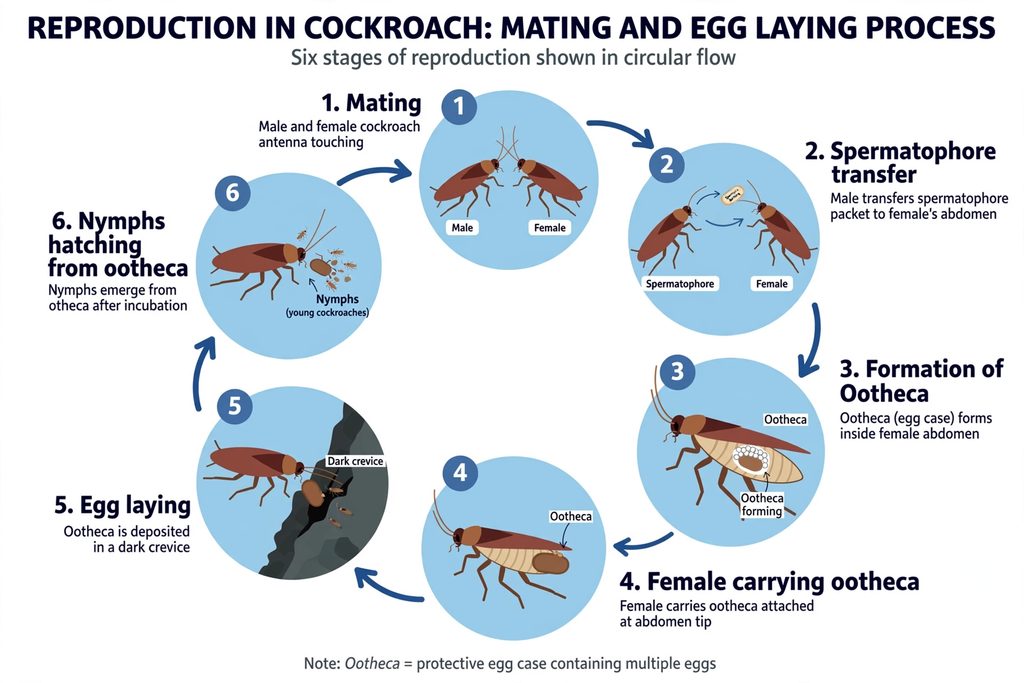
Reproduction in cockroach is sexual. It involves a male cockroach and a female cockroach. After mating and fertilization, the female produces eggs and places them inside a protective case called an ootheca. The eggs later hatch into young cockroaches called nymphs.
Unlike mosquitoes, cockroaches do not pass through a larval and pupal stage. Their young look similar to adults but are smaller and do not have fully developed wings and reproductive organs. This type of development is called incomplete metamorphosis.
The cockroach life cycle can therefore be summarized as:
Egg → Nymph → Adult
Understanding how cockroaches reproduce helps explain why they can establish populations quickly when they have access to suitable food, water and shelter.
Male and Female Cockroaches
Male and female cockroaches have some features that help them reproduce successfully. Although their general body structure is similar, differences can usually be observed between the sexes.
The male cockroach generally has a narrower abdomen and may have longer wings than the female, depending on the species. The male possesses reproductive organs that produce sperm, while the female has reproductive organs responsible for producing eggs.
The female’s reproductive system is especially important because it produces eggs and allows the developing eggs to be packaged into an ootheca.
The exact appearance of male and female cockroaches varies among species, but their reproductive roles remain broadly similar.
How Cockroaches Mate
Reproduction begins when mature male and female cockroaches meet and mate. Cockroaches use chemical signals and other behaviours to recognize suitable mates.
During mating, the male transfers sperm to the female. The sperm is stored within the female reproductive system and is used to fertilize the eggs.
After mating, the female begins preparing to produce and package her eggs. The process does not end immediately after mating because the female must still produce the eggs and protect them in an ootheca.
This is one of the important features of cockroach reproduction: the eggs are not simply left exposed in the environment. They are enclosed in a protective structure.
Egg Formation in the Female Cockroach
The female cockroach produces eggs inside her reproductive system. As the eggs develop, they are arranged into groups.
The eggs eventually become enclosed within a special protective case known as an ootheca.
An ootheca is not simply an ordinary egg. It is a case containing several eggs. It protects the developing embryos from some environmental dangers and helps keep the eggs together.
The number of eggs in an ootheca differs according to the species of cockroach. Some species produce oothecae containing many eggs, while others produce fewer.
What Is an Ootheca?
The ootheca is one of the most important structures in cockroach reproduction.
It is a protective egg case produced by the female cockroach. The developing eggs are arranged inside the case, which provides protection while they develop.
The appearance of an ootheca varies between species, but it may look like a small brown, dark or hardened capsule.
People sometimes mistake the ootheca for an unusual part of the cockroach itself. In reality, it is an egg case containing developing eggs.
The ootheca is important because cockroach eggs are protected rather than being exposed individually.
How the Female Cockroach Handles the Ootheca
After producing an ootheca, the female’s behaviour varies according to the species. Some cockroaches carry the ootheca for some time before depositing it, while others attach or place it in a suitable protected location.
In some species, the female carries the ootheca partly or almost completely until the young are ready to hatch. In others, the ootheca is deposited in a hidden location.
The choice of location matters because the developing eggs need suitable conditions to survive.
Dark, protected areas can provide shelter from predators and environmental disturbances. This is one reason cockroach eggs are often difficult to find in an infested area.
Hatching of Cockroach Eggs
When the embryos have completed their development, the eggs hatch from the ootheca.
The young cockroaches that emerge are called nymphs.
A nymph does not look exactly like an adult cockroach. It is smaller and usually lacks fully developed wings and mature reproductive organs. However, it already has the basic body form of a cockroach.
This is different from insects such as mosquitoes, where the young larva looks completely different from the adult.
The Nymph Stage
The nymph stage is the main period of growth after the eggs hatch.
A young cockroach must grow considerably before becoming an adult. Since its outer body covering does not expand continuously with the growing body, the nymph has to shed its old outer covering several times.
This process is called moulting.
After each moult, the cockroach becomes larger and gradually develops the characteristics of an adult.
The number of moults can vary according to the species and environmental conditions.
From Nymph to Adult
As the cockroach continues to grow, its body gradually becomes more like that of an adult.
The wings, where present, develop gradually. The reproductive organs also mature. Eventually, the cockroach reaches adulthood and becomes capable of reproducing.
The adult stage is therefore important because it allows the cockroach to begin another reproductive cycle.
A simplified sequence is:
Egg → Nymph → Growing Nymph → Adult
There is no separate pupal stage.
Cockroach and Incomplete Metamorphosis
Cockroaches undergo incomplete metamorphosis, also called hemimetabolous development.
In incomplete metamorphosis, the young insect resembles the adult but is smaller and not sexually mature.
The three main stages are:
- Egg – The developing cockroach remains protected inside an ootheca.
- Nymph – The young cockroach grows and moults several times.
- Adult – The cockroach becomes fully mature and capable of reproduction.
This is different from complete metamorphosis, which has four stages: egg, larva, pupa and adult.
For example, a mosquito undergoes complete metamorphosis, while a cockroach undergoes incomplete metamorphosis.
Why Cockroaches Produce Many Eggs
Cockroaches can produce many offspring during their reproductive lives. However, not every egg will successfully develop into an adult.
Eggs and nymphs may be affected by lack of food, lack of water, predators, unsuitable temperature, disease and other environmental conditions.
Producing several eggs gives the species a better chance of maintaining its population even when some young do not survive.
The ability of cockroaches to reproduce repeatedly under favourable conditions can contribute to large populations in places where food, water and shelter are readily available.
Conditions That Support Cockroach Reproduction
The environment has a major effect on cockroach reproduction. Cockroaches are more likely to establish themselves in places that provide the basic conditions needed for survival.
Food: Food waste, crumbs and other available food sources can support adult cockroaches and growing nymphs.
Water: Moisture is important to many cockroach species. Leaking pipes, wet areas, drains and other sources of moisture can make an environment more suitable for them.
Shelter: Cockroaches prefer protected places where they can hide from light, predators and disturbances. Cracks, gaps, cupboards and other hidden spaces can provide shelter.
Temperature: Cockroaches are affected by temperature because they are cold-blooded animals. Suitable temperatures can support their growth and reproduction.
Hiding places: Clutter and objects that provide narrow, protected spaces can make it easier for cockroaches to remain hidden and establish themselves.
Cockroach Reproduction in Homes
Cockroaches can reproduce successfully inside buildings when conditions are favourable.
A home may provide several things that cockroaches need: food, water, warmth and hiding places. Food crumbs, uncovered waste, leaking pipes and poorly maintained areas can therefore contribute to conditions that allow cockroaches to survive.
Once adult cockroaches establish themselves, they can mate and produce oothecae. The nymphs that emerge can continue growing until they become adults.
This creates a repeating cycle that can make a cockroach population difficult to notice at first and more obvious later.
Why Cockroach Eggs Are Difficult to Notice
One reason cockroach populations can increase without being noticed immediately is that the eggs are protected inside oothecae.
The ootheca may be placed in a hidden or protected location. It can therefore remain unnoticed while the young develop.
When the nymphs hatch, they are also relatively small and may hide in cracks and other protected areas.
This means that seeing adult cockroaches is not necessarily an indication that only a few cockroaches are present. There may also be younger stages hidden nearby.
Factors That Affect Cockroach Reproduction
Several factors can affect the ability of cockroaches to reproduce and survive.
Availability of food: A steady supply of food can support growth and reproduction.
Availability of water: Moist environments can provide suitable conditions for many cockroach species.
Temperature: Suitable temperatures support normal growth and development.
Shelter: Protected spaces reduce exposure to predators and other dangers.
Sanitation: Poor sanitation can provide food and hiding places that support cockroach populations.
Predators: Other animals and insects can feed on cockroaches and reduce their numbers.
Human activities: Cleaning, removing food sources, repairing leaks and reducing hiding places can make an environment less suitable for cockroaches.
Importance of Cockroach Reproduction in Biology
Studying cockroach reproduction helps students understand important biological concepts such as sexual reproduction, fertilization, egg development, metamorphosis and insect growth.
Cockroaches are particularly useful when learning about incomplete metamorphosis because their nymphs resemble the adults.
Their reproduction also provides a clear example of how organisms protect their developing young. The ootheca protects the eggs during development, while the nymphs continue growing through repeated moulting.
Cockroach Reproduction Compared With Mosquito Reproduction
Cockroaches and mosquitoes are both insects, but their development is different.
| Feature | Cockroach | Mosquito |
|---|---|---|
| Type of reproduction | Sexual | Sexual |
| Egg protection | Ootheca | Eggs laid according to species and breeding site |
| Young stage | Nymph | Larva |
| Pupal stage | Absent | Present |
| Type of metamorphosis | Incomplete | Complete |
| Main stages | Egg → Nymph → Adult | Egg → Larva → Pupa → Adult |
| Young appearance | Similar to adult | Very different from adult |
| Water needed for young stages | Not normally required | Important for many species |
The main difference is that a cockroach nymph resembles a small adult cockroach, while a mosquito larva looks completely different from the adult mosquito.
Common Misunderstandings About Cockroach Reproduction
One common misunderstanding is that cockroach eggs are laid individually like the eggs of some other animals. In reality, cockroach eggs are enclosed in an ootheca containing several eggs.
Another misunderstanding is that cockroaches have a larval stage. They do not. The young cockroach is called a nymph, and it develops gradually into an adult through moulting.
It is also incorrect to say that cockroaches have a pupal stage. The cockroach life cycle does not include a pupa. This is one of the main features that separates incomplete metamorphosis from complete metamorphosis.
Simple Summary of Reproduction in Cockroach
Cockroaches reproduce sexually. A mature male mates with a mature female and transfers sperm. The female produces eggs, which become enclosed in an ootheca.
The ootheca protects the developing eggs until they are ready to hatch. Young cockroaches called nymphs emerge from the eggs. They resemble adults but are smaller and not fully mature.
The nymph grows by moulting several times. As it grows, its body becomes more developed until it reaches the adult stage.
The adult cockroach can then mate and reproduce, starting the cycle again.
The complete process can be remembered as:
Mating → Fertilization → Egg formation → Ootheca → Hatching → Nymph → Moulting → Adult
Conclusion
Reproduction in cockroach is an example of sexual reproduction and incomplete metamorphosis. The male and female cockroach mate, after which the female produces eggs and encloses them in an ootheca.
The eggs eventually hatch into nymphs. Unlike mosquito larvae, cockroach nymphs already resemble the adult insect. They grow through repeated moulting until they become mature adults capable of reproduction.
The availability of food, water, shelter and suitable environmental conditions can affect cockroach survival and reproduction. Understanding the cockroach life cycle is therefore useful not only in biology but also in understanding why cockroach populations can become established in homes and other buildings.
Revision Questions
- What is an ootheca and what is its function in cockroach reproduction?
- Describe how mating and fertilization occur in cockroaches.
- What is a nymph, and how does it develop into an adult cockroach?
- Why is cockroach development described as incomplete metamorphosis?
- State three environmental conditions that can support cockroach reproduction.
Frequently Asked Questions
1. How do cockroaches reproduce?
Cockroaches reproduce sexually through mating between male and female cockroaches. After mating and fertilization, the female produces eggs and encloses them in an ootheca.
2. What is an ootheca?
An ootheca is a protective egg case produced by a female cockroach. It contains several developing cockroach eggs.
3. What is a young cockroach called?
A young cockroach is called a nymph. It resembles the adult but is smaller and has not reached full reproductive maturity.
4. Do cockroaches have a pupal stage?
No. Cockroaches do not have a pupal stage. They undergo incomplete metamorphosis, with the main stages being egg, nymph and adult.
5. What are the stages of the cockroach life cycle?
The stages are egg, nymph and adult. The nymph grows through several moults before becoming a mature adult.
Related Articles