Exothermic and endothermic reactions are two types of chemical reactions that differ in how they transfer heat. An exothermic reaction gives off heat to its surroundings, while an endothermic reaction takes in heat from its surroundings. You can observe these energy changes in everyday activities, such as burning fuel, using a cold pack, and cooking food.
Meaning of Exothermic and Endothermic Reactions
Exothermic Reaction
An exothermic reaction is a chemical reaction that releases heat from the reacting system into its surroundings. The surroundings may become warmer because heat is transferred to them.
Examples include the combustion of fuels, the neutralization of an acid by a base, and the reaction between an acid and certain metals.
Endothermic Reaction
An endothermic reaction is a chemical reaction that absorbs heat from its surroundings. The surroundings may become cooler as heat is transferred into the reacting system.
Examples include the thermal decomposition of calcium carbonate and certain reactions in which ammonium nitrate dissolves in water.
A simple way to remember the difference is that exothermic reactions release heat, while endothermic reactions absorb heat.
Differences Between Exothermic and Endothermic Reactions
| Feature | Exothermic Reaction | Endothermic Reaction |
|---|---|---|
| Heat transfer | Releases heat | Absorbs heat |
| Enthalpy change (ΔH) | Negative | Positive |
| Relative enthalpy | Products have lower enthalpy than reactants | Products have higher enthalpy than reactants |
| Energy transfer | Energy moves from the reacting system to the surroundings | Energy moves from the surroundings into the reacting system |
| Example | Combustion of fuel | Thermal decomposition of calcium carbonate |
The temperature of the surroundings may rise during an exothermic reaction and fall during an endothermic reaction. However, the observed temperature change depends on the experimental conditions and how heat is exchanged with the surroundings.
Examples of Exothermic Reactions
1. Combustion of Fuels
Combustion is a chemical reaction in which a substance reacts with oxygen and releases energy. The complete combustion of many hydrocarbon fuels produces carbon dioxide and water.
For example, the complete combustion of methane is represented by the equation:
CH₄ + 2O₂ → CO₂ + 2H₂O + heat
This reaction releases heat and is used in applications such as cooking and heating.
2. Respiration
During aerobic respiration, glucose reacts with oxygen to produce carbon dioxide and water while releasing energy.
The simplified equation is:
C₆H₁₂O₆ + 6O₂ → 6CO₂ + 6H₂O + energy
Living organisms use the released energy to support activities such as movement, growth, and the maintenance of body functions.
3. Neutralization
Neutralization occurs when an acid reacts with a base to form a salt and water. The reaction between a strong acid and a strong base in dilute aqueous solution generally releases heat.
For example:
HCl + NaOH → NaCl + H₂O
Hydrochloric acid reacts with sodium hydroxide to form sodium chloride and water.
4. Reaction of Sodium with Water
Sodium reacts vigorously with water to form sodium hydroxide and hydrogen gas. The reaction releases heat.
2Na + 2H₂O → 2NaOH + H₂
The heat released may ignite the hydrogen produced. This is a hazardous reaction and should not be attempted outside properly equipped, supervised laboratories.
5. Freezing of Water
When liquid water freezes, it releases heat to its surroundings as it changes into ice.
H₂O(l) → H₂O(s) + heat
Freezing is a physical change rather than a chemical reaction. It is included here to illustrate an important principle: a process can release heat without being a chemical reaction.
Examples of Endothermic Reactions
1. Thermal Decomposition of Calcium Carbonate
Thermal decomposition occurs when a compound breaks down into simpler substances because of heating.
Calcium carbonate decomposes when sufficiently heated to produce calcium oxide and carbon dioxide.
CaCO₃(s) + heat → CaO(s) + CO₂(g)
The reaction requires an input of heat energy.
2. Photosynthesis
Photosynthesis is the process by which green plants use light energy to produce glucose from carbon dioxide and water.
The simplified equation is:
6CO₂ + 6H₂O + light energy → C₆H₁₂O₆ + 6O₂
Light energy is absorbed and used to drive the chemical changes involved in producing glucose. Photosynthesis is therefore an energy-absorbing process, although it is more precisely described as a light-driven process than simply a heat-driven reaction.
3. Dissolving Ammonium Nitrate in Water
Ammonium nitrate absorbs heat from its surroundings when it dissolves in water under suitable conditions.
NH₄NO₃(s) → NH₄⁺(aq) + NO₃⁻(aq)
The dissolving process is endothermic, so the solution becomes colder as it absorbs heat from its surroundings. This principle is used in some instant cold packs.
4. Electrolysis of Water
Electrolysis uses electrical energy to decompose water into hydrogen and oxygen.
2H₂O(l) → 2H₂(g) + O₂(g)
Electrical energy is supplied to drive the process. However, electrolysis should not be classified as endothermic merely because it requires electricity; its heat and enthalpy changes depend on the reaction conditions.
Bond Breaking, Bond Formation and Energy Changes
Chemical reactions involve the breaking of bonds in reactants and the formation of new bonds in products.
Bond breaking: Energy must be absorbed to break a chemical bond.
Bond formation: Energy is released when a chemical bond forms.
The overall energy change depends on the balance between these two processes.
In an exothermic reaction, the energy released during bond formation is greater than the energy absorbed during bond breaking.
In an endothermic reaction, the energy absorbed during bond breaking is greater than the energy released during bond formation.
This explains why some chemical reactions release heat while others absorb it.
Enthalpy Change (ΔH)
Enthalpy change is the difference between the enthalpy of the products and that of the reactants at the same stated conditions. At constant pressure, it corresponds to the heat transferred to or from the reacting system when only pressure–volume work is considered.
The formula is:
ΔH = H(products) − H(reactants)
Where:
- ΔH = enthalpy change
- H(products) = total enthalpy of the products
- H(reactants) = total enthalpy of the reactants
For an exothermic reaction, ΔH is negative because the products have lower enthalpy than the reactants.
For an endothermic reaction, ΔH is positive because the products have higher enthalpy than the reactants.
Worked Example 1: Calculating Enthalpy Change
A reaction has a total reactant enthalpy of 200 kJ and a total product enthalpy of 260 kJ. Calculate its enthalpy change and identify the reaction type.
Step 1: Write the formula.
ΔH = H(products) − H(reactants)
Step 2: Substitute the values.
ΔH = 260 − 200
Step 3: Calculate.
ΔH = +60 kJ
Answer: The enthalpy change is +60 kJ. Since the value is positive, the reaction is endothermic.
Heat Energy Formula
The formula for calculating heat transferred when a substance changes temperature without changing state is:
Q = mcΔT
Where:
- Q = heat transferred, measured in joules (J)
- m = mass of the substance, measured in kilograms (kg)
- c = specific heat capacity, measured in J kg⁻¹ °C⁻¹
- ΔT = change in temperature, calculated as final temperature minus initial temperature
Worked Example 2: Calculating Heat Energy
A 3 kg sample of water increases in temperature by 4°C. If the specific heat capacity of water is 4,200 J kg⁻¹ °C⁻¹, calculate the heat absorbed by the water.
Step 1: Write the formula.
Q = mcΔT
Step 2: Substitute the values.
Q = 3 × 4,200 × 4
Step 3: Calculate.
Q = 50,400 J
Answer: The water absorbs 50,400 J of heat energy.
This calculation gives the heat absorbed by the water. It does not, by itself, establish whether the chemical reaction supplying that heat is exothermic or endothermic. That conclusion depends on the complete experimental setup.
Activation Energy
Activation energy is the minimum energy that reacting particles must have for a reaction to occur through a particular reaction pathway.
Even an exothermic reaction generally requires activation energy to begin. For example, a match needs an initial input of energy from friction before combustion can start.
Once the reaction begins, the energy released by an exothermic reaction can help sustain the process.
Activation energy is different from enthalpy change. Activation energy describes the energy barrier that must be overcome, while enthalpy change describes the difference in enthalpy between the products and reactants.
Energy Profile Diagrams
An energy profile diagram shows how the energy of a reacting system changes as a reaction proceeds.
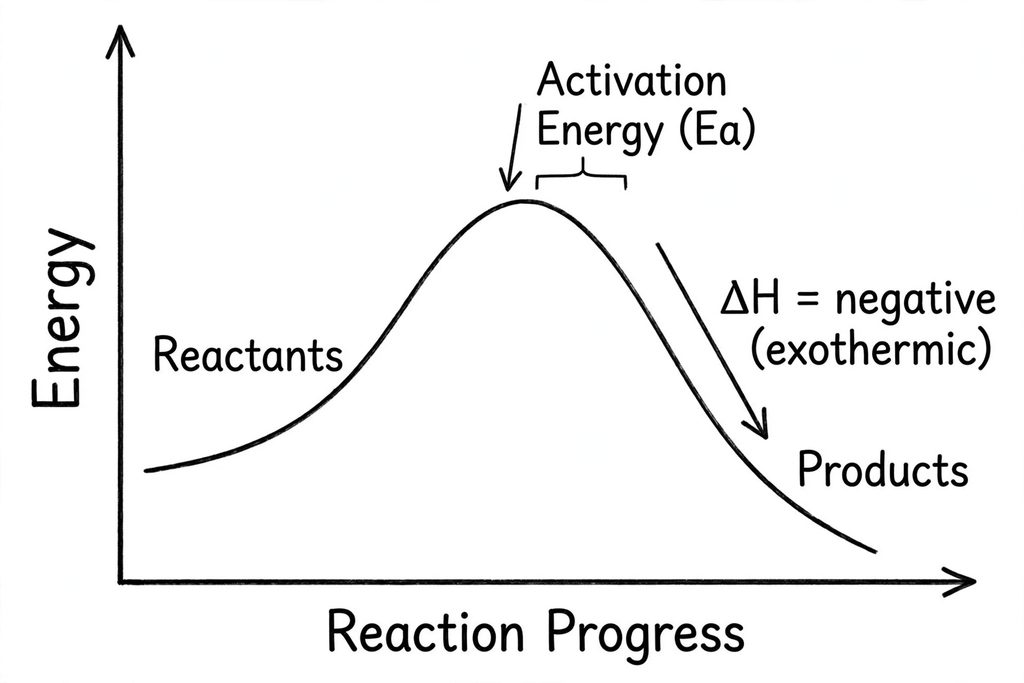
The vertical axis represents energy or enthalpy, while the horizontal axis represents the reaction progress.
Exothermic Energy Profile
In an exothermic reaction, the products have lower enthalpy than the reactants. The diagram begins at a higher energy level for the reactants and ends at a lower level for the products.
The difference between these levels represents a negative enthalpy change.
Endothermic Energy Profile
In an endothermic reaction, the products have higher enthalpy than the reactants. The diagram begins at a lower energy level for the reactants and ends at a higher level for the products.
The difference between these levels represents a positive enthalpy change.
Important parts of an energy profile diagram
- Reactants: The substances present at the beginning of the reaction.
- Products: The substances formed at the end.
- Activation energy: The energy difference between the reactants and the top of the energy barrier.
- Enthalpy change (ΔH): The difference between the enthalpy of the products and reactants.
Applications of Exothermic and Endothermic Processes
Exothermic and endothermic processes have several practical applications.
Applications of exothermic processes
- Cooking and heating: Fuels release heat during combustion.
- Respiration: Living organisms release usable energy from food through cellular processes.
- Industrial production: Some industrial chemical reactions release heat that must be controlled or may be recovered for useful purposes.
Applications of endothermic processes
- Instant cold packs: Certain dissolving processes absorb heat and help cool the pack.
- Photosynthesis: Plants absorb light energy to produce energy-rich organic compounds.
- Thermal decomposition: Heat is supplied to break down certain compounds into simpler substances.
Common Mistakes Students Should Avoid
- Confusing heat with temperature: Heat is energy transferred because of a temperature difference, while temperature measures the thermal state of a substance.
- Mixing up the signs of ΔH: Exothermic reactions have negative enthalpy changes, while endothermic reactions have positive enthalpy changes.
- Thinking bond breaking releases energy: Bond breaking requires energy, while bond formation releases energy.
- Confusing activation energy with enthalpy change: Activation energy is the energy barrier; enthalpy change is the difference between the products and reactants.
- Assuming every process that absorbs energy is endothermic: The type of energy involved and the thermodynamic process must be considered carefully.
Revision Questions
- Define an exothermic reaction.
- Define an endothermic reaction.
- State three differences between exothermic and endothermic reactions.
- Give two examples of exothermic chemical reactions.
- Give two examples of endothermic chemical reactions.
- Explain why bond breaking requires energy.
- What is meant by activation energy?
- Write the formula for calculating enthalpy change.
- A reaction has a reactant enthalpy of 150 kJ and a product enthalpy of 110 kJ. Calculate ΔH and identify the reaction type.
- State two differences between an exothermic and an endothermic energy profile diagram.
Frequently Asked Questions
1. What is the main difference between exothermic and endothermic reactions?
An exothermic reaction releases heat to its surroundings, while an endothermic reaction absorbs heat from its surroundings.
2. Is combustion exothermic or endothermic?
Combustion is generally exothermic because it releases energy as substances react with oxygen.
3. Is photosynthesis exothermic or endothermic?
Photosynthesis absorbs light energy to drive the production of glucose and other products, making it an energy-absorbing process.
4. What does a negative enthalpy change mean?
A negative ΔH indicates that the reaction releases heat under the stated constant-pressure conditions.
5. What does a positive enthalpy change mean?
A positive ΔH indicates that the reaction absorbs heat under the stated constant-pressure conditions.
6. Why do some endothermic processes make their surroundings colder?
They absorb heat from the surroundings, reducing the thermal energy available to the surrounding materials.
7. Do exothermic reactions need activation energy?
Generally, yes. An exothermic reaction may require an initial energy input before it can proceed.
8. What is the difference between activation energy and enthalpy change?
Activation energy is the energy barrier that reacting particles must overcome. Enthalpy change is the difference between the enthalpy of the products and reactants.
Related Articles