Newton’s Laws of Motion are one of the most important topics in physics because they explain how and why objects move. Every movement you see around you, from a car moving on the road to a person walking or even a rocket launching into space, can be explained using these laws. They form the foundation of mechanics, and without understanding them properly, many other topics in physics will feel difficult.
Before going into the laws themselves, it is necessary to clearly understand the basic ideas that support them. These ideas include motion, force, mass, and acceleration. If these are not well understood, the laws will look confusing instead of simple.
Understanding Motion Properly
Motion is defined as the change in position of an object with time, but this definition needs to be understood beyond just memorizing it. When we say an object is in motion, it means its position is changing relative to another object or point. This is why motion is said to be relative.
For example, a student sitting inside a moving bus may appear to be at rest to another student sitting beside him, but to someone standing outside the bus, that same student is moving. This shows that motion depends on the observer.
In real life, motion can happen in different ways:
- Straight line motion (a car moving on a straight road)
- Circular motion (a fan rotating)
- Random motion (movement of gas particles)
Understanding motion properly helps you see why force is needed to change motion, which brings us to the next concept.
Understanding Force in a Deeper Way
Force is commonly defined as a push or pull, but this definition is only the starting point. Force is actually what changes the state of motion of an object. Without force, an object will either remain at rest or continue moving the same way.
Force can:
- Start motion
- Stop motion
- Increase speed
- Reduce speed
- Change direction
Some common forces you should know include:
- Friction (opposes motion)
- Gravitational force (pulls objects toward the Earth)
- Tension (force in ropes or strings)
- Normal reaction (support force from surfaces)
Force is measured in Newtons (N), and it always has both magnitude and direction, meaning it is a vector quantity.
Mass and Why It Matters
Mass is not just about how heavy something is. It also tells you how difficult it is to change the motion of that object. This is why mass is closely related to inertia.
A small stone can be pushed easily, but a big rock requires much more effort. This is not just because it is “heavy,” but because it has more mass and therefore more resistance to change.
Acceleration Explained Clearly
Acceleration is often misunderstood as only “speeding up,” but it actually means any change in velocity. Since velocity includes both speed and direction, acceleration can occur in three ways:
- Increase in speed
- Decrease in speed (deceleration)
- Change in direction
For example, a car moving at constant speed in a circular path is still accelerating because its direction is changing.
Newton’s First Law of Motion (Law of Inertia)
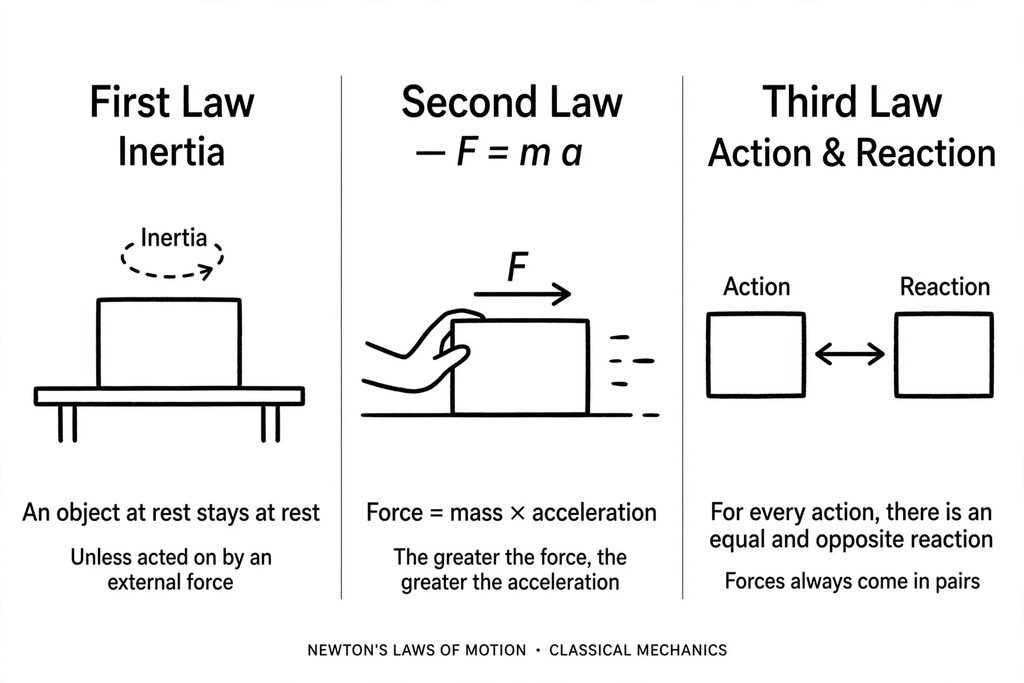
Newton’s First Law states that a body will remain at rest or continue moving in a straight line at constant speed unless acted upon by an external force. This law is very important because it explains the natural behavior of objects when no force is acting on them.
In everyday life, it may seem like objects naturally come to rest, but that is not actually true. What happens is that forces like friction and air resistance are always acting, gradually reducing motion until the object stops. If these forces were removed, an object in motion would continue moving forever.
The key idea in this law is inertia. Inertia is the tendency of a body to resist any change in its state. This means that objects do not want to change what they are doing. If they are at rest, they want to stay at rest. If they are moving, they want to keep moving.
The amount of inertia an object has depends on its mass. Objects with larger mass have greater inertia and are more difficult to move or stop.
Types of Inertia Explained
- Inertia of Rest
This occurs when a body at rest resists being moved. A good example is trying to push a heavy box. The box does not move easily because it resists change. - Inertia of Motion
A moving object resists stopping. This is why a vehicle continues moving even after the engine is turned off, although it will eventually stop due to friction. - Inertia of Direction
A moving object resists a change in its direction. This is why passengers feel pushed sideways when a car takes a sharp turn.
Real-Life Situations You Must Understand
- When a bus starts suddenly, passengers fall backward because their bodies try to remain at rest while the bus moves forward.
- When a bus stops suddenly, passengers move forward because their bodies were already in motion.
- Dust comes out of a carpet when it is beaten because the carpet moves suddenly while the dust tends to remain at rest.
- Pulling a tablecloth quickly from under plates leaves the plates almost unmoved due to inertia.
From all these, you should clearly understand that force is not needed to maintain motion, but only to change motion.
Newton’s Second Law of Motion (Law of Acceleration)
Newton’s Second Law explains how force affects motion. It states that the rate of change of momentum is directly proportional to the applied force and takes place in the direction of that force.
In simpler terms, this law shows the relationship between force, mass, and acceleration. When force is applied to an object, it causes acceleration, but the amount of acceleration depends on the mass of the object.
From practical understanding:
- If you increase the force, acceleration increases
- If you increase the mass, acceleration decreases
This explains why it is easier to push a bicycle than a car. The bicycle has less mass, so it accelerates more easily.
Momentum and Its Importance
Momentum is defined as the product of mass and velocity. It gives a measure of how much motion an object has.
- A heavy object moving slowly can have large momentum
- A light object moving very fast can also have large momentum
The second law shows that force is required to change momentum, whether by changing speed or direction.
Everyday Applications
- A football moves farther when kicked harder because greater force produces greater acceleration.
- A loaded truck requires more force to start moving compared to a small car.
- In athletics, athletes apply force to the ground to increase their speed.
This law is very important in engineering because it helps in designing machines, vehicles, and structures.
Newton’s Third Law of Motion (Action and Reaction)
Newton’s Third Law states that for every action, there is an equal and opposite reaction. This law explains what happens when two objects interact.
Whenever a force is applied, there is always another force acting in the opposite direction. These forces are equal in size but act on different bodies.
This is very important because many students think these forces cancel each other, but they do not. Since they act on different objects, each object experiences its own force.
Clear Everyday Examples
- When you walk, your foot pushes the ground backward, and the ground pushes you forward.
- When a gun is fired, the bullet moves forward, and the gun moves backward (recoil).
- A rocket moves upward because it pushes gases downward.
- A swimmer moves forward by pushing water backward.
Key Points to Remember
- Forces always occur in pairs
- They are equal and opposite
- They act on different objects
Summary Table of the Laws
| Law | Explanation | Key Idea |
|---|---|---|
| First Law | Objects resist change | Inertia |
| Second Law | Force changes motion | F = ma |
| Third Law | Forces act in pairs | Action & Reaction |
Final Understanding of the Newton’s Laws of Motion
Newton’s Laws of Motion give a complete explanation of motion. The first law tells you why objects do not change their state easily. The second law explains how motion changes when force is applied. The third law explains how forces interact between objects.
If you understand these laws deeply, you will not just memorize physics, you will actually understand how the physical world works.
Revision Questions on Newton’s Laws of Motion
- State Newton’s First Law of Motion and explain the concept of inertia with two examples.
- Describe the relationship between force, mass, and acceleration according to Newton’s Second Law of Motion.
- Explain what momentum is and how it is connected to Newton’s Second Law of Motion.
- State Newton’s Third Law of Motion and give two real-life examples to illustrate it.
- Differentiate clearly between inertia of rest, inertia of motion, and inertia of direction.
- A loaded wheelbarrow is harder to push than an empty one. Explain this using Newton’s laws of motion.
- Why does a passenger move forward when a moving bus stops suddenly? Explain using the appropriate law of motion.
Related Articles
omonusiseyi640@gmail.com
Am new please i need some video on the topic
Alright