Introduction
First 20 elements: The periodic table is one of the most useful tools in chemistry. It brings the chemical elements together and arranges them according to their atomic numbers and properties. By studying the table, students can understand why elements behave differently, how they combine with one another, and where they are used in everyday life.
The First 20 Elements in the Periodic Table are a good place to begin because they introduce students to many of the basic ideas in chemistry. They include metals, non-metals, metalloids and noble gases. Some are found in the air we breathe, some are important to plants and animals, while others are used to make metals, electronics, medicines and other useful products.
Learning Objectives
After studying this lesson, you should be able to:
- List the First 20 Elements in the correct order.
- Write the correct symbol and atomic number for each element.
- Explain what an element is.
- Identify metals, non-metals, metalloids and noble gases among the First 20 Elements.
- State some important properties and uses of the elements.
- Explain simple periodic trends.
- Distinguish between an element’s name, symbol and atomic number.
What Is an Element?
An element is a pure substance made up of only one type of atom. Each element has its own atomic number, which is determined by the number of protons in the nucleus of its atoms.
For example, every hydrogen atom has one proton, so hydrogen has atomic number 1. Oxygen has eight protons, so its atomic number is 8.
Elements cannot be broken down into simpler substances by ordinary chemical methods. However, two or more different elements can combine to form compounds. Water is a familiar example because it contains hydrogen and oxygen.
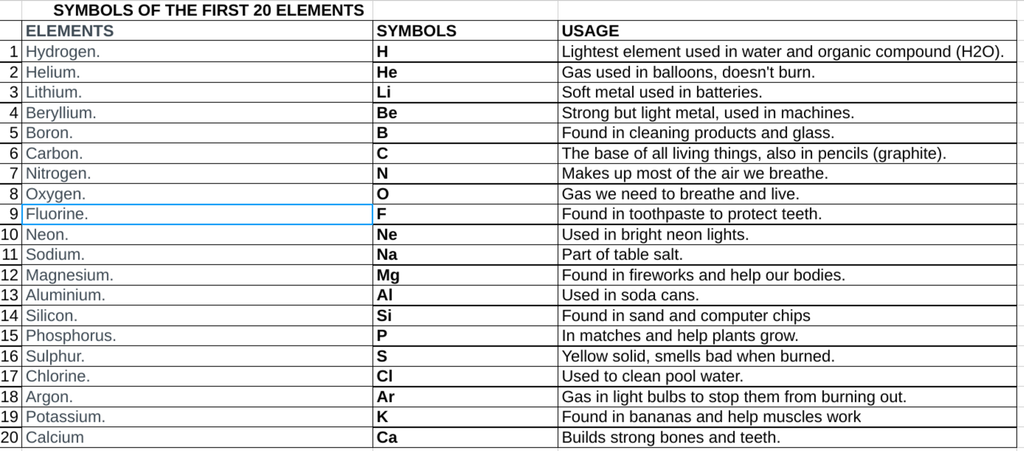
First 20 Elements: Names, Symbols and Atomic Numbers
The First 20 Elements begin with hydrogen and end with calcium. They are arranged according to increasing atomic number.
| Element | Symbol |
|---|---|
| Hydrogen | H |
| Helium | He |
| Lithium | Li |
| Beryllium | Be |
| Boron | B |
| Carbon | C |
| Nitrogen | N |
| Oxygen | O |
| Fluorine | F |
| Neon | Ne |
| Sodium | Na |
| Magnesium | Mg |
| Aluminium | Al |
| Silicon | Si |
| Phosphorus | P |
| Sulfur | S |
| Chlorine | Cl |
| Argon | Ar |
| Potassium | K |
| Calcium | Ca |
Properties and Uses of the First 20 Elements
1. Hydrogen (H)
Hydrogen is the first element and has atomic number 1. It is a very light, colourless gas and is highly flammable. Hydrogen is present in water and in many compounds containing hydrogen.
Hydrogen is used in chemical industries and in the production of ammonia. It is also being studied and used in some energy systems because it can release a large amount of energy when used as a fuel.
2. Helium (He)
Helium has atomic number 2 and belongs to the noble gases. It is colourless, very light and does not react easily with other substances.
Helium is commonly used to fill balloons because it is lighter than air and does not burn. It is also useful in scientific and industrial equipment where very low temperatures are needed.
3. Lithium (Li)
Lithium has atomic number 3. It is a soft, silvery metal and is one of the lightest metals.
One of its best-known uses is in rechargeable batteries. Lithium is therefore important in devices such as mobile phones, laptops and some electric vehicles. Lithium compounds also have other industrial and medical uses.
4. Beryllium (Be)
Beryllium has atomic number 4. It is a light and hard metal with useful strength and stiffness.
It is used in specialised aerospace equipment, precision instruments and some electrical and electronic components. Because exposure to beryllium dust can be harmful, it must be handled carefully in industrial settings.
5. Boron (B)
Boron has atomic number 5 and is classified as a metalloid. It has some properties of metals and some properties of non-metals.
Boron compounds are used in heat-resistant glass, ceramics, detergents and other industrial products. Small amounts of boron are also needed by plants for healthy growth.
6. Carbon (C)
Carbon has atomic number 6 and is one of the most important elements in living organisms. It forms a very large number of compounds and is present in plants, animals and many materials.
Carbon occurs in different forms. Diamond is very hard, while graphite is soft and can conduct electricity. Carbon is also found in fuels, plastics, food and many other substances.
7. Nitrogen (N)
Nitrogen has atomic number 7 and makes up about 78% of Earth’s atmosphere. It is a colourless gas and is important to living organisms.
Plants need nitrogen for proper growth and for making proteins. This is why nitrogen compounds are important in agriculture and fertilizer production. Nitrogen is also used in several industrial processes.
8. Oxygen (O)
Oxygen has atomic number 8 and makes up about 21% of Earth’s atmosphere. It is essential for respiration in humans and many other organisms.
Oxygen also supports burning. It is used in hospitals, metal processing and several industrial processes. Oxygen is one of the First 20 Elements that students can easily connect with everyday life because of its importance to living things.
9. Fluorine (F)
Fluorine has atomic number 9 and is a very reactive non-metal. In its elemental form, it is a pale yellow gas and is not normally found freely in nature because it reacts readily with other substances.
Fluoride compounds have several uses. Fluoride is commonly added to toothpaste because it helps protect teeth from decay. Fluorine compounds are also used in some industrial processes.
10. Neon (Ne)
Neon has atomic number 10 and is a noble gas. It is colourless and does not react easily with other elements.
Neon is best known for its use in lighting and advertising signs. When electricity passes through neon gas in a suitable tube, it produces a bright reddish-orange glow.
11. Sodium (Na)
Sodium has atomic number 11 and is a soft, silvery metal. It belongs to the alkali metals and reacts strongly with water, so it is not normally found as a free metal in nature.
Sodium is found in many compounds. Sodium chloride, for example, is ordinary table salt. Sodium ions are also important for normal nerve and muscle function in the body.
12. Magnesium (Mg)
Magnesium has atomic number 12 and is a light, silvery metal. It is useful for making lightweight alloys.
Magnesium and its alloys are used in some vehicle parts, aircraft components, electronic products and other materials. Magnesium compounds also have uses in medicine and agriculture.
13. Aluminium (Al)
Aluminium has atomic number 13. It is a lightweight metal that is easy to shape and has good resistance to corrosion.
Aluminium is used to make cans, cooking foil, building materials, electrical products and parts of aircraft and other vehicles. Its low weight makes it particularly useful where reducing weight is important.
14. Silicon (Si)
Silicon has atomic number 14 and is a metalloid. It is one of the major elements found in Earth’s crust and occurs in many rocks and minerals.
Silicon is very important in modern electronics because it is used to make semiconductor devices and computer chips. Silicon compounds are also used in glass, ceramics and construction materials.
15. Phosphorus (P)
Phosphorus has atomic number 15 and is a non-metal. It is important in living organisms and occurs in several biological compounds.
Phosphorus compounds are widely used in fertilizers because phosphorus is one of the major nutrients required by plants. Phosphorus is also important in bones and teeth and in several processes that take place inside living cells.
16. Sulfur (S)
Sulfur has atomic number 16 and is a yellow solid non-metal. It occurs naturally and is also found in many compounds.
Sulfur is important in the manufacture of sulfuric acid, fertilizers and other chemicals. It is also used in rubber processing and in the production of some medicines.
17. Chlorine (Cl)
Chlorine has atomic number 17 and belongs to the halogens. Elemental chlorine is a reactive yellow-green gas.
Chlorine compounds are widely used to disinfect water and swimming pools. They are also used in making bleach, plastics and other chemicals. Chloride ions are naturally present in the body and are needed for normal body functions.
18. Argon (Ar)
Argon has atomic number 18 and is a noble gas. It is colourless, odourless and very unreactive.
Argon is used in some electric lamps and in welding. Its low reactivity makes it useful where a material needs protection from reacting with oxygen in the surrounding air.
19. Potassium (K)
Potassium has atomic number 19 and is an alkali metal. It is soft and highly reactive and is therefore not normally found as a free element in nature.
Potassium compounds are important in agriculture because potassium is one of the major nutrients needed by plants. Potassium ions also play an important role in normal nerve and muscle function.
20. Calcium (Ca)
Calcium has atomic number 20 and belongs to the alkaline earth metals. It is an important mineral in living organisms.
Calcium is needed for the development and maintenance of bones and teeth. Calcium compounds are also used in construction, including the production of lime and cement.
Classification of the First 20 Elements
The First 20 Elements can be divided into four broad groups based on their general properties.
Metals
Lithium, Beryllium, Sodium, Magnesium, Aluminium, Potassium and Calcium are metals. Metals generally conduct heat and electricity and can form positive ions.
Non-metals
Hydrogen, Carbon, Nitrogen, Oxygen, Fluorine, Phosphorus, Sulfur and Chlorine are non-metals. Their properties differ from those of metals, and many form compounds by gaining or sharing electrons.
Noble gases
Helium, Neon and Argon are noble gases. They are very unreactive because their outer electron shells are stable.
Metalloids
Boron and Silicon are metalloids. Their properties fall between those of metals and non-metals.
Periods and Groups
The periodic table is arranged in rows called periods and columns called groups.
The First 20 Elements occur in the first four periods of the periodic table. Elements in the same group often have similar chemical properties because they have similar arrangements of electrons in their outer shells.
For example, lithium and sodium are both in Group 1 and are reactive metals. Helium, neon and argon are in Group 18 and are noble gases.
Simple Periodic Trends
Studying the First 20 Elements also helps students understand some basic patterns in the periodic table.
Atomic size: Atomic size generally becomes smaller from left to right across a period and becomes larger down a group.
Metallic character: Metallic properties generally decrease from left to right across a period and increase down a group.
Reactivity: Reactivity does not change in exactly the same way for all types of elements. For example, alkali metals such as lithium and sodium are reactive, while noble gases such as helium and neon are very unreactive.
Ion formation: Metals usually lose electrons to form positive ions, while many non-metals gain or share electrons when forming compounds.
Why Students Should Understand the First 20 Elements
Knowing the names and symbols of the First 20 Elements is useful, but understanding them is even more important. Their symbols appear in chemical formulas and equations, while their positions in the periodic table help explain their behaviour.
They also provide familiar examples when learning chemistry. Oxygen is connected with respiration, nitrogen with plant nutrition, silicon with electronics, calcium with bones and building materials, and sodium and chlorine with common compounds.
A good understanding of these elements makes later chemistry topics easier because students will already be familiar with atomic numbers, symbols, groups, periods and basic chemical properties.
How to Learn the First 20 Elements Easily
Trying to memorise all 20 elements at once can be confusing. A better method is to learn them in smaller groups.
Start with elements 1–10:
Hydrogen, Helium, Lithium, Beryllium, Boron, Carbon, Nitrogen, Oxygen, Fluorine, Neon.
Then learn elements 11–20:
Sodium, Magnesium, Aluminium, Silicon, Phosphorus, Sulfur, Chlorine, Argon, Potassium, Calcium.
After learning the names, practise matching each one with its symbol and atomic number. For example:
Hydrogen — H — 1
Carbon — C — 6
Oxygen — O — 8
Sodium — Na — 11
Calcium — Ca — 20
Writing them from memory, using a periodic table and answering short revision questions can help you identify the ones you still find difficult.
Common Mistakes to Avoid
One common mistake is assuming that every element symbol comes directly from the first one or two letters of its English name. This is not always the case. Sodium has the symbol Na, while potassium has the symbol K.
Another mistake is confusing an element’s atomic number with its atomic mass. The atomic number tells us the number of protons in the atom. Atomic mass is related to the mass of the protons and neutrons.
Students should also remember that some of these elements are rarely found as free elements in nature because they react readily with other substances. Sodium and potassium are good examples.
Conclusion
The First 20 Elements in the Periodic Table are an important part of basic chemistry. They introduce students to elements, atomic numbers, symbols, metals, non-metals, metalloids, noble gases, groups, periods and simple periodic trends.
Learning these elements should go beyond memorising their names. When you understand their properties and common uses, it becomes easier to recognise their importance in agriculture, medicine, technology, industry and everyday life. Regular practice with the periodic table will also make later chemistry topics easier to understand.
Revision Questions
- What is an element?
- What does the atomic number of an element tell us?
- List the First 20 Elements in the correct order.
- Write the symbols of the first 10 elements.
- Which three of the First 20 Elements are noble gases?
- Name the two metalloids among the First 20 Elements.
- What is the atomic number of oxygen?
- State two uses of silicon.
- Why is nitrogen important in agriculture?
- What is the difference between a metal and a non-metal?
Frequently Asked Questions
1. What are the First 20 Elements?
They are the elements with atomic numbers 1 to 20, beginning with hydrogen and ending with calcium.
2. Why are the First 20 Elements important in chemistry?
They help students understand basic chemical ideas such as atomic numbers, symbols, properties, groups, periods and chemical reactions.
3. Which of the First 20 Elements are metals?
The metals are lithium, beryllium, sodium, magnesium, aluminium, potassium and calcium.
4. Which of the First 20 Elements are noble gases?
Helium, neon and argon are noble gases.
5. What is the easiest way to learn the First 20 Elements?
Learn them in groups of 10, practise their symbols and atomic numbers, use the periodic table regularly and test yourself with revision questions.
Related Articles