Gas Laws in Chemistry: Meaning, Types, Formulas, Applications,
Take a deep breath in. Without thinking about it, your lungs expand and fill with air. When you breathe out, that air leaves your body. This simple everyday action is actually controlled by important scientific rules known as gas laws. These laws help us understand how gases behave when conditions like temperature, pressure, and volume change.
Gases are different from solids and liquids because they have no fixed shape or size. They can expand, compress, and move freely. Because of this, scientists studied gases closely and developed laws that explain their behavior. In this article, we will study Gas Laws in Chemistry in a simple and clear way, including their meaning, types, formulas, real-life uses, and their limitations.
Meaning of Gas Laws
Gas laws are scientific principles that describe how gases behave under different conditions. These laws show the relationship between four main properties of gases:
- Pressure
- Volume
- Temperature
- Amount of gas (number of moles)
In simple terms, gas laws help us understand what happens to a gas when we heat it, cool it, compress it, or add more of it. For example, if you heat a gas, it usually expands. If you compress it, the pressure increases.
Gas laws are very important because they allow scientists and engineers to predict how gases will behave in different situations.
Types of Gas Laws in Chemistry
There are four main gas laws you need to know. Each one explains a different relationship between gas properties.
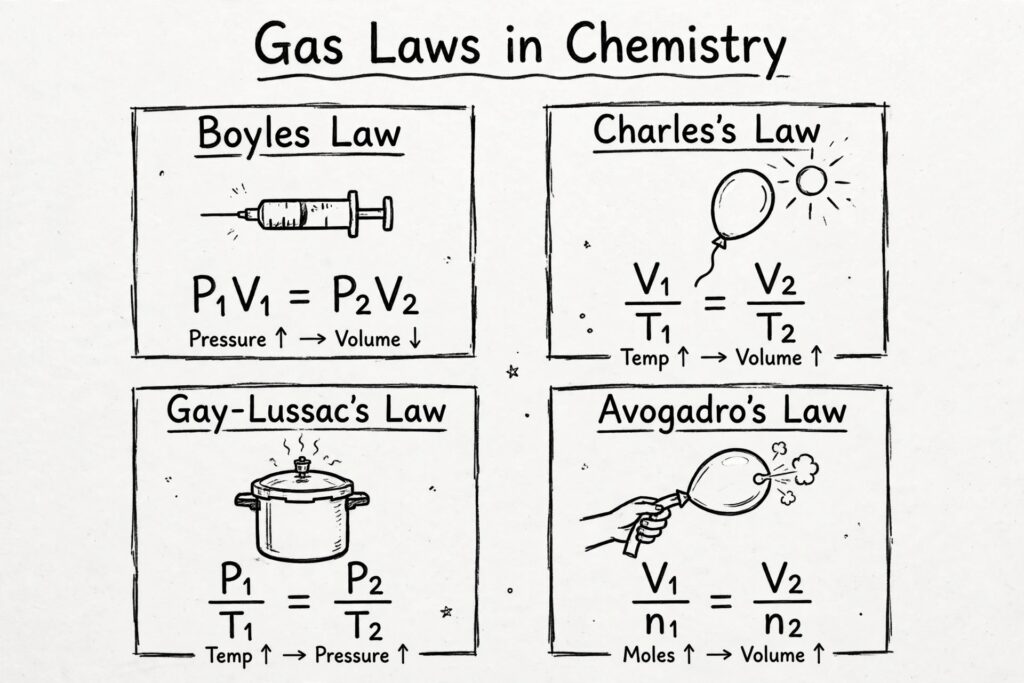
1. Boyle’s Law
Boyle’s Law explains the relationship between pressure and volume when temperature is constant.
It states that:
The pressure of a gas is inversely proportional to its volume.
This means:
- If the volume decreases, the pressure increases
- If the volume increases, the pressure decreases
Formula:
P₁V₁ = P₂V₂
Explanation:
Imagine using a syringe. When you push the plunger down, the space inside becomes smaller. As a result, the air molecules are forced closer together, and the pressure increases. When you pull the plunger up, the space increases, and the pressure decreases.
Key idea: Pressure and volume move in opposite directions.
Example Solved: Pressure and volume:
Question: A gas occupies 300cm³ at 2 atm. Find volume at 3 atm.
Solution:
P1V1 = P2V2
2 × 300 = 3 × V2
V2 = 600 / 3 = 200cm³
2. Charles’s Law
Charles’s Law explains the relationship between volume and temperature when pressure is constant.
It states that:
The volume of a gas is directly proportional to its temperature.
This means:
- If temperature increases, volume increases
- If temperature decreases, volume decreases
Formula:
V₁/T₁ = V₂/T₂
Explanation:
Think of a balloon. When you heat it, the gas inside gains energy and expands, making the balloon bigger. When you cool it, the gas loses energy and shrinks.
Important note: Temperature must be measured in Kelvin, not Celsius.
Key idea: Volume and temperature move in the same direction.
Example 2 Solved – Volume and Temperature:
Question: A gas at 27°C occupies 200cm³. What is volume at 127°C? Pressure constant.
Solution:
Convert to Kelvin: T1 = 27+273 = 300K, T2 = 127+273 = 400K
V1/T1 = V2/T2
200/300 = V2/400
V2 = 80000 / 300 = 266.7cm³
3. Gay-Lussac’s Law
Gay-Lussac’s Law explains the relationship between pressure and temperature when volume is constant.
It states that:
The pressure of a gas is directly proportional to its temperature.
This means:
- If temperature increases, pressure increases
- If temperature decreases, pressure decreases
Formula:
P₁/T₁ = P₂/T₂
Example 3 Solved – Pressure and Temperature:
Question: Pressure of gas at 300K is 2 atm. What is pressure at 600K? Volume constant.
Solution:
P1/T1 = P2/T2
2/300 = P2/600
P2 = 1200 / 300 = 4 atm
Explanation:
Consider a sealed gas container. When it is heated, the gas particles move faster and collide more often with the walls of the container. This increases the pressure inside.
That is why heating a closed gas container can be dangerous—it may explode due to high pressure.
Key idea: Pressure and temperature move in the same direction.
4. Avogadro’s Law
Avogadro’s Law explains the relationship between volume and the amount of gas when temperature and pressure are constant.
It states that:
The volume of a gas is directly proportional to the number of moles.
This means:
- More gas → larger volume
- Less gas → smaller volume
Formula:
V₁/n₁ = V₂/n₂
Explanation:
When you blow air into a balloon, you are adding more gas molecules. As a result, the balloon expands and becomes larger.
Key idea: More particles mean more space is needed.
Combined Gas Law
The combined gas law brings together Boyle’s Law, Charles’s Law, and Gay-Lussac’s Law into one equation. It is used when pressure, volume, and temperature all change at the same time.
Formula:
(P₁V₁)/T₁ = (P₂V₂)/T₂
Explanation:
This law is very useful when dealing with real-life problems where more than one condition changes. Instead of using separate laws, you can solve everything using one equation.
Ideal Gas Equation (PV = nRT)
The ideal gas equation is a general formula that combines all the gas laws into one simple equation.
Formula:
PV = nRT
Meaning of each symbol:
- P (Pressure): The force the gas exerts on the walls of its container
- V (Volume): The space occupied by the gas
- n (Number of moles): The amount of gas present
- R (Gas constant): A fixed value used in calculations
- T (Temperature): Measured in Kelvin
Explanation:
This equation allows us to calculate any one of the variables if the others are known. It is widely used in chemistry, physics, and engineering.
My Classroom Example:
Question: 0.5 moles of gas at 2 atm and 300K. Find volume. R = 0.0821
Solution:
PV = nRT
V = nRT/P
V = 0.5 × 0.0821 × 300 / 2
V = 6.16 Litres
Applications of Gas Laws in Real Life
Gas laws are not just for the classroom. They are used in many real-life situations.
- Breathing in humans
When you inhale, your chest expands, reducing pressure inside your lungs. Air flows in to balance the pressure. - Pressure cookers
The pressure inside increases as temperature rises, helping food cook faster. - Weather and atmosphere
Gas laws help explain how air pressure and temperature affect weather patterns. - Hot air balloons
Heating the air inside the balloon makes it expand and become lighter, allowing it to rise. - Car engines
Gas laws help engineers design engines that use pressure and temperature changes efficiently. - Gas storage cylinders
Understanding pressure helps in safely storing gases like oxygen and cooking gas.
Importance of Gas Laws
Instead of calling them “advantages,” it is more correct to talk about their importance.
- Gas laws help us understand how gases behave in different conditions.
- They allow scientists to predict changes in pressure, volume, and temperature.
- Gas laws are useful in solving real-life problems in science and engineering.
- They form the foundation for many concepts in chemistry and physics.
- Gas laws are essential in industries such as medicine, aviation, and manufacturing.
- They help in designing safe systems for storing and using gases.
Limitations of Gas Laws
Gas laws are very useful, but they are not perfect. They have some limitations.
- Gas laws assume gases behave ideally, which is not always true.
- They do not work well at very high pressure.
- They fail at very low temperatures where gases may condense into liquids.
- They ignore intermolecular forces between gas particles.
- They assume gas particles have no volume, which is not realistic.
- They may give inaccurate results under extreme conditions.
Differences Between Ideal Gas and Real Gas
Ideal Gas:
- Follows all gas laws perfectly
- Has no intermolecular forces
- Particles have no volume
- Works best at low pressure and high temperature
Real Gas:
- Does not follow gas laws perfectly
- Has intermolecular forces
- Particles occupy space
- Behavior changes under extreme conditions
Conclusion on Gas Laws in Chemistry
Gas laws are very important in understanding how gases behave in our world. From breathing to weather changes and industrial processes, these laws help explain many everyday events. Although they have limitations, they remain a key part of chemistry and science as a whole.
Revision Questions on Gas Laws in Chemistry
- What are gas laws?
- State Boyle’s Law and explain it.
- What does Charles’s Law say about temperature and volume?
- Write the formula for the combined gas law.
- What does each symbol in PV = nRT represent?
- Mention three real-life applications of gas laws.
- State two limitations of gas laws.
Related Articles
It was very amazing, I love it
That’s good… Check other articles for physics, chemistry biology, history, general knowledge