About This Lesson
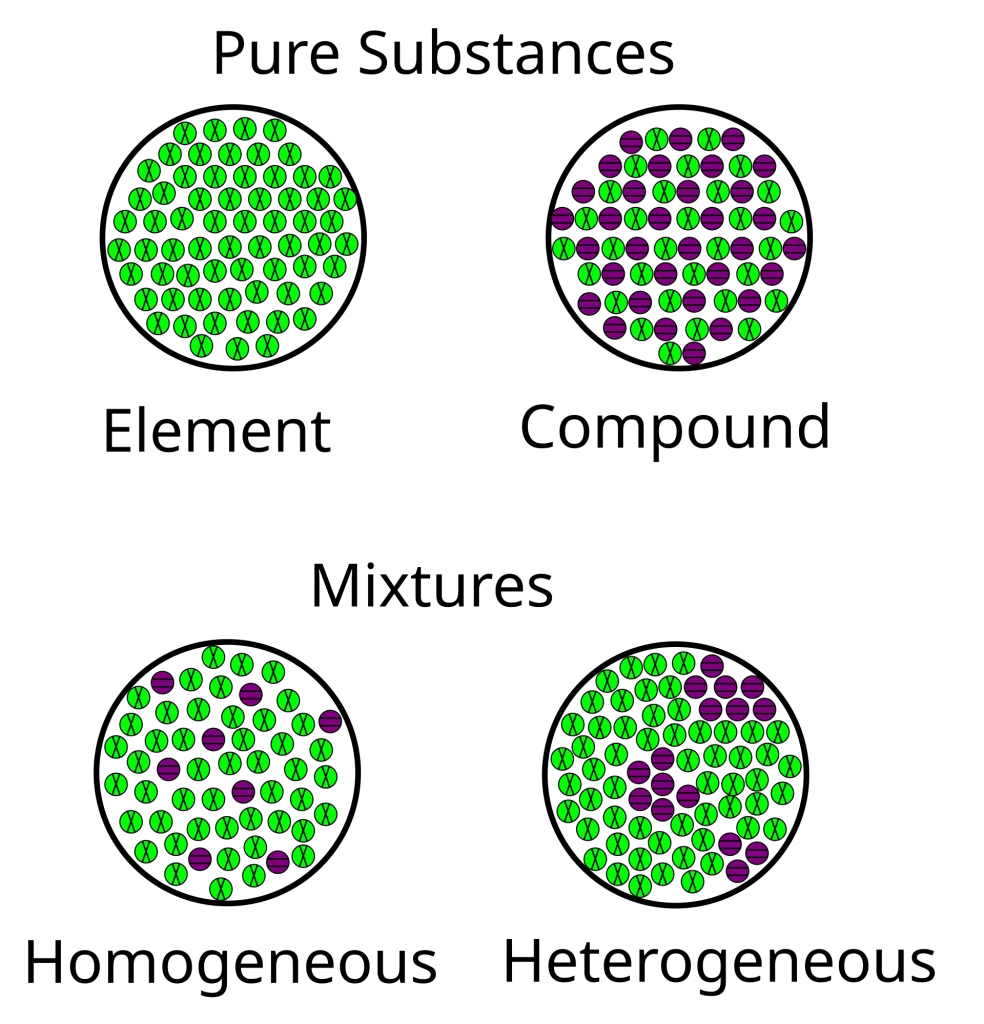
The difference between elements, compounds and mixtures is an important topic in chemistry because these three groups describe different ways substances exist and are formed. An element contains only one type of atom, a compound contains different elements that are chemically joined, while a mixture contains two or more substances that are together without being chemically joined.
The difference becomes clearer when you look at their composition, properties and methods of separation. For example, oxygen is an element, water is a compound, and air is a mixture. Although all three are forms of matter, they are not formed or separated in the same way.
Learning Objectives on Elements
By the end of this lesson, you should be able to:
- Define an element, compound and mixture.
- Give examples of each.
- Explain how compounds differ from mixtures.
- Distinguish between homogeneous and heterogeneous mixtures.
- Describe how mixtures can be separated.
- Identify the main differences among elements, compounds and mixtures.
What Is an Element?
An element is a pure substance made up of only one type of atom. An element cannot be broken down into simpler substances by ordinary chemical methods.
Every element has its own chemical symbol and is listed on the periodic table. For example, hydrogen is represented by H, oxygen by O, iron by Fe, and gold by Au.
An element can exist as a solid, liquid or gas under different conditions. For example, iron is a solid, mercury is a liquid, and oxygen is a gas at room temperature.
Some elements exist as individual atoms, while others naturally exist as molecules. Oxygen gas, for example, normally exists as O₂, which means that two oxygen atoms are joined together. It is still an element because only oxygen atoms are present.
Examples of Elements
- Hydrogen (H)
- Oxygen (O₂)
- Carbon (C)
- Iron (Fe)
- Gold (Au)
- Copper (Cu)
- Sulfur (S)
What Is a Compound?
A compound is a pure substance formed when two or more different elements combine chemically in definite proportions.
During the formation of a compound, the atoms of the elements become chemically bonded. The resulting substance has properties that may be very different from those of the elements from which it was formed.
Water is a good example. It is made from hydrogen and oxygen, but water does not have the same properties as either hydrogen gas or oxygen gas. The hydrogen and oxygen atoms are chemically bonded in a definite proportion to form water.
Compounds have chemical formulas that show the elements present and the ratio in which their atoms are combined.
Examples of Compounds
- Water (H₂O)
- Carbon dioxide (CO₂)
- Sodium chloride (NaCl)
- Ammonia (NH₃)
- Calcium carbonate (CaCO₃)
A compound can be broken down into simpler substances through a chemical process. For example, water can be decomposed into hydrogen and oxygen under suitable conditions.
What Is a Mixture?
A mixture is formed when two or more substances are combined without forming a new substance through chemical bonding.
The substances in a mixture retain their individual chemical identities and can usually be separated by physical methods. Unlike a compound, a mixture does not have one fixed chemical formula.
For example, when salt dissolves in water, the salt and water form a mixture. The amount of salt can be increased or decreased without changing the identity of the substances present.
Examples of Mixtures
- Air
- Salt water
- Soil
- Sand and iron filings
- Oil and water
- Fruit juice containing different components
Mixtures may contain solids, liquids or gases. They can also contain substances in different proportions.
Types of Mixtures
Mixtures are commonly divided into homogeneous mixtures and heterogeneous mixtures.
Homogeneous Mixture
A homogeneous mixture has a uniform composition throughout. Its components are evenly distributed, so different parts of the mixture appear similar.
Examples include:
- Salt solution
- Sugar solution
- Air
- Brass
For example, if salt completely dissolves in water, a sample taken from the top and another taken from the bottom can contain the same proportions of dissolved salt and water, provided the solution is properly mixed.
Heterogeneous Mixture
A heterogeneous mixture does not have a uniform composition throughout. Different parts of the mixture may contain different amounts or types of components.
Examples include:
- Sand and water
- Oil and water
- Soil
- Granite
- Sand and iron filings
In some heterogeneous mixtures, the different components can be seen easily. In others, special methods may be needed to distinguish them.
Differences Between Elements, Compounds and Mixtures
| Element | Compound | Mixture |
|---|---|---|
| One type of atom | Different elements chemically bonded | Two or more substances physically combined |
| Fixed composition | Fixed proportion of elements | Proportions can vary |
| Separation | Cannot be separated by ordinary physical methods | Components can usually be separated physically |
| Properties | Has its own properties | Components generally retain their properties |
| Formula | Chemical symbol or molecular formula | No single fixed chemical formula |
| Examples | Iron, oxygen, copper | Water, carbon dioxide, sodium chloride |
Compound and Mixture: What Is the Main Difference?
The difference between a compound and a mixture is especially important because both can contain more than one substance.
In a compound, the constituent elements are chemically bonded and are present in a definite ratio. A new substance is formed, and separating its elements requires a chemical process.
In a mixture, the substances are combined without forming a new chemical substance. Their proportions can change, and the components can usually be separated using physical methods.
For example, sodium and chlorine combine chemically to form sodium chloride, a compound with the formula NaCl. On the other hand, sand and salt placed together form a mixture. The sand and salt remain separate substances and can be separated using appropriate physical methods.
Element and Compound: What Is the Difference?
An element contains only one type of atom, while a compound contains atoms of two or more different elements that are chemically bonded.
For example, copper contains only copper atoms, so it is an element. Copper(II) oxide contains copper and oxygen chemically combined, so it is a compound.
An element cannot be broken down into simpler substances by ordinary chemical means, while a compound can be chemically decomposed into simpler substances.
Element and Mixture: What Is the Difference?
An element is a pure substance containing only one type of atom. A mixture contains two or more substances that have been combined physically.
For example, pure iron is an element. Soil is a mixture because it contains different materials such as mineral particles, organic matter, water and air.
Similarities Between Elements, Compounds and Mixtures
Although they differ in composition and properties, elements, compounds and mixtures have some things in common.
- They are all forms of matter.
- They have mass and occupy space.
- They are made up of particles such as atoms, molecules or ions.
- They can occur in different physical states depending on the substance and conditions.
- They are found in natural and human-made materials.
Separation of Mixtures
One useful feature of mixtures is that their components can usually be separated without changing the chemical identity of the substances.
The method used depends on the properties of the components.
Filtration can be used to separate an insoluble solid from a liquid. For example, sand can be separated from water by filtration.
Evaporation can be used to recover a dissolved solid from a solution. For example, salt can be obtained from salt water by evaporating the water.
Distillation can be used to separate liquids based on differences in their boiling points or to obtain a solvent from a solution.
Decantation involves carefully pouring a liquid away from a settled solid or from another liquid that forms a separate layer.
Magnetic separation can be used when one component of a mixture is attracted to a magnet. Iron filings can therefore be separated from sand using a magnet.
Why Compounds Cannot Be Separated Like Mixtures
The components of a compound are chemically bonded, so simply filtering, settling, or using a magnet will not separate the compound into its constituent elements.
A chemical change is needed to break the bonds and form simpler substances.
This is one of the clearest ways to distinguish a compound from a mixture. In a mixture, the substances remain chemically separate. In a compound, the elements have combined to form a new substance.
Why This Topic Is Important in Chemistry
Knowing whether a substance is an element, compound or mixture helps you predict how it behaves and how it can be separated or analysed.
The classification is also useful in laboratory work. A chemist needs to know whether a sample is a pure substance or a mixture before deciding which method to use for identification or separation.
The distinction is also seen in everyday materials. Air, drinking water, soil, metals, medicines and food products can contain different types of substances, and understanding their composition helps explain their properties and uses.
Common Mistakes Students Make
Thinking every substance containing more than one element is a mixture: This is not correct. Water contains hydrogen and oxygen, but they are chemically bonded, so water is a compound.
Thinking mixtures always contain visible substances: Some mixtures, such as air and salt solution, appear uniform even though they contain more than one substance.
Saying compounds can be separated by filtration: Filtration is a physical separation method and does not normally break chemical bonds in a compound.
Thinking oxygen gas is a compound because it contains two atoms: O₂ contains two atoms, but both are oxygen atoms. It is therefore an element, not a compound.
Assuming all pure substances are elements: A compound is also a pure substance because it has a definite composition and consistent properties.
A Simple Way to Remember the Difference
A useful way to remember the three terms is:
Element → one type of atom
Compound → different elements chemically joined
Mixture → substances physically combined
The important point is not just to memorise these lines. Look at what happens to the substances when they are combined. If a chemical combination produces a new substance with a definite composition, it is a compound. If substances are brought together without forming a new substance, it is a mixture.
Summary on Difference Between Elements
An element is a pure substance made up of one type of atom. A compound is a pure substance formed when two or more different elements combine chemically in fixed proportions. A mixture contains two or more substances that are physically combined and can usually be separated by physical methods.
Compounds have definite chemical formulas and properties that differ from those of their constituent elements. Mixtures do not have one fixed chemical formula, and their components generally retain their individual properties. Mixtures may be homogeneous or heterogeneous depending on how evenly their components are distributed.
Understanding these differences makes it easier to identify substances and choose suitable methods for separating mixtures.
Revision Questions
- Define an element and give two examples.
- What is a compound? Give two examples.
- State three differences between a compound and a mixture.
- Explain the difference between a homogeneous and a heterogeneous mixture.
- Name three physical methods used to separate mixtures.
Frequently Asked Questions on Difference Between Elements
1. What is the difference between an element, compound and mixture?
An element contains one type of atom, a compound contains different elements chemically bonded in definite proportions, and a mixture contains two or more substances that are physically combined.
2. Is water an element, compound or mixture?
Water is a compound because hydrogen and oxygen are chemically bonded in a fixed ratio to form H₂O.
3. Is air an element, compound or mixture?
Air is a mixture because it contains several gases, including nitrogen, oxygen and other gases, that are not chemically bonded together as one substance.
4. Can a mixture be separated?
Yes. Many mixtures can be separated using physical methods such as filtration, evaporation, distillation, decantation or magnetic separation.
5. Are all pure substances elements?
No. Both elements and compounds are pure substances. An element contains one type of atom, while a compound contains two or more different elements chemically bonded in a definite composition.
Related Articles
Really helpful alot thanks very much
Thanks you
Keep learning