Types of Fertilizers: Fertilizers are important materials used in agriculture to improve soil fertility and help crops grow well. Plants need nutrients such as nitrogen, phosphorus, potassium, calcium, magnesium and sulfur for healthy growth. When the soil does not contain enough of these nutrients, farmers can apply fertilizers to supply what the crops need.
Fertilizers can help crops develop strong roots, healthy leaves, flowers, fruits and seeds. They can also increase crop yield when they are used correctly. However, using too much fertilizer or applying the wrong type can damage crops and cause problems for the soil and environment.
Types of Fertilizers
Fertilizers can be classified in different ways, including according to their source and the nutrients they supply. Based on their source, they may be grouped into organic and inorganic fertilizers. They can also be classified according to the nutrients they contain, such as nitrogen, phosphorus, potassium or combinations of these nutrients
1. Organic Types of Fertilizers
Organic fertilizers are obtained from plant and animal materials. They contain nutrients and also add organic matter to the soil.
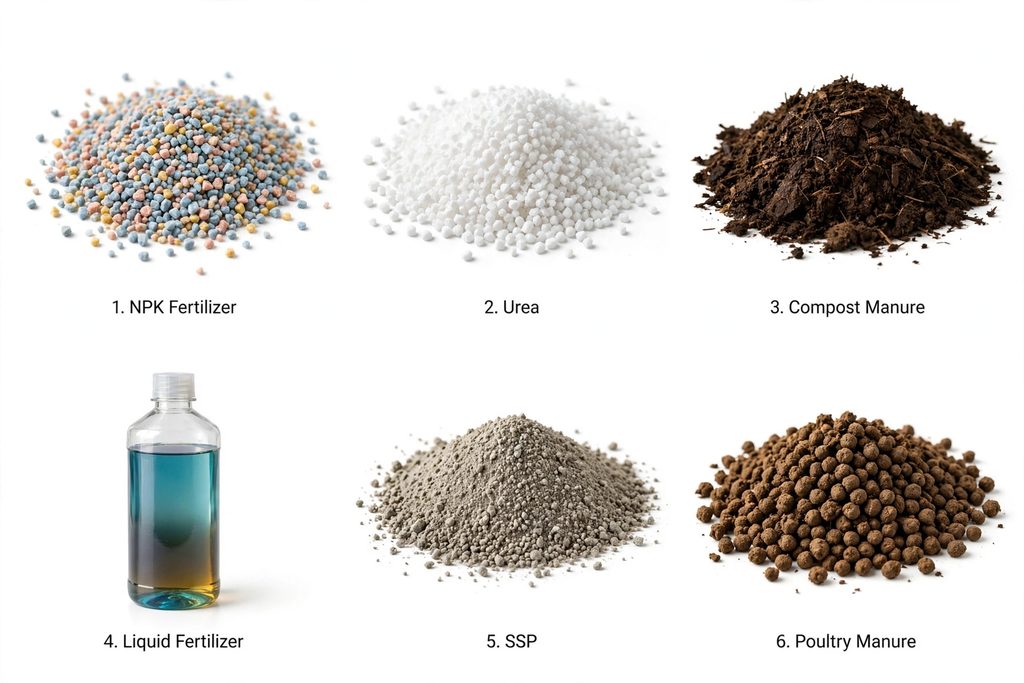
Examples include farmyard manure, compost, poultry manure, animal dung and green manure.
Organic fertilizers are useful because they improve the structure of the soil and help the soil hold water and nutrients. They usually release nutrients slowly, making them useful for maintaining soil fertility over time.
2. Inorganic Types of Fertilizers
Inorganic fertilizers are manufactured or processed from mineral materials. They usually contain specific nutrients in known amounts, so farmers can select a fertilizer based on the nutrient needed by a crop.
Examples include urea, ammonium sulfate, superphosphate and muriate of potash.
Inorganic fertilizers often act faster than organic fertilizers because their nutrients are readily available to plants. However, they should be applied according to the needs of the crop and soil.
3. Nitrogen Fertilizers
Nitrogen fertilizers supply nitrogen to crops. Nitrogen is important for the formation of chlorophyll and the growth of leaves and stems.
Examples include urea, ammonium sulfate and calcium ammonium nitrate.
Nitrogen fertilizers are commonly used for crops that need good leaf and stem development. When nitrogen is lacking, plants may grow slowly and their leaves may become pale or yellow.
4. Phosphorus Fertilizers
Phosphorus fertilizers supply phosphorus to the soil. Phosphorus is important for root development, energy transfer and the formation of flowers, fruits and seeds.
Examples include single superphosphate and triple superphosphate.
Phosphorus is particularly important during the early stages of plant growth because healthy root development helps plants obtain water and other nutrients from the soil.
5. Potassium Types of Fertilizers
Potassium fertilizers supply potassium, which helps plants remain strong and supports several important plant processes.
Examples include muriate of potash and sulfate of potash.
Potassium fertilizers can improve the strength of plants and help crops cope better with some environmental stresses. It is also important in the development and quality of many fruits and other harvested crops.
6. Compound or Mixed Fertilizers
Compound fertilizers contain two or more major plant nutrients. They may contain nitrogen, phosphorus and potassium in different proportions.
For example, an NPK fertilizer supplies nitrogen, phosphorus and potassium.
Compound fertilizers are useful when a soil or crop needs several nutrients at the same time. The fertilizer selected should match the nutrient requirements of the crop and the condition of the soil.
Advantages of Fertilizers
Fertilizers can provide several benefits in crop production when the appropriate type and amount are used. Their benefits are not limited to supplying nutrients; proper fertilizer management can also support better crop performance and make farming more productive.
They Supply Nutrients in Needed Amounts
Different fertilizers contain different nutrients, allowing farmers to supply particular nutrients according to the needs of the crop and soil. This is especially useful when a soil test or other reliable information shows that certain nutrients are deficient.
They Support Better Crop Development
Adequate nutrient supply helps crops develop their roots, stems, leaves, flowers, fruits and seeds properly. When nutrient requirements are met, plants are better able to carry out their normal growth processes.
They Can Improve Crop Yield
Where nutrient deficiency is limiting crop growth, applying a suitable fertilizer can increase the amount of produce obtained from a given area of farmland. The actual result depends on other factors such as seed quality, water availability, pest control and general farm management.
They Can Improve the Use of Farmland
Fertilizers can help maintain nutrient availability on farmland that is cultivated repeatedly. Replacing nutrients removed through harvesting can help farmers continue producing crops without allowing nutrient depletion to become a major limitation.
They Can Increase Farm Returns
When fertilizer is used correctly and the increase in crop production is greater than the cost of the fertilizer and its application, farmers may earn more from their harvest. The economic benefit therefore depends on both crop response and production costs.
They Allow Nutrient Management to Be Targeted
Because fertilizers differ in their nutrient content, farmers can select products that match particular crop or soil needs. For example, a nitrogen fertilizer may be appropriate where nitrogen is deficient, while a phosphorus-containing fertilizer may be selected where phosphorus is needed.
Disadvantages of Fertilizers
Although fertilizers can improve crop production when used correctly, improper or excessive application can create problems for crops, soil, farmers and the environment. The effects often depend on the type of fertilizer used, the amount applied, the condition of the soil and how the fertilizer is managed.
They Can Damage Crops
Applying too much fertilizer, especially close to plant roots or directly onto sensitive plant parts, can cause injury. High concentrations of some fertilizers may damage roots or leaves and interfere with normal plant growth.
They Can Cause Nutrient Imbalance
Plants need several nutrients in appropriate proportions. Applying large amounts of one nutrient while other nutrients remain deficient can create an imbalance and may prevent crops from using other nutrients effectively.
They May Affect Soil Condition
Repeated or excessive use of some fertilizers can contribute to changes in soil properties, including increased soil acidity in certain conditions. Poor fertilizer management can also lead to the accumulation of particular nutrients in the soil.
They Can Pollute Water Sources
When fertilizers are applied in excessive amounts, nutrients may be carried away by rainwater or irrigation water into rivers, streams, lakes and other water bodies. Excess nutrients in water can encourage excessive growth of algae and aquatic plants and reduce water quality.
They Can Be Expensive
Commercial fertilizers may be costly, particularly for small-scale farmers. Farmers may also have to pay for transportation, storage and application, increasing the overall cost of production.
They May Be Wasted Through Poor Application
Applying fertilizer at the wrong time, in the wrong place or in an unsuitable amount can reduce its effectiveness. For example, heavy rainfall soon after application may move some nutrients away from where crops can use them.
They Require Proper Management
Fertilizers need to be selected and applied according to the needs of the crop and soil. Using them without considering soil condition, crop requirements and recommended application practices can result in unnecessary expenses and environmental problems.
For these reasons, fertilizer should not simply be applied in large quantities. Farmers should consider the nutrient needs of the crop, the condition of the soil, the appropriate rate and the right time and method of application.
Factors to Consider Before Applying Fertilizer
Farmers should not apply fertilizer randomly. Several factors should be considered before choosing and applying one.
Soil condition: The nutrient content and condition of the soil should be considered. Soil testing can help identify nutrient deficiencies.
Type of crop: Different crops have different nutrient requirements. A fertilizer suitable for one crop may not be suitable for another.
Stage of crop growth: Nutrient requirements can change as a crop grows. Some nutrients are especially important during particular stages of development.
Amount of fertilizer: Applying too little may not provide enough nutrients, while applying too much can waste money and cause problems.
Method of application: Fertilizers can be applied in different ways, such as placing them near plants, mixing them with the soil or applying suitable fertilizers to plant leaves.
Weather and soil moisture: Weather conditions can affect fertilizer application. Heavy rainfall soon after application can wash nutrients away, while very dry conditions can reduce nutrient availability.
Difference Between Organic and Inorganic Fertilizers
Organic fertilizers come mainly from plant and animal materials, while inorganic fertilizers are manufactured or processed from mineral sources.
Organic fertilizers generally add organic matter to the soil and release nutrients more slowly. Inorganic fertilizers usually provide nutrients in more concentrated and readily available forms.
Both types can be useful in agriculture. The best choice depends on the crop, soil condition, available materials and nutrient requirements.
Summary on Types of Fertilizers in Agriculture
Fertilizers are important agricultural inputs used to supply nutrients required for crop growth. They can be organic or inorganic and may provide nutrients such as nitrogen, phosphorus and potassium.
Proper fertilizer use can improve soil fertility, promote plant growth, increase crop yield and correct nutrient deficiencies. However, excessive or incorrect use can cause soil problems, water pollution, crop damage and unnecessary expenses.
For good results, farmers should choose the appropriate fertilizer, apply the correct amount and use it at the right time and in the right way. Fertilizer use should also be combined with other good farming practices to maintain productive and healthy farmland.
Revision Question on Types of Fertilizers
- What is a fertilizer?
- Mention four types of fertilizers.
- Give three examples of organic fertilizers.
- State three examples of inorganic fertilizers.
- What is the importance of nitrogen to plants?
- Mention two uses of phosphorus fertilizers.
- State four advantages of fertilizers.
- Mention four disadvantages of excessive fertilizer use.
- What is a compound fertilizer?
- State five factors to consider before applying fertilizer.
Frequently Asked Questions On Types of Fertilizers
What is fertilizer in agriculture?
Fertilizer is a material applied to soil or plants to supply nutrients needed for healthy crop growth and development.
What are the main types of fertilizers?
The main types include organic fertilizers, inorganic fertilizers, nitrogen fertilizers, phosphorus fertilizers, potassium fertilizers and compound fertilizers.
What is NPK fertilizer?
NPK fertilizer is a fertilizer that contains nitrogen (N), phosphorus (P) and potassium (K), three major nutrients required by plants.
Why do farmers use fertilizers?
Farmers use fertilizers mainly to supply nutrients, improve crop growth, correct nutrient deficiencies and increase crop yield.
Can too much fertilizer harm plants?
Yes. Excessive fertilizer can damage plant roots or leaves, create nutrient imbalances and reduce plant growth.
What is the difference between organic and inorganic fertilizers?
Organic fertilizers are mainly obtained from plant and animal materials, while inorganic fertilizers are manufactured or processed from mineral sources.
Are fertilizers important for crop production?
Yes. Fertilizers can be important for maintaining nutrient availability and supporting good crop production, especially where the soil does not contain enough of the required nutrients.
Related Articles