About This Lesson
Simple farm tools are basic tools used by farmers to carry out different agricultural activities by hand. They are useful for tasks such as clearing land, preparing the soil, planting, weeding, watering crops, harvesting, carrying materials and maintaining farm structures. Unlike farm machinery, most simple farm tools are operated manually and are suitable for small-scale farm activities, gardens and school agricultural practicals.
Knowing the names, functions and uses of simple farm tools is important because each tool is designed for particular jobs. Using the right tool can make farm work easier, faster and safer. Farmers and students should also learn how to clean, store and maintain these tools properly so that they remain useful for a long time.
Learning Objectives
By the end of this lesson, you should be able to:
- explain the meaning of simple farm tools;
- identify common simple farm tools;
- state the function of different farm tools;
- describe the uses of important farm tools;
- explain how to care for farm tools; and
- distinguish simple farm tools from farm machinery.
What Are Simple Farm Tools?
Simple farm tools are manually operated agricultural tools used to perform specific farm operations. They usually have a simple design and do not require an engine or motor to operate.
Examples include the cutlass, hoe, shovel, rake, hand fork, wheelbarrow, watering can, spade, garden trowel, pickaxe, sickle, axe and secateurs.
The particular tools used on a farm depend on the type of farming activity being carried out. For example, a farmer preparing soil may need a hoe or spade, while a farmer harvesting certain crops may need a sickle or secateurs.
Names, Functions and Uses of Simple Farm Tools
The table below gives a quick reference to 20 common tools and their main uses.
| Farm Tool | Main Function | Common Uses |
|---|---|---|
| Cutlass | Clearing and cutting | Cutting weeds, grasses and small branches |
| Hoe | Soil preparation and weeding | Making ridges, loosening soil and removing weeds |
| Shovel | Digging and moving materials | Moving soil, sand, manure and compost |
| Rake | Gathering and levelling | Collecting leaves and levelling loose soil |
| Hand Fork | Loosening soil | Breaking up soil and removing small weeds |
| Wheelbarrow | Carrying materials | Transporting soil, manure, tools and harvested crops |
| Watering Can | Watering plants | Supplying water to seedlings and garden crops |
| Spade | Digging and turning soil | Digging beds and moving soil |
| Garden Trowel | Small-scale digging | Planting seedlings and working around plants |
| Pickaxe | Breaking hard soil | Breaking compacted soil and hard ground |
| Sickle | Harvesting and cutting | Cutting grasses and suitable crops |
| Axe | Cutting woody materials | Cutting branches and splitting suitable wood |
| Secateurs | Pruning and cutting | Cutting small branches and stems |
| Knapsack Sprayer | Applying farm products | Applying crop protection products and other approved treatments |
| Hand Weeder | Removing weeds | Removing weeds around crops |
| Measuring Tape | Measuring distance | Measuring plots, spacing and farm structures |
| Digging Fork | Turning and loosening soil | Working with soil, compost and manure |
| Head Pan | Carrying materials | Carrying soil, manure, sand and farm produce |
| File | Sharpening and maintaining tools | Maintaining cutting edges of suitable farm tools |
| Hammer | Driving and repair work | Farm construction and tool maintenance |
Note: File and hammer are mainly workshop or maintenance tools rather than direct field tools, but they are useful in farm work for repairing and maintaining equipment.
Common Simple Farm Tools and Their Uses
1. Cutlass
A cutlass is one of the most commonly used hand tools in many farming communities. It has a long metal blade attached to a handle and is mainly used for cutting and clearing vegetation.
Farmers can use a cutlass to clear grasses, cut weeds, remove small branches and open paths through vegetation. It can also be used during general land preparation and harvesting of some crops. Because the blade is sharp, it should be handled carefully and stored safely after use.
2. Hoe
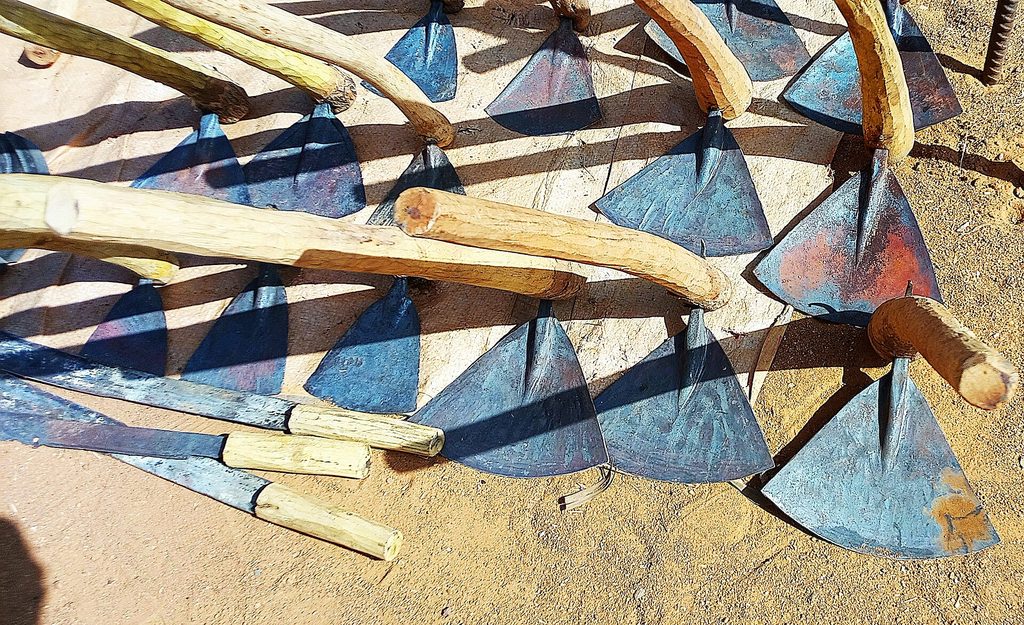
The hoe is an important soil-working and weeding tool. It normally consists of a metal blade attached to a long handle.
It is used for loosening soil, making ridges and mounds, removing weeds and preparing planting areas. The hoe is especially useful when working around crops where large machinery cannot easily be used.
3. Shovel
A shovel has a broad blade attached to a handle and is mainly used for digging and moving loose materials.
It can be used to move soil, sand, compost, manure and other materials around the farm. Shovels are also useful when filling containers, preparing planting beds and carrying out construction-related farm activities.
4. Rake
A rake has a row of teeth attached to a handle. It is mainly used for gathering and levelling materials.
Farmers and gardeners use rakes to collect leaves, grass and other plant materials. They can also be used to level loose soil and prepare a relatively even surface before planting.
5. Wheelbarrow
A wheelbarrow is a small manually operated transport tool with a container, one or more wheels and handles. It helps reduce the effort needed to move materials over short distances.
It can be used for transporting soil, manure, compost, harvested crops, tools and other farm materials. Proper loading is important because an overloaded wheelbarrow can be difficult to control.
6. Watering Can
A watering can is a portable container used to supply water to plants. Many watering cans have a nozzle that helps distribute water over a wider area.
It is particularly useful for seedlings, nursery beds, vegetable gardens and other small areas where water needs to be applied by hand. Gentle watering can help reduce disturbance of young plants and loose soil.
7. Spade
A spade has a strong, usually flat metal blade and a handle. It is mainly used for digging, turning and moving soil.
It can be used to prepare planting beds, dig holes, cut through soil and transfer loose soil from one place to another. A spade is particularly useful for jobs that require a firm, controlled digging action.
8. Garden Trowel
A garden trowel is a small hand tool with a narrow metal blade. It is designed for light digging and planting work.
It is useful when transplanting seedlings, making small planting holes, loosening soil around plants and removing small weeds. Its small size makes it suitable for gardens, nurseries and confined planting areas.
9. Pickaxe
A pickaxe is a strong tool used for breaking hard or compacted ground. It usually has a metal head with pointed and flattened ends attached to a handle.
It can be used where ordinary digging tools have difficulty penetrating hard soil. It is also useful for breaking compacted ground and carrying out certain land-preparation tasks.
10. Sickle
A sickle is a hand-held cutting tool with a curved blade. It is commonly associated with harvesting and cutting grasses or suitable crops.
Its curved blade allows the user to cut plant stems close to the ground or at the required point. The exact crops for which a sickle is appropriate depend on the farming activity and local practice.
11. Secateurs
Secateurs are hand-operated cutting tools designed mainly for pruning and cutting small branches or stems.
They are useful for maintaining fruit trees, ornamental plants and other crops that require controlled pruning. Keeping the blades clean and properly maintained helps the tool work effectively.
12. Knapsack Sprayer
A knapsack sprayer is a portable sprayer designed to be carried on the back. It is used to apply approved agricultural products to crops.
Because some products applied with sprayers can be hazardous, users should follow the product label and applicable safety guidance, use appropriate protective equipment and wash their hands after handling such products. Spraying should also be carried out in a way that avoids exposing people, animals or unintended areas.
13. Hand Weeder
A hand weeder is a small tool designed for removing weeds manually, especially around growing crops.
It is useful in gardens and crop beds where weeds need to be removed without disturbing nearby plants. Different designs may have pointed, hooked or narrow working ends.
14. Measuring Tape
A measuring tape is used to measure distances and dimensions. Although it is not a cutting or digging tool, it is useful in farm planning and practical agricultural work.
It can help farmers and students measure plot dimensions, planting distances, rows, structures and other farm areas where accurate measurements are needed.
15. Digging Fork
A digging fork has several strong metal tines attached to a handle. It is used for loosening and turning soil and handling certain organic materials.
It can be useful for working with compost and manure and for breaking up or turning loose soil. Its tines can also make it useful where a solid-bladed tool would be less suitable.
16. Head Pan
A head pan is a shallow container commonly used for carrying materials. It can be useful on farms and during other manual work.
Farmers may use it to carry soil, manure, sand, harvested produce and other materials. Its usefulness is mainly in transporting materials from one location to another.
Other Important Farm Tools
Some tools are less involved in everyday crop production but remain useful in farm maintenance and supporting activities.
Axe: An axe is used for cutting suitable woody materials, branches and wood. The type of axe determines the work it is best suited for.
File: A file is mainly used to maintain or sharpen suitable metal edges and surfaces. It can therefore help farmers keep certain tools in usable condition.
Hammer: A hammer is useful for driving nails, joining wooden materials and carrying out repair or construction work on farm structures.
These tools show that farm work involves more than planting and harvesting. Farmers may also need tools for transporting materials, constructing structures and maintaining other equipment.
How to Care for Simple Farm Tools
Proper care helps farm tools remain useful and reduces unnecessary damage. Some important practices include:
- Clean tools after use to remove soil, plant materials and other dirt.
- Dry metal parts before storage to reduce rust.
- Keep cutting tools properly protected when they are not being used.
- Store tools in a dry and suitable place.
- Inspect handles regularly for cracks, looseness or damage.
- Repair or replace damaged parts where necessary.
- Keep tools organised so that they can be found easily.
- Use each tool for the work it was designed to perform.
For tools used with agricultural chemicals, cleaning and disposal should follow the product label and applicable safety instructions.
Importance of Simple Farm Tools
Simple farm tools are important because they make many agricultural activities easier to carry out manually. They are useful in soil preparation, planting, weeding, watering, harvesting, transportation and maintenance.
They are also important for agricultural education because students can learn practical farming skills by identifying and using appropriate tools. When properly selected and maintained, simple tools can help reduce unnecessary effort and improve the organisation of farm activities.
Simple Farm Tools and Farm Machinery
Simple farm tools and farm machinery are not the same. Simple farm tools are generally operated by hand and have relatively simple designs, while farm machinery normally uses engines, motors or other mechanical power systems.
For example, a hoe is a simple hand tool, while a tractor is farm machinery. A watering can is operated manually, whereas some modern irrigation systems use pumps and other powered equipment.
The choice between manual tools and machinery depends on factors such as the size of the farm, available resources, type of operation and local conditions.
Common Mistakes to Avoid
Students sometimes confuse the function of a tool with its use. The function describes the main job a tool is designed to perform, while the use gives a practical example of how that tool is applied.
Another common mistake is assuming that every tool can perform every type of farm operation. For example, a garden trowel is useful for small planting tasks but is not a substitute for a heavy soil-working tool.
It is also important not to ignore maintenance. A tool that is dirty, rusty, damaged or poorly stored may become less effective and may be more difficult or unsafe to use.
Summary – Simple Farm Tools
Simple farm tools are basic manually operated tools used for different agricultural activities. Common examples include the cutlass, hoe, shovel, rake, wheelbarrow, watering can, spade, trowel, pickaxe, sickle, axe and secateurs.
Each tool has a particular function and should be selected according to the task being performed. Proper cleaning, maintenance and storage help extend the useful life of farm tools. Some tools, such as files and hammers, are mainly used for farm maintenance and workshop activities rather than direct field operations.
Revision Questions On common Simple Farm Tools
- What are simple farm tools?
- State three uses of a hoe.
- Mention five simple farm tools and give one function of each.
- Explain two ways of caring for simple farm tools.
- State two differences between simple farm tools and farm machinery.
Frequently Asked Questions on Simple Farm Tools
1. What are simple farm tools?
Simple farm tools are manually operated tools used to perform different agricultural activities such as digging, clearing, weeding, planting, harvesting and transporting materials.
2. What is the most common farm tool?
The tools commonly used depend on the type of farming activity and local practice. Tools such as cutlasses, hoes and watering cans are widely used for different manual farm operations.
3. What is the function of a hoe?
A hoe is mainly used for loosening soil, weeding and preparing soil for planting.
4. What is the use of a wheelbarrow on the farm?
A wheelbarrow is used to transport materials such as soil, manure, compost, tools and harvested crops.
5. How should farm tools be maintained?
Farm tools should be cleaned after use, dried properly, checked for damage, repaired when necessary and stored in a dry and suitable place.
Related Articles
Pingback: Sources of Farm Power: Types, Examples and Uses - EbisLearn