Enzymes in Biology: Enzymes are very important biological substances that control almost all chemical reactions that take place inside living organisms. Without enzymes, most reactions in the body would happen too slowly to support life. For example, digestion of food, breathing processes, and even movement depend on enzyme activity. Enzymes make these reactions faster and more efficient without being used up in the process.
Definition of Enzymes in Biology
Enzymes are biological catalysts, usually proteins, that speed up chemical reactions in living cells without being permanently changed or destroyed.
This means enzymes help reactions occur quickly, but after the reaction, the enzyme remains the same and can be reused again.
Characteristics of Enzymes in Biology
Enzymes have unique features that make them different from ordinary chemical substances.
- They are proteins: Most enzymes are made up of proteins, which are built from amino acids.
- They are specific: Each enzyme works on a particular substance called a substrate.
- They are reusable: Enzymes are not used up during reactions and can be used repeatedly.
- They are sensitive to conditions: Changes in temperature, pH, and other factors can affect how enzymes work.
- They speed up reactions: Enzymes reduce the activation energy needed for a reaction to occur.
Structure of Enzymes in Biology
Enzymes have a special three-dimensional shape that is very important for their function. Each enzyme has a region called the active site, where the substrate binds.
The shape of the active site is specific to the substrate, which means only the correct substrate can fit into it. This is often explained using the lock and key model or the induced fit model.
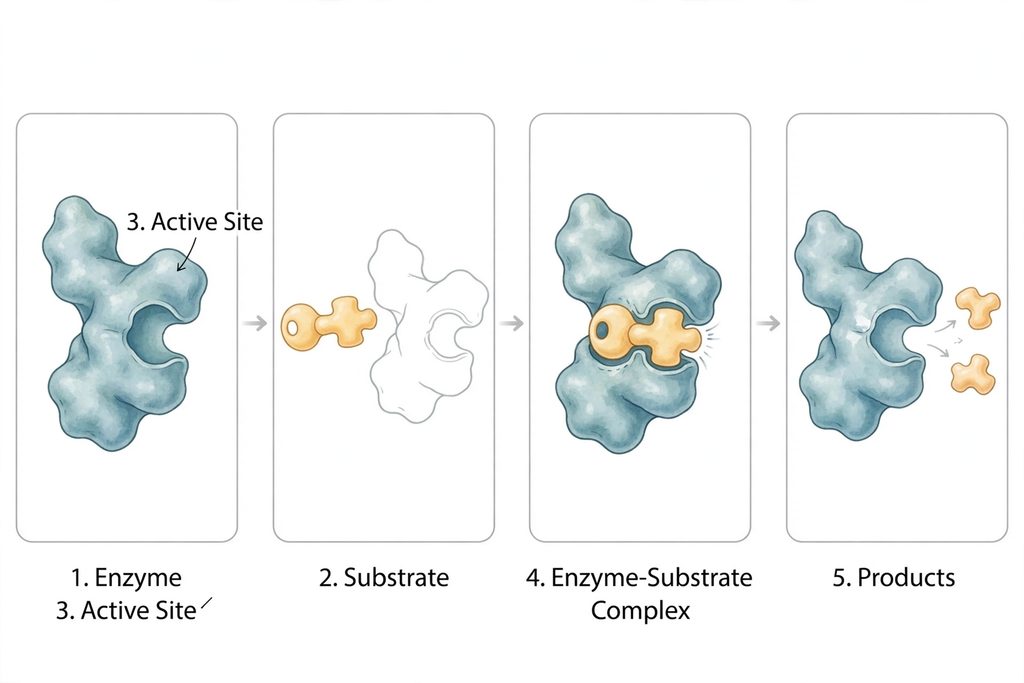
- Active site: The part of the enzyme where the reaction occurs.
- Substrate: The substance that the enzyme acts upon.
- Enzyme-substrate complex: A temporary structure formed when the enzyme binds to the substrate.
Functions of Enzymes in Biology
Enzymes perform many important roles in living organisms. They help maintain life by controlling different biological processes.
- Digestion of food: Enzymes break down large food molecules into smaller ones that can be absorbed. For example, amylase breaks down starch into sugars.
- Energy production: Enzymes are involved in respiration, helping cells release energy from food.
- Building molecules: Enzymes help in synthesizing important compounds like proteins and DNA.
- Detoxification: Some enzymes help break down harmful substances in the body.
- Regulation of metabolism: Enzymes control the speed of metabolic reactions to maintain balance in the body.
Types of Enzymes in Biology
Enzymes can be grouped based on where they work and what they do in the body.
Digestive Enzymes
Digestive enzymes help to break down food into smaller substances that the body can absorb. They are produced in parts of the digestive system like the mouth, stomach, and pancreas.
For example, amylase breaks down starch into simple sugars, protease breaks proteins into amino acids, and lipase breaks fats into fatty acids and glycerol. These enzymes are very important because without them, food cannot be properly digested or used by the body.
Metabolic Enzymes
Metabolic enzymes control chemical reactions that take place inside the cells. These reactions include processes like respiration, where energy is released, and synthesis, where new substances like proteins are formed.
These enzymes ensure that all body processes happen at the right speed. Without metabolic enzymes, cells would not be able to function or survive.
Intracellular Enzymes
Intracellular enzymes are enzymes that work inside the cell. They carry out important reactions within the cytoplasm and organelles of the cell.
These enzymes help in processes like energy production, cell repair, and growth. They ensure that activities inside the cell are well controlled and efficient.
Extracellular Enzymes
Extracellular enzymes are produced inside cells but function outside the cell. A common example is digestive enzymes that are released into the digestive tract.
These enzymes break down large molecules into smaller ones before they enter the cells. This makes it easier for the body to absorb nutrients.
Mechanism of Enzyme Action
The mechanism of enzyme action explains how enzymes carry out reactions in a step-by-step manner. This process shows why enzymes are fast, efficient, and highly specific in their work.
Step 1: Binding of Substrate
The process begins when the enzyme comes into contact with its specific substrate. The substrate binds to a special region of the enzyme called the active site.
This binding is not random. It happens because the shape of the substrate matches the shape of the active site. When they fit together, an enzyme-substrate complex is formed.
This step is very important because it ensures that only the correct substrate can interact with the enzyme, preventing unwanted reactions in the body.
Step 2: Reaction Takes Place
After the enzyme-substrate complex is formed, the enzyme helps to speed up the reaction. It does this by lowering the activation energy, which is the minimum energy needed for a reaction to occur.
The enzyme may break bonds in the substrate or help new bonds to form. During this stage, the substrate is gradually converted into one or more products.
Because the enzyme reduces the energy required, the reaction happens much faster than it would without the enzyme.
Step 3: Release of Products
Once the reaction is complete, the products no longer fit perfectly into the active site. As a result, they are released from the enzyme.
The enzyme itself is not changed or used up during the reaction. It remains in its original form and is ready to bind with another substrate and repeat the same process many times.
This ability to be reused makes enzymes very efficient in biological systems.
Models Explaining Enzyme Action
Lock and Key Model
This model suggests that the active site of the enzyme has a fixed shape, and only a substrate with the exact matching shape can fit into it. Just like a key fits into a specific lock, only the correct substrate can bind to the enzyme.
Induced Fit Model
This model explains that the active site is not completely rigid. When the substrate approaches, the enzyme changes its shape slightly to fit the substrate more closely.
This adjustment makes the reaction more effective and ensures a tighter binding between the enzyme and the substrate. It also helps to explain why enzymes are both specific and flexible in their action.
Examples of Enzymes and Their Functions
Different enzymes perform specific functions in the body, and each one is adapted to work on a particular type of substrate. These examples help to show how enzymes support everyday life processes.
Amylase
Amylase is an enzyme that breaks down starch into simpler sugars such as maltose. It is present in saliva and begins digestion right in the mouth.
When food containing starch is chewed for some time, it may start to taste slightly sweet because amylase is already acting on it. This early stage of digestion helps reduce the work that will later be done in the stomach and intestines.
Protease
Protease is responsible for breaking down proteins into amino acids. It is mainly active in the stomach and small intestine.
Proteins are large and complex molecules, so they must be broken down into smaller units before the body can use them. The amino acids produced are then absorbed and used for growth, repair of tissues, and production of important substances like enzymes and hormones.
Lipase
Lipase breaks down fats into fatty acids and glycerol. It is produced by the pancreas and works in the small intestine.
Fats are an important source of energy, but they cannot be absorbed in their large form. Lipase helps to convert them into smaller molecules that can pass through the intestinal walls and be used by the body.
Catalase
Catalase is an enzyme found in many living cells. Its function is to break down hydrogen peroxide into water and oxygen.
Hydrogen peroxide is a harmful by-product of some chemical reactions in the body. If it accumulates, it can damage cells. Catalase acts quickly to remove this substance, protecting the body and maintaining a safe internal environment.
Enzyme Specificity
Enzyme specificity means that each enzyme works on only one specific substrate or a group of similar substrates.
This happens because the active site of the enzyme has a unique shape. Only a substrate with a matching shape can fit into it. If the shape does not match, the enzyme cannot work on that substrate.
This property is very important because it ensures that only the correct reactions take place in the body. It prevents confusion between different chemical processes and keeps everything well organized.
It also allows many different reactions to occur at the same time without interfering with each other, since each enzyme works independently with its own substrate.
Industrial Uses of Enzymes
Enzymes are widely used in industries because they make processes faster and more efficient.
Food Industry
In the food industry, enzymes are used in baking, brewing, and cheese production. They help improve the taste, texture, and quality of food. For example, enzymes help dough rise and assist in fermentation.
Textile Industry
In the textile industry, enzymes are used to treat fabrics. They help remove impurities, soften materials, and improve the appearance of clothes. This makes fabrics smoother and better in quality.
Pharmaceutical Industry
In medicine, enzymes are used for diagnosing and treating diseases. They are also used in the production of drugs. Enzymes help break down harmful substances in the body.
Detergent Industry
Enzymes are used in detergents to remove stains such as fats and proteins. They make cleaning more effective, even at lower temperatures.
Factors Affecting Enzyme Activity
1. Temperature
Temperature has a strong effect on enzyme activity. As temperature increases, enzyme activity also increases because molecules move faster and collide more often. However, if the temperature becomes too high, the enzyme structure gets damaged (denatured), and it stops working.
- Low temperature → slow enzyme activity
- Optimum temperature → maximum activity
- High temperature → enzyme denatures and stops working
2. pH (Acidity or Alkalinity)
Each enzyme works best at a specific pH level known as the optimum pH. If the pH changes too much, the enzyme’s structure can change, affecting its activity.
For example, enzymes in the stomach work best in acidic conditions, while others in the intestine prefer neutral or alkaline conditions.
- Low or high pH → reduced activity
- Optimum pH → best performance
- Extreme pH → enzyme denatured
3. Substrate Concentration
The amount of substrate available can affect how fast an enzyme works. When substrate concentration increases, enzyme activity also increases because more enzyme-substrate complexes are formed.
However, after a certain point, all enzyme active sites become occupied, and increasing substrate will no longer increase the rate.
- Low substrate → slow reaction
- High substrate → faster reaction (until saturation)
4. Enzyme Concentration
Increasing the amount of enzyme increases the rate of reaction, as long as there is enough substrate available. More enzymes mean more active sites for reactions to occur.
- More enzyme → faster reaction
- Limited substrate → no further increase
5. Inhibitors
Inhibitors are substances that reduce or stop enzyme activity. They can block the active site or change the enzyme’s shape.
- Competitive inhibitors → compete with substrate for active site
- Non-competitive inhibitors → change enzyme shape
Importance of Enzymes In Biology
Enzymes are essential for life because they make biochemical reactions fast enough to sustain living organisms.
- They speed up digestion and nutrient absorption
- They help in energy release during respiration
- They support growth and repair of tissues
- They regulate body processes efficiently
- They are used in industries like food production and medicine
Problems Associated with Enzymes
When enzymes do not function properly, it can lead to serious health and biological problems.
- Enzyme deficiency: Lack of certain enzymes can cause diseases (e.g., inability to digest certain foods).
- Denaturation: High temperature or extreme pH can destroy enzymes.
- Genetic disorders: Some people inherit faulty enzymes.
- Toxic substances: Some chemicals can inhibit enzyme activity and disrupt body processes.
Care and Maintenance of Enzyme Activity
Maintaining proper enzyme function is important for health and biological systems.
- Maintain normal body temperature
- Eat a balanced diet to supply nutrients needed for enzyme production
- Avoid harmful chemicals and toxins
- Maintain proper pH balance in the body
- Store enzyme-containing products properly (in industries and labs)
Applications of Enzymes in Biology
Enzymes in Biology are widely used in everyday life and industries.
- Food industry: Used in baking, brewing, and cheese production
- Medicine: Used in diagnosis and treatment of diseases
- Detergents: Help remove stains from clothes
- Agriculture: Improve soil fertility and crop production
- Biotechnology: Used in genetic engineering and research
Summary on Enzymes
Enzymes are biological catalysts that speed up chemical reactions in living organisms. They are specific, reusable, and sensitive to environmental conditions like temperature and pH. Enzymes play essential roles in digestion, respiration, and metabolism. Their activity is affected by factors such as substrate concentration and inhibitors. Proper functioning of enzymes is necessary for good health, and they also have many practical uses in industries and medicine.
Revision Questions
- What are enzymes in biology, and why are they important in living organisms?
- State and explain five characteristics of enzymes.
- Describe the mechanism of enzyme action, including the formation of the enzyme-substrate complex.
- Explain five factors that can affect enzyme activity.
- Differentiate between intracellular and extracellular enzymes, giving an example of each.
- Describe the functions of amylase, protease, lipase, and catalase.
Frequently Asked Questions (FAQs)
1. What is an enzyme?
An enzyme is a biological catalyst that speeds up chemical reactions in living organisms without being permanently changed or used up during the reaction.
2. Why are enzymes important in the body?
Enzymes make important chemical reactions happen fast enough to support life. They are involved in digestion, respiration, energy production, growth, repair, and many other processes.
3. What are the main types of enzymes in Biology?
Enzymes can be grouped in different ways. Common groups include digestive enzymes, metabolic enzymes, intracellular enzymes, and extracellular enzymes, based on their functions and where they work.
4. What is an active site?
The active site is the specific part of an enzyme where its substrate binds. Its shape allows the enzyme to recognize and interact with the correct substrate.
5. What happens when an enzyme is exposed to very high temperatures?
Very high temperatures can change the shape of an enzyme’s active site. This process is called denaturation, and it can prevent the enzyme from working properly.
6. What is enzyme specificity?
Enzyme specificity is the ability of an enzyme to act on a particular substrate or a group of closely related substrates. It occurs because the active site has a specific shape.
7. Can enzymes be used more than once?
Yes. Enzymes are not normally used up during the reactions they catalyse. After releasing the products, an enzyme can bind to another substrate and carry out the reaction again.
Related Articles
How do I will fine another subject in your page
You can easily search.. or scroll down to other articles