Farm animals are very important in agriculture because they provide food, income, labour and other useful products. Animals such as cattle, goats, sheep, pigs, chickens, rabbits and fish are kept by farmers for different purposes. Some are raised mainly for meat, some for milk or eggs, while others may provide labour, manure or raw materials. Understanding the classification of farm animals helps students to recognise the major groups of farm animals and understand why different animals have different feeding, management and production needs.
Farm animals are not all the same. They differ in their feeding habits, digestive systems, habitats, uses and methods of reproduction. For this reason, farmers and students can classify them in different ways depending on the feature being considered. A single animal can also belong to more than one group. For example, cattle are herbivores because they feed mainly on plants, ruminants because they chew cud, terrestrial animals because they live mainly on land, and dairy or meat animals depending on the purpose for which they are kept.
About This Lesson
This lesson explains the meaning of farm animals and the major ways in which they are classified. It covers classification according to feeding habit, digestive system, habitat, purpose or use, and reproduction. The lesson also discusses the importance of farm animals, their basic care and management, and some common problems that affect animal production.
Learning Objectives
At the end of this lesson, you should be able to:
- explain the meaning of farm animals;
- give examples of common farm animals;
- explain the major ways farm animals are classified;
- distinguish between herbivores, carnivores and omnivores;
- differentiate between ruminant and non-ruminant animals;
- explain terrestrial and aquatic farm animals;
- classify farm animals according to their uses;
- distinguish between oviparous and viviparous animals;
- state the importance of farm animals; and
- explain basic methods of caring for farm animals.
Meaning of Farm Animals
Farm animals are animals that are kept and managed by humans for useful purposes. They are commonly raised to provide food, income, labour, breeding stock and materials that can be used by people. The type of animal kept on a farm usually depends on the farmer’s purpose, available resources, climate, land, market and level of farming.
Examples of farm animals include cattle, goats, sheep, pigs, chickens, turkeys, ducks, rabbits and fish. Some farmers keep only one type of animal, such as poultry or cattle, while others keep several types of animals. Animals may also be raised on a small scale around the home or on large commercial farms where hundreds or thousands of animals are managed for production.
Common Examples of Farm Animals
There are many types of farm animals, and each has characteristics that make it suitable for particular purposes. Cattle are commonly raised for meat and milk, while oxen may also be used for farm work in some farming systems. Goats and sheep are mainly kept for meat, although goats can also provide milk and some sheep breeds are valued for wool. Pigs are mainly raised for meat and are able to make use of a variety of feeds.
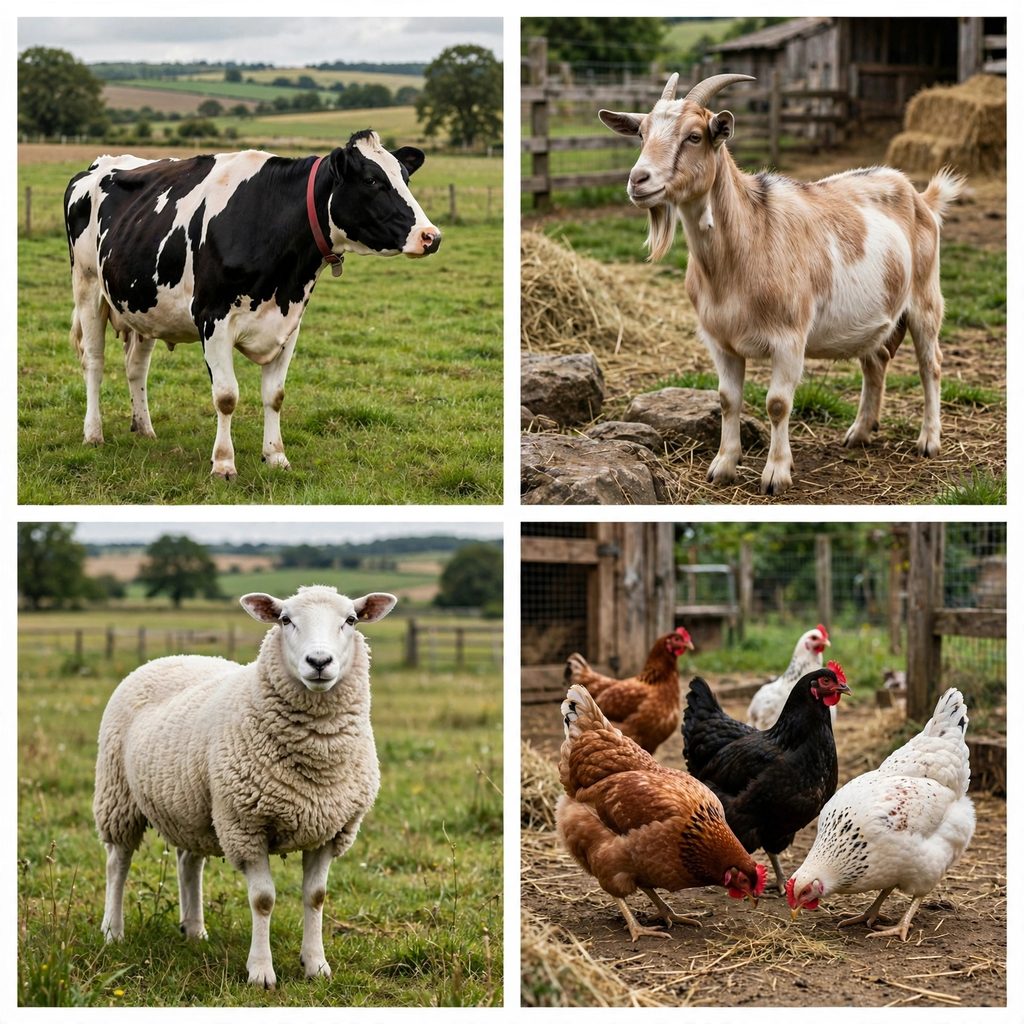
Poultry birds such as chickens, turkeys and ducks are widely kept for meat and eggs. Rabbits are commonly raised for meat and breeding, while fish such as catfish and tilapia are produced in fish farms for food and income. These examples show that farm animals are diverse, and their value depends partly on the way farmers manage and use them.
Classification of Farm Animals
Farm animals can be classified in several ways. The major methods include classification according to feeding habit, digestive system, habitat, purpose or use, and reproduction. These methods are useful because they help farmers understand the characteristics and needs of different animals.
Classification Based on Feeding Habit
When farm animals are classified according to feeding habit, they are grouped by the type of food they normally eat. Herbivores are animals that feed mainly on plants such as grasses, leaves and other plant materials. Cattle, sheep and goats are common examples. These animals are important in livestock farming because many of them can make good use of pasture and other roughages.
Carnivores are animals that mainly feed on the flesh of other animals. Carnivores are not commonly kept as livestock for food production, but some meat-eating animals may be found around farms for particular purposes. For example, dogs may be kept on farms mainly for guarding and security, although they are not normally regarded as livestock like cattle, sheep or goats. Omnivores, on the other hand, can feed on both plant and animal materials. Pigs and poultry such as chickens are examples of farm animals with omnivorous feeding habits.
Classification Based on Digestive System
The digestive system is another important basis for the classification of farm animals. Ruminants are animals that chew cud and have a specialised stomach with four compartments: the rumen, reticulum, omasum and abomasum. This digestive system enables them to make good use of fibrous plant materials such as grasses and other roughages. Cattle, sheep and goats are common examples of ruminant farm animals.
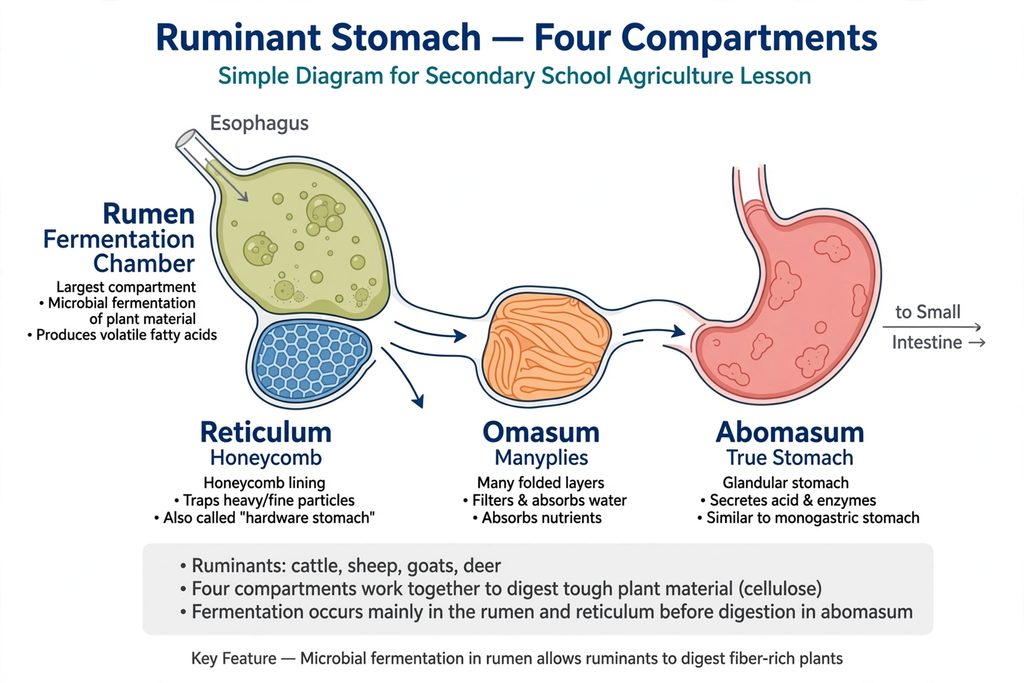
Non-ruminants have a relatively simple stomach and do not chew cud like ruminants. Pigs and poultry are common examples. Rabbits are also non-ruminants, but their digestive system has a special adaptation known as hindgut fermentation, which allows them to obtain nutrients from fibrous plant materials. Therefore, rabbits should not simply be treated as being exactly the same as pigs or chickens when discussing digestion.
Classification Based on Habitat
Farm animals can also be classified according to where they normally live. Terrestrial animals are animals that live mainly on land. Most of the common livestock kept by farmers fall into this group, including cattle, goats, sheep, pigs and poultry. These animals require suitable land-based housing, feeding areas and protection from weather conditions and other dangers.
Aquatic animals live mainly in water and are produced through aquaculture or fish farming. Fish such as catfish and tilapia are common examples. Aquatic farming requires suitable water conditions, proper feeding and good management because the quality of the water can directly affect the health and growth of the animals.
Classification Based on Purpose or Use
Farm animals can also be classified according to the main purpose for which they are kept. Meat animals are raised mainly for meat production, with cattle, goats, sheep and pigs being common examples. Dairy animals are kept mainly for milk production, with cattle and goats being important examples. Egg-producing animals include poultry birds such as chickens and ducks that are kept mainly for the production of eggs.
Some animals are classified as work or draught animals because they can be used for farm work and transportation. Oxen and donkeys are examples, particularly in farming systems where machinery is limited or expensive. Some animals are also valued for fibres or other materials. For example, sheep of suitable breeds can provide wool, while cattle and other livestock can provide hides and skins. It is important to remember that one animal can serve more than one purpose. Cattle, for example, may provide milk, meat, manure and, in some farming systems, labour.
Classification Based on Reproduction
Farm animals can also be grouped according to how they produce their young. Viviparous animals give birth to live young. The developing young usually grows inside the mother’s body before birth. Common examples among farm animals include cattle, goats, sheep, pigs and rabbits.
Oviparous animals lay eggs, and the developing young grows inside the egg outside the mother’s body. Chickens, ducks and turkeys are common examples. This difference is particularly useful when studying livestock reproduction because mammals commonly kept on farms are generally viviparous, while poultry birds are oviparous.
Summary of the Classification of Farm Animals
| Basis | Groups | Examples |
|---|---|---|
| Feeding habit | Herbivores | Cattle, sheep, goats |
| Feeding habit | Carnivores | Dogs |
| Feeding habit | Omnivores | Pigs, poultry |
| Digestive system | Ruminants | Cattle, sheep, goats |
| Digestive system | Non-ruminants | Pigs, poultry, rabbits |
| Habitat | Terrestrial animals | Cattle, goats, sheep |
| Habitat | Aquatic animals | Catfish, tilapia |
| Purpose or use | Meat animals | Cattle, goats, pigs |
| Purpose or use | Dairy animals | Cattle, goats |
| Purpose or use | Egg-producing animals | Chickens, ducks |
| Purpose or use | Work animals | Oxen, donkeys |
| Reproduction | Viviparous animals | Cattle, goats, sheep |
| Reproduction | Oviparous animals | Chickens, ducks, turkeys |
Importance of Farm Animals
Farm animals are important because they provide food for people and support the activities of farmers and other workers. Meat, milk and eggs obtained from farm animals are important food products, while the sale of animals and their products provides income for many farming households. A farmer may sell live goats, chickens or cattle, or sell products such as eggs, milk and meat depending on the type of animal production being practised.
Farm animals also provide useful materials. Hides and skins from some livestock can be processed into leather for making items such as shoes, bags and other products. Wool from suitable sheep breeds is used as a fibre, while feathers and other animal materials may also have different uses. The importance of these products varies according to the animal species, breed and production system.
Another important benefit is farm labour. In some farming communities, oxen and donkeys are used for ploughing, carrying loads and transporting agricultural materials. Animal manure is also useful in crop production because properly managed manure can add organic matter and nutrients to the soil. This creates a useful connection between livestock production and crop farming.
Farm animal production also creates employment and supports businesses. Farmers, animal-feed sellers, traders, transporters, processors, veterinary professionals and other workers can all benefit from livestock and fish production. For this reason, farm animals contribute not only to food supply but also to household income and agricultural development.
Care and Management of Farm Animals
Good care and management are necessary if farm animals are to remain healthy and productive. Farmers should provide animals with suitable feed based on their species, age, size and purpose. Clean water should also be available regularly because animals need water for digestion, growth, body temperature regulation and production. Feeding should be properly planned rather than simply giving animals whatever food is available.
Housing is another important part of animal management. Animals should be kept in suitable shelters that protect them from excessive heat, rain, cold and other environmental dangers. The housing should have enough space, proper ventilation and good drainage where necessary. Regular cleaning is important because dirty and overcrowded housing can encourage the spread of diseases and parasites.
Farmers should also pay attention to animal health. Vaccination and other disease-prevention measures should be carried out where appropriate, while sick animals should be identified early and given proper veterinary attention. Parasites should also be controlled because they can reduce growth and production. Good records of feeding, vaccination, treatment, breeding and production can help farmers identify problems and make better management decisions.
Protection is also part of good animal management. Farms should be properly secured against theft and predators, while animals should be handled carefully to reduce unnecessary injuries and stress. When feeding, housing, sanitation, health care and protection are properly managed, animals have a better chance of growing well and producing according to their purpose.
Problems Facing Farm Animal Production
Farm animal production faces several challenges that can make livestock farming difficult and expensive. One major problem is the high cost of feed. Feed can represent a large part of the cost of production, and increases in the prices of grains, concentrates and other feed ingredients can make it difficult for farmers to maintain their animals profitably.
Diseases and parasites are another serious challenge. An outbreak of disease can reduce growth, lower production and, in severe cases, cause the death of animals. Farmers may also have difficulty obtaining veterinary services quickly, especially in areas where veterinary facilities and professionals are limited. Poor housing and inadequate sanitation can make these health problems worse.
Lack of capital can also limit animal production. Farmers need money to purchase animals, construct housing, buy feed, obtain veterinary care and maintain equipment. Theft and attacks by predators may cause additional losses, particularly when farms are poorly secured. Poor management, such as incorrect feeding, overcrowding or failure to maintain proper records, can also reduce productivity.
Weather and environmental conditions may create further problems. Excessive heat, flooding, drought and changes in the availability of feed and water can affect animal health and farm operations. Farmers therefore need to choose suitable production systems and use appropriate management practices to reduce the effects of these challenges.
Why the Classification of Farm Animals Is Important
The classification of farm animals makes it easier to understand the differences between animals and the management practices they require. For example, knowing that cattle, sheep and goats are ruminants helps a farmer understand why these animals can make good use of grasses and other roughages. Knowing that chickens are oviparous also helps students understand why poultry reproduction involves eggs rather than live birth.
Classification is also useful when choosing animals for a particular farming purpose. A farmer who wants to produce milk needs suitable dairy animals, while another farmer interested in egg production needs appropriate poultry birds. Understanding the characteristics of different groups therefore helps farmers make better decisions about feeding, housing, breeding, health care and production.
Conclusion
Farm animals are animals that are kept and managed by humans for food, income, labour, breeding and other useful purposes. They include cattle, goats, sheep, pigs, poultry, rabbits and fish. Because these animals differ in their characteristics and uses, they can be classified according to feeding habit, digestive system, habitat, purpose and reproduction.
A good understanding of the classification of farm animals is important in Agriculture Science because it helps students and farmers understand the needs and characteristics of different animals. It also provides a useful foundation for learning about animal nutrition, breeding, housing, health and general farm management.
Revision Questions
- What are farm animals?
- State six examples of farm animals.
- Explain the classification of farm animals based on feeding habit.
- What are herbivores? Give three examples.
- Differentiate between ruminant and non-ruminant animals.
- State two examples each of terrestrial and aquatic farm animals.
- Explain four ways in which farm animals can be classified.
- Differentiate between oviparous and viviparous animals.
- State five importance of farm animals.
- Mention five problems facing farm animal production.
Frequently Asked Questions
What are farm animals?
Farm animals are animals kept and managed by humans for useful purposes such as food production, income generation, farm work, breeding and the production of useful materials.
What are the main ways of classifying farm animals?
Farm animals can be classified according to feeding habit, digestive system, habitat, purpose or use, and reproduction.
What are examples of ruminant farm animals?
Cattle, sheep and goats are common examples of ruminant farm animals.
What is the difference between oviparous and viviparous animals?
Oviparous animals lay eggs, while viviparous animals give birth to live young.
Are rabbits ruminant animals?
No. Rabbits are non-ruminant animals. However, their digestive system has a special adaptation called hindgut fermentation, which helps them make use of fibrous plant materials.
Which farm animals are commonly used for egg production?
Chickens and ducks are commonly kept for egg production, although other poultry birds can also produce eggs.
Why are farm animals important?
Farm animals provide food, income, manure, raw materials and, in some farming systems, labour. They also support employment and other economic activities.
Related Articles