After learning about elements, the next important concept in chemistry is compounds. Elements are simple substances made from only one type of atom, but compounds are more complex. They are formed when different elements come together and combine in a specific and meaningful way. This process is not random—it follows fixed rules that give compounds their identity and behavior.
Compounds are a major part of everything around us. The water we drink, the air we breathe, the food we eat, and even the medicines we take are all made of compounds. So, understanding compounds is not just for passing exams—it helps you understand real life better. When you understand how compounds form and behave, chemistry becomes easier and more interesting.
Performance Objectives: Compounds in Chemistry
At the end of this lesson, students should be able to:
- Define compound in Chemistry.
- Differentiate between compounds and mixtures.
- State the characteristics / properties of compounds.
- Mention the two major types of compounds with examples.
- Give at least 5 common examples of compounds we see everyday.
- Write the chemical formulae of simple compounds.
What is a Compound?
A compound is a pure substance formed when two or more different elements combine chemically in a fixed ratio. This means the elements are joined together by strong chemical bonds and cannot be separated by simple physical methods.
To understand this clearly:
- A pure substance has the same composition throughout
- It is made up of different elements, meaning more than one type of atom is involved
- The elements are chemically combined, not just mixed
- They combine in a fixed ratio, so the proportion is always the same
Because of this, a compound has its own unique properties, which are usually very different from the elements that formed it.
Examples of Compounds
Water (H₂O)
Water is formed when hydrogen and oxygen combine in a ratio of 2:1. Hydrogen is a gas that burns easily, while oxygen supports burning. However, when they combine, they form water, which is a liquid and is used to put out fire. This shows that the properties of a compound are different from those of its elements.
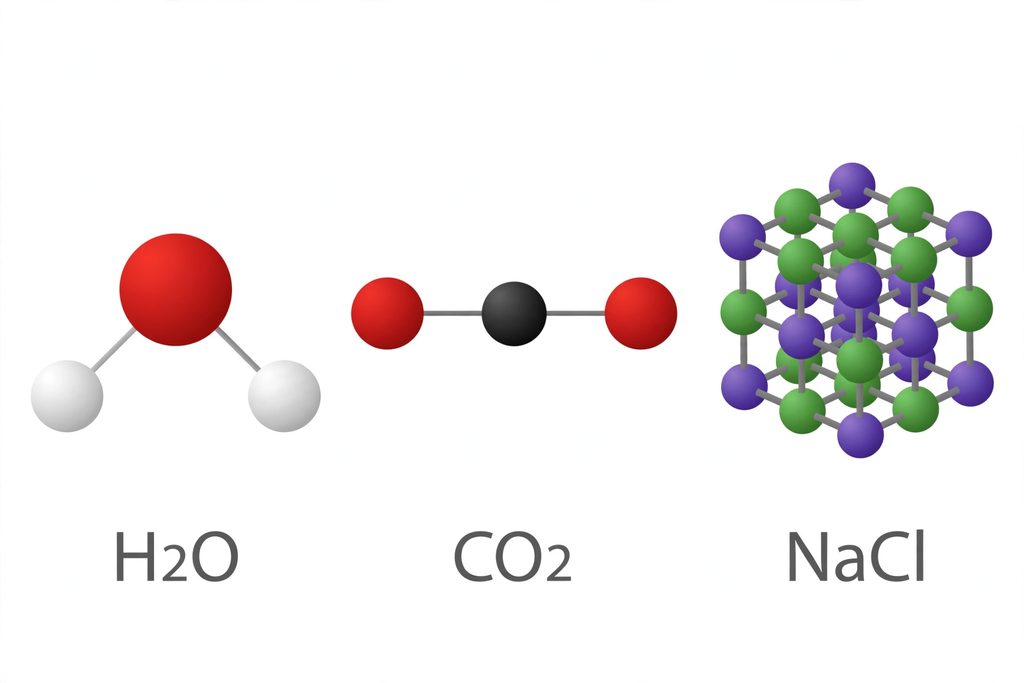
Carbon Dioxide (CO₂)
Carbon dioxide is made from carbon and oxygen. Carbon is a solid, while oxygen is a gas. When combined, they form a gas that is important in nature. Plants use it for photosynthesis, and it is released during breathing and burning.
Sodium Chloride (NaCl)
Sodium chloride is common table salt. Sodium is a highly reactive metal, and chlorine is a poisonous gas. But when they combine, they form a stable compound that is safe to eat and is widely used in cooking and food preservation.
These examples show that compounds have new properties that are completely different from the elements that make them.
Key Features of Compounds in Chemistry
Compounds have specific characteristics that make them different from mixtures and individual elements. These features help us understand how compounds behave and why they are important in chemistry.
Fixed Composition
Compounds always contain the same elements in a fixed ratio. This means the proportion of each element does not change.
For example, water is always H₂O and carbon dioxide is always CO₂. This fixed composition makes compounds consistent, reliable, and easy to study.
Chemical Bonding
In compounds, atoms are held together by strong forces known as chemical bonds. These bonds are formed either by the sharing of electrons (covalent bonding) or by the transfer of electrons (ionic bonding).
Because of these strong bonds, compounds are stable and cannot be easily broken apart.
New Properties
A compound has properties that are completely different from the elements that formed it. This happens because the atoms are rearranged and bonded in a new way.
As a result, the compound behaves differently in terms of physical and chemical properties.
Cannot Be Separated Physically
Compounds cannot be separated by simple physical methods such as filtering, sieving, or using a magnet.
To break a compound into its elements, chemical methods are required. These include processes like electrolysis, heating at high temperatures, or other chemical reactions.
Represented by Chemical Formulas
Every compound is represented by a chemical formula that shows the types and number of atoms present.
For example, H₂O shows that water contains two hydrogen atoms and one oxygen atom, while CO₂ shows one carbon atom and two oxygen atoms. These formulas make it easier to identify and study compounds.
How Are Compounds Formed?
Compounds are formed through chemical reactions. In these reactions, substances change completely to form new substances with different properties.
During a chemical reaction:
- Old bonds between atoms are broken
- New bonds are formed between atoms
- Energy may be released or absorbed
This process involves a real change, not just a simple mixing of substances.
Example Explained
When hydrogen reacts with oxygen, water is formed:
2H₂ + O₂ → 2H₂O
In this reaction, hydrogen and oxygen molecules first break apart into individual atoms. These atoms then rearrange and form new bonds to produce water molecules.
This clearly shows that compounds are formed through chemical changes, where new substances are created with entirely different properties.
Types of Compounds in Chemistry
Compounds can be grouped into different types based on how atoms combine and the kind of elements involved. Understanding these types helps explain their properties and uses.
1. Ionic Compounds
Ionic compounds are formed when electrons are transferred from one atom to another. This usually happens between a metal and a non-metal.
In this process, the metal loses electrons while the non-metal gains electrons. This forms charged particles called ions, which attract each other strongly.
A common example is sodium chloride (NaCl). Sodium gives one electron to chlorine, forming positive and negative ions that bond together.
Properties of Ionic Compounds:
- They have high melting and boiling points
- They are usually solid at room temperature
- They conduct electricity when dissolved in water or in molten form
2. Covalent Compounds
Covalent compounds are formed when atoms share electrons instead of transferring them. This usually occurs between non-metals.
In this type of bonding, atoms share electrons to achieve stability.
Examples include water (H₂O) and methane (CH₄).
Properties of Covalent Compounds:
- They have lower melting and boiling points
- They do not conduct electricity
- They can exist as gases, liquids, or solids
3. Organic Compounds
Organic compounds are compounds that contain carbon and hydrogen. They are very important because they are related to living organisms.
Examples include methane (CH₄), which is used as a fuel, and glucose (C₆H₁₂O₆), which provides energy in the body.
Uses of Organic Compounds:
- Fuels
- Food substances
- Plastics
- Medicines
Organic compounds play a major role in life processes and everyday activities.
4. Inorganic Compounds
Inorganic compounds are those that are not mainly based on carbon-hydrogen bonds. They include a wide range of substances used in daily life and industry.
Examples include water, ammonia, and salt. Water is essential for life, ammonia is used in fertilizers, and salt is used in food.
These compounds are important in industrial processes and many natural activities.
Properties of Compounds in Chemistry
Compounds have specific characteristics that help us understand how they behave. These properties are divided into physical and chemical properties.
Physical Properties
Physical properties are those that can be observed or measured without changing the substance into something new.
Main Physical Properties:
- Melting point:
The temperature at which a solid changes into a liquid
(Example: Ice melts into water) - Boiling point:
The temperature at which a liquid changes into a gas
(Example: Water boils into steam) - Solubility:
The ability of a substance to dissolve in a liquid (usually water)
Examples:
- Salt dissolves in water
- Sand does not dissolve in water
Chemical Properties
Chemical properties describe how a compound changes into a new substance during a chemical reaction.
Main Chemical Properties:
- Ability to burn (combustion)
- Reaction with acids or bases
- Ability to decompose (break down) when heated
Example Explained:
When calcium carbonate is heated, it breaks down into new substances:
Calcium carbonate → Calcium oxide + Carbon dioxide
This shows a chemical change because completely new substances are formed.
Understanding these properties helps scientists and students predict how compounds will behave in different situations.
Examples of Compounds in Real Life (With Context)
Compounds are not just found in laboratories—they are part of everyday life and perform important functions in the environment, our homes, and even inside our bodies. Understanding how these compounds work helps us see their real importance beyond simple definitions.
Water (H₂O)
Water is essential for life. It helps transport nutrients in the body, regulates temperature through sweating, and supports digestion. In industries, it is widely used for cooling machinery and producing steam for power generation.
Carbon Dioxide (CO₂)
Carbon dioxide plays a key role in nature. Plants use it during photosynthesis to make food and release oxygen. It is also responsible for the fizz in soft drinks and is used in fire extinguishers to control fires by reducing oxygen.
Sodium Chloride (NaCl)
Common salt is important for maintaining fluid balance in the body, which supports proper nerve and muscle function. It is also used to preserve food by preventing the growth of bacteria.
Ammonia (NH₃)
Ammonia is widely used in agriculture to produce fertilizers that help crops grow efficiently. It is also found in cleaning products because it can remove grease and tough stains effectively.
Calcium Carbonate (CaCO₃)
This compound occurs naturally in chalk, shells, and limestone. It is used in construction materials like cement and is also added to toothpaste to help clean and strengthen teeth.
Uses of Compounds
Compounds are essential in many areas of life. They are used in medicine, farming, industries, food, and daily hygiene, making modern living possible and more efficient.
Medicine
Compounds are used to create medicines that help treat and prevent diseases. Some compounds kill harmful bacteria, while others reduce pain or control infections. Modern healthcare depends heavily on chemical compounds to improve and save lives.
Agriculture
In farming, compounds play a major role in increasing food production. Fertilizers supply essential nutrients to crops, pesticides protect plants from pests, and soil conditioners improve the quality of soil. These uses help farmers grow healthy and abundant crops.
Industry
Compounds are widely used in industries to manufacture products such as plastics, fuels like petrol and diesel, and various chemicals. Many industrial processes rely on chemical compounds to produce materials used in everyday life.
Food and Nutrition
Food contains many useful compounds that the body needs. Sugars provide energy, salts add flavor and help maintain balance in the body, and vitamins support overall health and proper body functions.
Cleaning and Hygiene
Compounds are important for maintaining cleanliness and health. Soaps and detergents remove dirt and grease, disinfectants kill harmful germs, and toothpaste helps protect teeth and keep the mouth clean.
Challenges in Learning Compounds in Chemistry
Some students find compounds difficult because:
- Chemical formulas look confusing at first
- Bonding concepts require understanding electrons
- Many compounds have similar names
- Writing equations needs practice
- It can be hard to imagine atoms and bonds
- There are many examples to remember
How to Master Compounds
Learning about compounds becomes much easier when you follow a clear and simple approach. Instead of trying to memorize everything at once, focus on understanding the basics and building your knowledge step by step.
Start Simple:
So, try begin with common compounds like water and salt. These are easy to understand and help you build a strong foundation before moving to more complex examples.
Understand Bonding:
Focus on how atoms combine to form compounds. Understanding ionic and covalent bonding will make it easier to understand formulas and reactions instead of just memorizing them.
Practice Regularly:
Write chemical formulas and simple equations often. Regular practice helps improve memory and makes it easier to recognize patterns in compounds.
Use Real-Life Connections:
Relate compounds to things you see every day, like food, cleaning products, or air. This makes learning more interesting and easier to remember.
Break Topics Into Parts:
Study one concept at a time, such as types of compounds, properties, or uses. This prevents confusion and helps you understand each part clearly.
Revise Frequently:
Go over what you have learned regularly. Revision strengthens memory and helps you retain information for a longer time.
Quick Difference: Elements vs Compounds
| Feature | Elements | Compounds |
|---|---|---|
| Composition | One type of atom | Two or more elements |
| Combination | Not combined | Chemically combined |
| Separation | Cannot be broken down | Broken by chemical methods |
| Example | Oxygen (O₂) | Water (H₂O) |
Conclusion on Compounds in Chemistry
Compounds are an essential part of chemistry and everyday life. They are formed when elements combine chemically in fixed ratios, creating new substances with unique properties. From water and food to medicines and industrial materials, compounds are everywhere.
Understanding compounds helps you understand how the world works. With practice and clear explanations, this topic becomes simple and very useful for further learning in chemistry.
Revision Questions
- What is a compound?
- Explain why compounds have fixed composition.
- Give three examples of compounds and explain them.
- What is the difference between ionic and covalent compounds?
- Why can compounds not be separated physically?
- List three uses of compounds in daily life.
- How are compounds formed?
Related Articles