About this Lesson
This lesson explains the 118 elements in the periodic table, their names and symbols, how the elements are classified, and how the periodic table is arranged. It also discusses some general properties and uses of elements and gives simple tips for learning them.
Learning Objectives
At the end of this lesson, you should be able to:
- Explain what a chemical element is.
- State the number of known chemical elements.
- Identify the names and symbols of the 118 elements.
- Explain the meaning of atomic number.
- Describe groups and periods in the periodic table.
- Identify metals, non-metals, metalloids, and noble gases.
- Mention some common uses of important elements.
- Use simple methods to study and remember the elements.
What Is an Element?
An element is a pure substance made up of atoms that all have the same number of protons in their nuclei. The number of protons in an atom is called its atomic number.
For example, every hydrogen atom has one proton, so hydrogen has an atomic number of 1. Carbon has six protons, giving it an atomic number of 6, while oxygen has eight protons and an atomic number of 8.
An element cannot be broken down into a simpler substance by ordinary chemical reactions. Elements can combine with one another to form compounds. For example, hydrogen and oxygen can combine to form water.
Some common examples of elements include:
- Oxygen – needed for respiration and used in several medical and industrial applications.
- Iron – widely used in construction and manufacturing.
- Carbon – an important element in living organisms and many fuels.
- Gold – used in jewellery, electronics, and other applications.
- Silicon – widely used in electronics and computer technology.
Complete List of the 118 Elements in the Periodic Table
The table below contains all 118 officially recognized chemical elements and their symbols.
| Element | Symbol |
|---|---|
| Hydrogen | H |
| Helium | He |
| Lithium | Li |
| Beryllium | Be |
| Boron | B |
| Carbon | C |
| Nitrogen | N |
| Oxygen | O |
| Fluorine | F |
| Neon | Ne |
| Sodium | Na |
| Magnesium | Mg |
| Aluminium | Al |
| Silicon | Si |
| Phosphorus | P |
| Sulfur | S |
| Chlorine | Cl |
| Argon | Ar |
| Potassium | K |
| Calcium | Ca |
| Scandium | Sc |
| Titanium | Ti |
| Vanadium | V |
| Chromium | Cr |
| Manganese | Mn |
| Iron | Fe |
| Cobalt | Co |
| Nickel | Ni |
| Copper | Cu |
| Zinc | Zn |
| Gallium | Ga |
| Germanium | Ge |
| Arsenic | As |
| Selenium | Se |
| Bromine | Br |
| Krypton | Kr |
| Rubidium | Rb |
| Strontium | Sr |
| Yttrium | Y |
| Zirconium | Zr |
| Niobium | Nb |
| Molybdenum | Mo |
| Technetium | Tc |
| Ruthenium | Ru |
| Rhodium | Rh |
| Palladium | Pd |
| Silver | Ag |
| Cadmium | Cd |
| Indium | In |
| Tin | Sn |
| Antimony | Sb |
| Tellurium | Te |
| Iodine | I |
| Xenon | Xe |
| Caesium | Cs |
| Barium | Ba |
| Lanthanum | La |
| Cerium | Ce |
| Praseodymium | Pr |
| Neodymium | Nd |
| Promethium | Pm |
| Samarium | Sm |
| Europium | Eu |
| Gadolinium | Gd |
| Terbium | Tb |
| Dysprosium | Dy |
| Holmium | Ho |
| Erbium | Er |
| Thulium | Tm |
| Ytterbium | Yb |
| Lutetium | Lu |
| Hafnium | Hf |
| Tantalum | Ta |
| Tungsten | W |
| Rhenium | Re |
| Osmium | Os |
| Iridium | Ir |
| Platinum | Pt |
| Gold | Au |
| Mercury | Hg |
| Thallium | Tl |
| Lead | Pb |
| Bismuth | Bi |
| Polonium | Po |
| Astatine | At |
| Radon | Rn |
| Francium | Fr |
| Radium | Ra |
| Actinium | Ac |
| Thorium | Th |
| Protactinium | Pa |
| Uranium | U |
| Neptunium | Np |
| Plutonium | Pu |
| Americium | Am |
| Curium | Cm |
| Berkelium | Bk |
| Californium | Cf |
| Einsteinium | Es |
| Fermium | Fm |
| Mendelevium | Md |
| Nobelium | No |
| Lawrencium | Lr |
| Rutherfordium | Rf |
| Dubnium | Db |
| Seaborgium | Sg |
| Bohrium | Bh |
| Hassium | Hs |
| Meitnerium | Mt |
| Darmstadtium | Ds |
| Roentgenium | Rg |
| Copernicium | Cn |
| Nihonium | Nh |
| Flerovium | Fl |
| Moscovium | Mc |
| Livermorium | Lv |
| Tennessine | Ts |
| Oganesson | Og |
What Do the Symbols of Elements Mean?
An element symbol is a short way of writing the name of an element. Most symbols contain one or two letters. The first letter is always written as a capital letter, while the second letter, when present, is written in lowercase.
For example:
- Hydrogen = H
- Helium = He
- Carbon = C
- Oxygen = O
- Sodium = Na
- Calcium = Ca
- Chlorine = Cl
Some symbols do not appear to match the English name of the element because they come from older or Latin names. For example, sodium has the symbol Na, from the Latin name natrium, while potassium has the symbol K, from kalium. Iron has the symbol Fe, from the Latin word ferrum, and gold has the symbol Au, from aurum.
Classification of the 118 Elements
The elements can be broadly classified into metals, non-metals, and metalloids. Other important categories, such as noble gases, alkali metals, alkaline earth metals, halogens, transition metals, lanthanides, and actinides, are also used when studying the periodic table.
Metals
Most elements in the periodic table are metals. Many metals are shiny, strong, and good conductors of heat and electricity. However, their properties are not all exactly the same.
Examples of metals include iron, copper, aluminium, silver, gold, zinc, and calcium.
Metals are used in buildings, vehicles, electrical equipment, machines, cooking materials, tools, and many other products.
Non-metals
Non-metals generally have properties that are different from metals. Many are poor conductors of heat and electricity, although there are exceptions. Non-metals may occur as solids, liquids, or gases at room temperature.
Examples include hydrogen, carbon, nitrogen, oxygen, sulfur, chlorine, and phosphorus.
Metalloids
Metalloids have some properties that are similar to metals and some that are similar to non-metals. Their ability to conduct electricity in a controlled way makes some of them particularly useful in electronics.
Examples include boron, silicon, germanium, arsenic, antimony, and tellurium.
Noble Gases
Noble gases are found in Group 18 of the periodic table. They are generally very unreactive because their outer electron shells are stable.
The noble gases include helium, neon, argon, krypton, xenon, radon, and oganesson.
Helium is used in balloons, while neon and other noble gases have applications in lighting and other specialized areas.
Groups and Periods in the Periodic Table
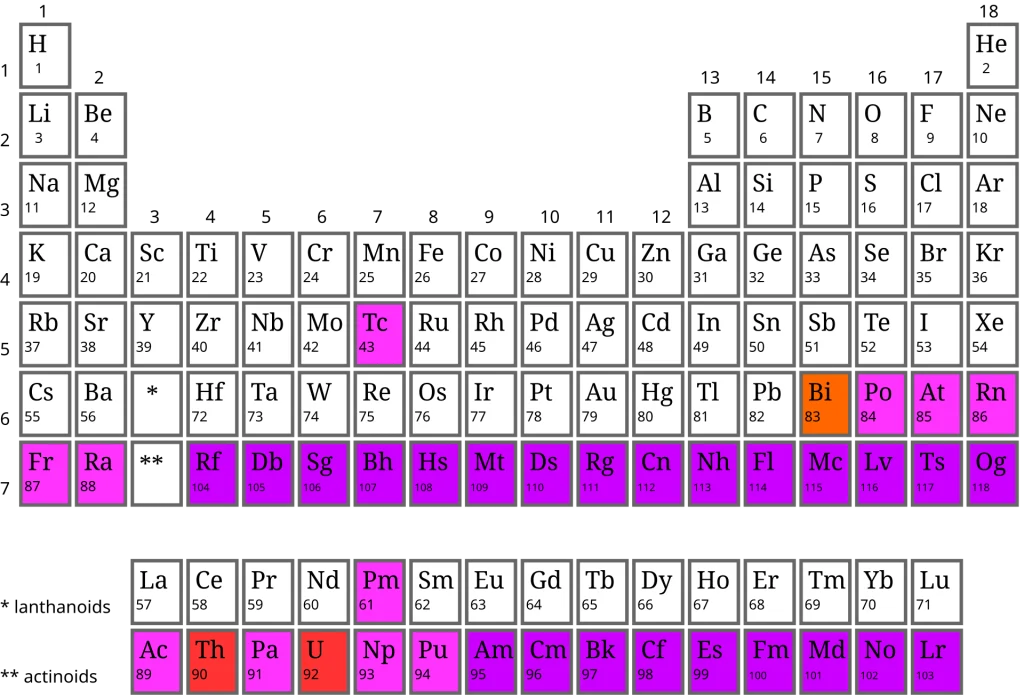
The periodic table is arranged into groups and periods.
Groups
Groups are the vertical columns of the periodic table. There are 18 groups.
Elements in the same group often have similar chemical properties because they have related arrangements of electrons in their outer shells.
For example, lithium, sodium, and potassium belong to Group 1 and are known as alkali metals. They are generally very reactive and share several chemical properties.
Periods
Periods are the horizontal rows of the periodic table. There are 7 periods.
As you move across a period, the atomic number increases from one element to the next. The properties of the elements also change gradually across the period.
Important Groups in the Periodic Table
Some groups are particularly important when studying chemistry.
Group 1 – Alkali Metals:
This group includes lithium, sodium, potassium, rubidium, caesium, and francium. They are highly reactive metals.
Group 2 – Alkaline Earth Metals:
This group includes beryllium, magnesium, calcium, strontium, barium, and radium.
Groups 3–12 – Transition Metals:
These include many familiar metals such as iron, copper, zinc, silver, gold, and platinum.
Group 17 – Halogens:
This group includes fluorine, chlorine, bromine, iodine, astatine, and tennessine. They are reactive non-metals or elements with predominantly non-metallic character.
Group 18 – Noble Gases:
This group includes helium, neon, argon, krypton, xenon, radon, and oganesson.
General Properties of Elements
The elements have different physical and chemical properties. These properties help scientists understand how elements behave and how they can be used.
One important property is reactivity. Some elements react easily with other substances, while others are much less reactive. The position of an element in the periodic table can help us understand its general reactivity.
Another important property is atomic size. Atomic size follows general patterns across groups and periods because of changes in the nuclear charge and electron arrangement.
Elements can also differ in their physical state. At room temperature, some elements are gases, some are liquids, and many are solids. For example, oxygen and nitrogen are gases, mercury is a liquid, while iron and copper are solids.
Some elements occur naturally on Earth, while others are produced artificially in laboratories. Many of the very heavy elements are radioactive and have been created or studied through nuclear reactions.
Uses of Some Important Elements
The elements have many uses in science, agriculture, medicine, construction, technology, and everyday life.
Oxygen: Oxygen is essential for respiration in humans and many other organisms. It is also used in medicine and several industrial processes.
Carbon: Carbon is an important part of living organisms. It is also found in fuels and many materials.
Silicon: Silicon is widely used in electronics and is an important material in the production of semiconductor devices.
Iron: Iron is widely used in construction and manufacturing. It is also an important component of steel.
Copper: Copper is a good conductor of electricity and is commonly used in electrical wiring and equipment.
Aluminium: Aluminium is lightweight and resistant to corrosion, making it useful in transportation, construction, packaging, and many household products.
Gold: Gold is used in jewellery and has applications in electronics because it resists corrosion and conducts electricity well.
Silver: Silver is used in jewellery, electrical applications, mirrors, and some specialized technologies.
Chlorine: Chlorine is used in water treatment and in the manufacture of many useful chemicals.
Uranium: Uranium is used as a fuel in some nuclear reactors and is important in nuclear science.
The uses of other elements range from medical applications and laboratory research to electronics, manufacturing, agriculture, and energy production.
Why Is It Important to Study the 118 Elements?
Studying the elements helps students understand the basic composition of matter and how substances interact with one another. Chemistry becomes easier to understand when students know the names, symbols, and general properties of common elements.
Knowledge of the elements also helps explain how compounds are formed. For example, understanding hydrogen and oxygen makes it easier to understand the composition of water, while knowledge of sodium and chlorine helps explain the formation of sodium chloride.
The periodic table is also important in many scientific and technological fields. Scientists use information about elements when developing medicines, materials, electronics, energy technologies, and industrial processes.
Challenges of Learning the 118 Elements
Learning all 118 elements can be challenging, especially when a student tries to memorize the entire list at once. Some element names are long or unfamiliar, and several symbols do not closely resemble the English names.
Another challenge is remembering which symbol belongs to which element. For example, students may find symbols such as Na, K, Fe, Cu, Ag, Sn, Au, and Pb more difficult because they are based on older or Latin names.
The best approach is to learn gradually. Trying to memorize everything in one sitting can make the task more difficult.
How to Learn the 118 Elements More Easily
A good way to begin is to learn the first 20 elements. These elements are commonly introduced early in chemistry and provide a useful foundation for understanding the periodic table.
After learning the first 20, continue with the elements in smaller sections. You can study one group or one period at a time instead of trying to memorize all 118 elements together.
Writing the names and symbols repeatedly can also help. For example, write Hydrogen – H, Helium – He, Lithium – Li, and continue until you can recall them without looking at the table.
It is also useful to keep a periodic table nearby when studying chemistry. Instead of only memorizing the names, pay attention to the arrangement of the elements and the similarities between elements in the same groups.
Regular revision is important. Spend a few minutes testing yourself each day by covering the symbols or names and trying to remember them. With consistent practice, the 118 elements become much easier to recognize.
Summary
There are currently 118 known chemical elements, beginning with hydrogen and ending with oganesson. Each element has a unique atomic number and an official symbol. The elements are arranged in the periodic table according to their atomic numbers and recurring chemical properties.
The periodic table contains 18 groups and 7 periods. The elements can be broadly classified as metals, non-metals, and metalloids, while other categories such as alkali metals, transition metals, halogens, and noble gases help us study their properties in greater detail.
Learning all 118 elements does not have to be difficult. Starting with the first 20 elements, studying in small sections, practicing the symbols, and revising regularly can make the process much easier.
Revision Questions
- How many chemical elements are currently known?
- What is a chemical element?
- What does the atomic number of an element represent?
- What is the first element in the periodic table?
- What is the last currently recognized element in the periodic table?
- What is the difference between a group and a period?
- How many groups are in the periodic table?
- How many periods are in the periodic table?
- What are metals, non-metals, and metalloids?
- Mention five elements and write their symbols.
Frequently Asked Questions
1. How many elements are in the periodic table?
There are currently 118 officially recognized chemical elements in the periodic table.
2. What is the first element in the periodic table?
Hydrogen is the first element. Its atomic number is 1 and its symbol is H.
3. What is the last element in the periodic table?
Oganesson is element number 118. Its symbol is Og.
4. What is an element symbol?
An element symbol is the shortened form used to represent an element. For example, O represents oxygen, C represents carbon, and Fe represents iron.
5. How many groups are in the periodic table?
There are 18 vertical groups in the periodic table.
6. How many periods are in the periodic table?
There are 7 horizontal periods in the periodic table.
7. Which element has the symbol Na?
Na is the symbol for sodium. The symbol comes from the element’s Latin name, natrium.
8. Why is potassium represented by K?
Potassium has the symbol K because its symbol comes from its Latin name, kalium.
9. What are noble gases?
Noble gases are elements in Group 18 that are generally very unreactive. Examples include helium, neon, argon, krypton, xenon, and radon.
10. What is the easiest way to learn the 118 elements?
Start with the first 20 elements, then learn the remaining elements in smaller groups. Regular practice with their names, symbols, and positions in the periodic table makes memorization easier.
Related Articles