For Types of Cropping Systems in Agriculture – SS1
Lesson Objectives:
At the end of this lesson, students should be able to:
- Define cropping system.
- List and explain the types of cropping systems.
- Give examples of crops under each cropping system.
- State advantages and disadvantages of each cropping system.
- Explain factors that determine the type of cropping system to adopt.
- Explain principles of crop rotation and design a simple crop rotation plan.
TYPES OF CROPPING SYSTEMS
Cropping system can be referred to as the patterns of growing crops on the farm. A pattern of growing only one type of crop on the same piece of land at the same time in each growing season.
1. Mono-cropping or Sole Cropping
This is a system of cropping where one type of crop is grown on a farm at the same time. This system is usually practised on large-scale farms, such as those growing oil palm, cocoa, kolanut, rubber trees, millet, maize, sorghum, etc.
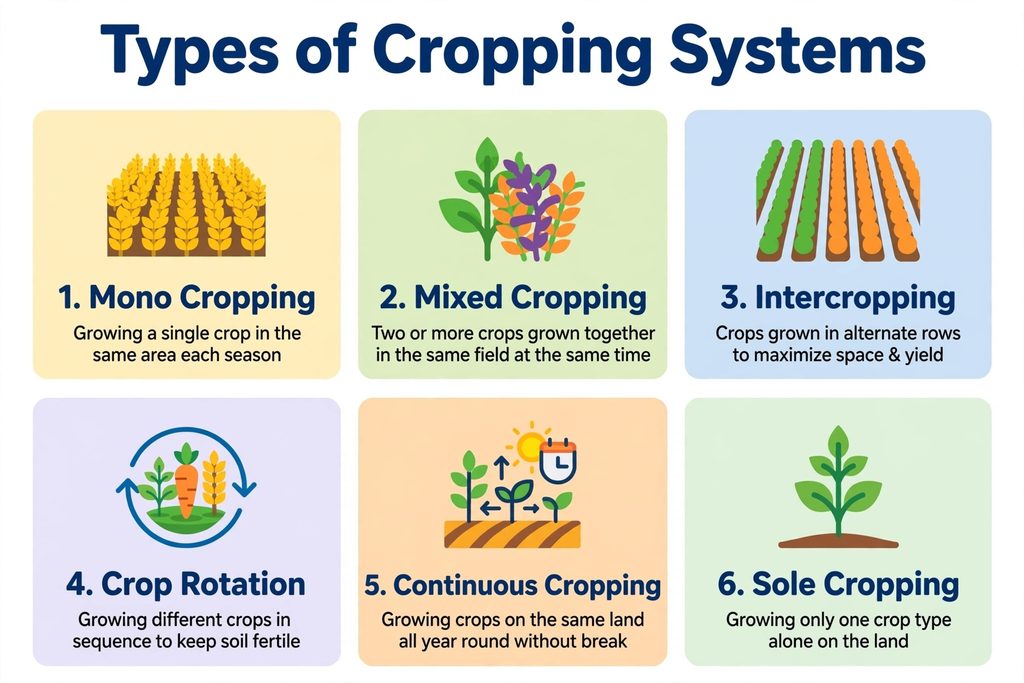
In mono-cropping, crops tend to remain on a particular piece of land or farm for many years when permanent or tree crops are grown. In the case of annual crops, the farmer grows a particular crop, harvests it, and cultivates the same piece of land with another crop during the next planting season.
This system of cropping can only be successful where there is plenty of farmland.
Advantages of Mono-cropping
(i) Mono-cropping encourages specialization.
(ii) It encourages mechanization of farm operations.
(iii) Through mono-cropping, management…
Disadvantages of Mono-cropping
(a) The system may be very risky. The farmer may lose all the crops if there is a pest or disease attack.
(b) There may be a build-up of pests and diseases on the farm.
(c) Mono-cropping may cause a glut in the market and lead to low prices if there is overproduction.
(d) Farmers may be discouraged from producing more if there are low prices in the world market for crops such as cocoa and rubber.
2. Mixed Cropping
This types of Cropping systems involves the growing of two or more crops on the same piece of land during the same growing season. This system is very common among small-scale farmers in Nigeria and West Africa. Crops commonly grown under this system include yam, cassava, maize, cocoyam, pepper, okra and melon on the same piece of land.
Mixed cropping is commonly practised where farmland is limited.
Inter-cropping
This is a system where a crop is grown between another crop, and the crop planted first is harvested first, while the other crop remains on the farm. For example, yam can be inter-cropped with melon.
Inter-planted Inter-cropping
This is a system of inter-cropping where the planting times of two crops are different, and the second crop is planted before the first crop is harvested. For example, maize and yam can be grown together. Maize is planted first, before yam is inter-planted with it.
Advantages of Mixed Cropping
(i) Mixed cropping provides insurance against the failure of one crop. When one crop fails, the farmer still has other crops.
(ii) The fertility of the soil can be improved by including legumes in the system.
(iii) Maximization of…
(iv) It protects the soil against erosion through the extensive root systems and leaves of the crops.
(v) The spread of pests and diseases is minimal.
Disadvantages of Mixed Cropping
(i) It discourages farm mechanization.
(ii) It is difficult to use chemicals, such as herbicides, to control weeds when different crops are growing together.
(iii) The system may be harmful to some crops when certain herbicides are used.
3. Alley Cropping
This is a Types of Cropping systems which involves the growing of rows of trees or shrubs that must undergo regular pruning every six months before planting. The species used are nitrogen-fixing or leguminous plants, such as Gliricidia and Leucaena.
The spacing of these plants is put at 4 metres between rows to allow for… The soil nutrients are improved through the decomposition of organic residues.
Advantages of Alley Cropping
(i) The pruned leaves help in feeding ruminants during the dry season.
(ii) The pruned leaves and stems are cut, and the plant residues help to suppress weed growth.
(iii) The shrubs serve as barriers when planted across slopes to control erosion.
(iv) Alley cropping serves as an…
(v) Nitrogen is supplied to food crops because nitrogen-fixing plants fix nitrogen for the food crops.
Disadvantages of Alley Cropping
(i) The land available for food crops…
(ii) Nitrogen supply may be insufficient for the crops if not properly…
(iii) The practice may be difficult to carry out on a large scale.
(iv) There is competition between the crops for nutrients, air, water, space and light, which may reduce the yield of some crops.
4. Continuous Cropping
This is a system which involves the growing of the same type of crop on the same piece of land every year. The system is normally practised where there is a scarcity of land and a dense population, or where environmental conditions limit the types of crops that can be cultivated in an area. Crops such as millet can only be grown in some parts of Northern Nigeria.
In this system, the farmer has to do a lot to maintain soil fertility through the addition of organic and inorganic manure.
Advantages of Continuous Cropping
(i) A lot of time, energy and money are saved because the farmer does not have to clear new farmland every year.
(ii) It helps to economise the use of farmland.
Disadvantages of Continuous Cropping
(i) Continuous cropping encourages soil erosion.
(ii) It leads to a rapid loss of soil fertility.
(iii) It encourages low crop yields.
(iv) A lot of money is spent on restoring and improving the soil.
(v) It encourages the build-up of pests, diseases and weeds on the farm.
(vi) It encourages the deterioration of the physical and chemical conditions of the soil.
5. Multiple Cropping
This is almost similar to mixed cropping. It is the growing of different crops on the same piece of land more than once a year and harvesting them at different times. The principle of this method is that the first crop is harvested before planting the others during the same year.
One type of crop or more than one type of crop may be planted on a farm in different seasons. In this system, the farmer may practise double cropping or triple cropping.
For example, maize may be grown twice during the same year on the same piece of land. The first crop is planted in late March or early April and harvested in July or August. Another crop is planted in August and harvested in November or December. The maize harvested in November or December is known as late maize.
This system is commonly practised in the southern part of Nigeria, where temperature and rainfall conditions are favourable. It can also be practised where irrigation is available.
Advantages of Multiple Cropping
(i) It guards against crop failure.
(ii) It makes maximum use of the land.
Disadvantages of Multiple Cropping
(i) It requires an adequate and regular supply of water.
(ii) The soil may be overused.
6. Monoculture
Monoculture is defined as the practice of cultivating one and the same crop on the same piece of land every cropping season.
This means that the farmer cultivates the same piece of land with the same crop every year. An example of monoculture is growing yam on the same piece of land year after year.
Nutrients may easily be depleted under this system, while pests and diseases may build up on the farm.
7. Taungya Farming
Definition
The taungya system is defined as the planting of arable crops during the early stages of the establishment of forest crops or forest trees.
In this system, both arable crops and forest trees are planted on the same piece of land at the same time. During this period, the arable crops are harvested before the trees begin to form canopies.
8. Crop Rotation
Definition
Crop rotation is defined as the growing of different crops on a piece of land in a definite sequence, with each crop following another on the same piece of land year after year.
This system is practised in areas where farmland is in short supply. A farmer with a small farm may plant maize on the whole farm in one year, cowpea the following year, and other crops in subsequent years. The farmer may return to planting maize after four years, depending on the chosen rotation sequence.
Another way of practising this system is to divide the farmland into plots, with each plot used to grow a different crop every year. The crops are then rotated among the plots each year to maintain the rotational system.
Table 14.1: Design of a Four-Year Crop Rotation System Using Yam, Cassava, Maize and Groundnut
| Year | Plot A | Plot B | Plot C | Plot D |
|---|---|---|---|---|
| 1st Year | Yam | Cassava | Maize | Groundnut |
| 2nd Year | … | … | … | … |
| 3rd Year | … | … | … | … |
| 4th Year | … | … | … | … |
Note: For the purpose of the four crops given:
(i) Yam and cassava must not follow each other.
(ii) Groundnut and maize must not follow each other.
Principles of Crop Rotation
In order to adopt the principles of crop rotation, the farmer must first consider the following factors:
(i) Climatic conditions, such as temperature, humidity and rainfall.
(ii) Vegetation of the area.
(iii) Soil type.
(iv) Soil fertility.
(v) Crops to be planted.
(vi) The root systems of the crops to be planted.
These factors must be considered by the farmer when planning a crop rotation system.
FACTORS THAT DETERMINE THE ADOPTION OF A CROPPING SYSTEM
There are many factors that determine the use of a cropping system. These include the following:
(i) Climatic Factors
These include rainfall, relative humidity, temperature and photoperiod, that is, the length of daylight. In Northern and Southern Nigeria, rainfall patterns differ, and this determines the types of crops that can be grown in each area.
(ii) Crop Factors
Deep-rooted crops should not follow each other in the same sequence. Therefore, deep-rooted crops should be followed by shallow-rooted crops. For example, yam may be followed by maize.
Crops of the same family should not succeed one another because they may share the same pests and diseases. Examples of related crops include maize, sorghum and millet.
(iii) Soil Factors
Soil factors include topography, the physical and chemical composition of the soil, and soil nutrients. For example, sandy soil may not be suitable for some intercropping systems.
If a particular soil has a high nutrient content, the farmer may use it for continuous cropping. However, the cropping system adopted will also depend on the crops being cultivated and the need to maintain soil fertility.
(iv) Economic Factors
These include market conditions and prices. These factors go a long way in determining the types of crops to be grown and the cropping system to be adopted.
For example, if the price of rice is high, a farmer may decide to produce rice repeatedly, thereby adopting a monocropping system.
(v) Social Factors
These include people’s tastes and local beliefs, which determine the types of crops grown and the cropping systems adopted.
(vi) Technological Factors
The technological advancement of a country can greatly influence the type of cropping system adopted in a particular area.
For example, where farmers have access to machinery, larger areas of farmland can be cultivated. However, farmers who depend on simple implements such as cutlasses and hoes may find mixed cropping more convenient.
(vii) Suitable Crops for the Area
The crops planted should be suitable for the climate of the area. For example, tree crops are commonly grown in rainforest zones, while crops such as maize, millet, beans and groundnut are grown in savannah areas. Swamp rice is suitable for swampy areas.
(viii) Fallow Period
A fallow period should be included in farm planning to help replenish soil fertility. During this period, leguminous crops may be planted to help increase the nitrogen content of the soil.
(ix) Other Physical and Chemical Factors
Other physical and chemical factors may also influence the choice of a cropping system.
Revision Questions On Types of Cropping Systems
1. Discuss briefly a named oil crop under the following headings:
(a) Climate and soil requirements
(b) Planting
(c) Nursery practices
(d) Planting dates and spacing
(e) Harvesting and storage
(SSCE June 1988)
2. Discuss the production of yam under the following headings:
(a) Soil requirement
(b) Materials of propagation
(c) Preparation
(d) Planting
(e) Staking
(f) Cultural practices
(g) Harvesting
(h) Storage
(i) Pests and diseases and their control
(SSCE June 1995)
3. Discuss briefly the production of tomato under the following headings:
(a) Soil requirement
(b) Land preparation
(c) Nursery practices
(d) Planting and spacing
(e) Fertilizer application and type
(f) Staking
(g) Harvesting and storage
(SSCE June 1993)
4. Discuss the production of either banana or citrus under the following headings:
(a) Soil requirement
(b) Planting materials
(c) Propagation
(d) Planting
(e) Cultural practices
(f) Harvesting
(g) Storage
(h) Diseases and pests of the crop and their control
(SSCE November 1992)
5(a). Give two examples of each of the following classes of crops:
(i) Cereals
(ii) Roots and tubers
(iii) Vegetables
(iv) Legumes
(b). Discuss briefly the production of tomato under the following headings:
(i) Soil and climatic requirements
(ii) Method
(iii) Harvesting
(iv) Marketing
(SSCE June 1995)
6(a). Discuss briefly the production of groundnut under the following headings:
(i) Soil requirement
(ii) Storage
(iii) Planting date
(iv) Spacing and harvesting
(b). Name two fungal diseases and two pests of groundnut.
(SSCE November 1995)
7. Describe briefly the cultivation of maize under the following headings:
(a) Land preparation
(b) Planting date
(c) Seed rate
(d) Planting
(e) Fertilizer application
(f) Weeding
(g) Harvesting
(h) Storage
8. Describe briefly the production of cocoa.