Transverse and Longitudinal Waves: Meaning, Types, Differences, and Applications
Introduction
Waves are one of the most important ideas in physics because they help us understand how energy moves from one place to another. Many everyday experiences—such as hearing a sound, seeing light, or watching ocean water move—are all connected to waves. Even though waves are common, students often find them confusing at first because the motion involved is not always easy to picture.
To understand waves clearly, it is important to study the two main types: transverse waves and longitudinal waves. These two types explain how particles behave when energy passes through a medium. In this article, we will explain both types carefully, compare them, and show how they are used in real life. The goal is to make the topic simple, clear, and easy to remember.
Meaning of Waves
A wave is a disturbance that moves through a medium or through space, transferring energy from one point to another without permanently moving the particles of the medium.
This definition has two key ideas:
- Waves carry energy, not matter
- The particles of the medium only vibrate around their positions, they do not travel with the wave
For example, when a stone is dropped into water, ripples spread outward. The water itself does not move across the surface; instead, the energy moves through it. This is how waves work.
Waves can travel through different media such as solids, liquids, and gases. Some waves, like light, can even travel through empty space.
Main Types of Waves
Waves are classified based on how the particles of the medium move relative to the direction of the wave. The two main types are:
- Transverse waves
- Longitudinal waves
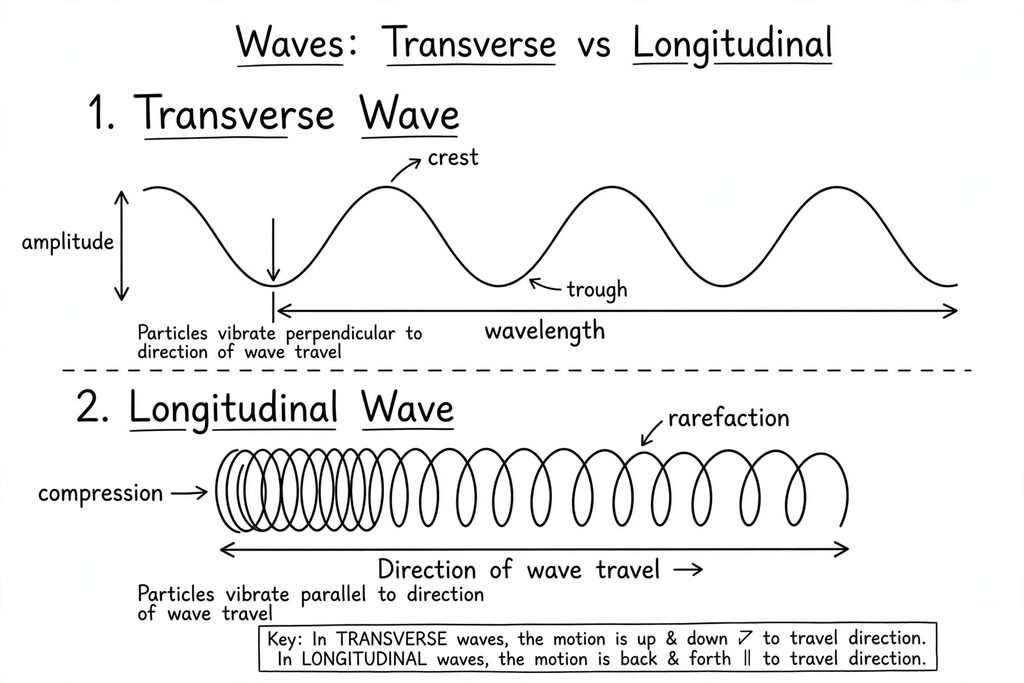
Understanding the difference between these two types is essential because it helps explain many physical processes, including sound, light, and vibrations.
Transverse Waves
Meaning of Transverse Waves
A transverse wave is a wave in which the particles of the medium move in a direction that is perpendicular (at a right angle) to the direction in which the wave travels.
This means that if the wave is moving forward, the particles are moving up and down.
Detailed Explanation
In a transverse wave, energy travels through the medium, but the particles do not move forward with the wave. Instead, they oscillate around their original positions.
To understand this better, imagine holding one end of a rope and moving your hand up and down. The wave travels along the rope, but each part of the rope only moves vertically. This clearly shows that the motion of the particles is different from the motion of the wave itself.
Main Features of Transverse Waves
- Particle motion is perpendicular to wave direction
- Waves form crests (highest points) and troughs (lowest points)
- Energy moves forward while particles move up and down
- Common in solids and on the surface of liquids
Examples of Transverse Waves
- Water waves on the surface of the ocean
- Waves produced on a stretched rope
- Light waves (electromagnetic waves)
- Radio waves
Light waves are especially important because they can travel through empty space, unlike many mechanical waves.
Longitudinal Waves
Meaning of Longitudinal Waves
A longitudinal wave is a wave in which the particles of the medium move in the same direction as the wave.
This means that both the wave and the particles move forward and backward along the same line.
Detailed Explanation
In longitudinal waves, particles vibrate back and forth, creating regions where particles are close together and regions where they are spread apart.
- Compressions: Areas where particles are close together
- Rarefactions: Areas where particles are spread apart
These alternating regions move through the medium, carrying energy.
A simple way to understand this is by using a spring (slinky). When you push and pull the spring, the coils move back and forth in the same direction as the wave. This is a clear example of a longitudinal wave.
Main Features of Longitudinal Waves
- Particle motion is parallel to wave direction
- Consists of compressions and rarefactions
- Can travel through solids, liquids, and gases
- Requires a medium (cannot travel in vacuum)
Examples of Longitudinal Waves
- Sound waves in air
- Waves in a stretched spring
- Seismic waves (P-waves) during earthquakes
Sound waves are the most common example and are very important in daily life.
Wave Properties
To understand waves properly, some key properties must be known:
Wavelength (λ)
This is the distance between two identical points on a wave, such as crest to crest or compression to compression.
Frequency (f)
This is the number of waves that pass a point in one second. It is measured in hertz (Hz).
Wave Speed (v)
Wave speed shows how fast a wave travels through a medium. It depends on both the type of wave and the properties of the medium.
Differences Between Transverse and Longitudinal Waves
| Feature | Transverse Waves | Longitudinal Waves |
|---|---|---|
| Direction of particle motion | Perpendicular to wave direction | Parallel to wave direction |
| Wave pattern | Crests and troughs | Compressions and rarefactions |
| Medium of travel | Mostly solids and liquid surfaces | Solids, liquids, and gases |
| Example | Light waves, water waves | Sound waves |
| Motion style | Up and down movement | Back and forth movement |
Similarities Between Transverse and Longitudinal Waves
- Both transfer energy from one place to another
- Both involve vibration of particles
- Both have measurable properties like wavelength and frequency
- Both can undergo reflection, refraction, and diffraction
- Both depend on the nature of the medium
Applications of Waves in Real Life
Waves play a major role in many areas of life and science.
Communication Systems
Radio waves and electromagnetic waves are used in television, radio broadcasting, and mobile communication.
Medical Field
Ultrasound waves are used to examine internal organs and monitor unborn babies.
Sound and Hearing
Sound waves allow us to hear speech, music, and environmental sounds.
Ocean and Marine Activities
Water waves affect ship movement and are important in coastal engineering.
Earthquake Detection
Seismic waves help scientists study the structure of the Earth and detect earthquakes.
Light and Vision
Light waves make vision possible and are essential for photography and imaging.
Limitations and Challenges in Studying Waves
- The motion of particles is not always easy to imagine
- Some wave types cannot be directly observed
- Students may confuse wave direction with particle motion
- Diagrams may not fully represent real-world behavior
- Mathematical relationships require consistent practice
- Understanding abstract concepts takes time
How to Understand and Master Waves
To learn this topic well, a student should:
- Study diagrams carefully and redraw them
- Relate concepts to real-life examples like water and sound
- Practice explaining the difference between the two types
- Solve simple numerical problems on wave speed
- Revise frequently to strengthen memory
- Use comparisons to avoid confusion
Regular practice and clear understanding will make the topic much easier.
Conclusion
Transverse and longitudinal waves are fundamental concepts in physics that explain how energy travels through different media. While transverse waves involve motion perpendicular to the direction of travel, longitudinal waves involve motion parallel to it. Understanding these differences provides a strong foundation for studying sound, light, and many other physical phenomena.
With careful study and consistent practice, this topic becomes clear and manageable.
Revision Questions
- What is a wave?
- Define transverse waves with an example
- Define longitudinal waves with an example
- What are compressions and rarefactions?
- State two differences between the two types of waves
- What is wavelength?
- Mention two applications of waves
Related Articles