The digestive system of farm animals includes all the organs and tissues associated with the breaking down or digestion of food in the body. It includes the mouth, tongue, the alimentary canal or digestive tract, and all the other body glands, secretory enzymes and other fluids.
Digestive System of Farm Animals
Farm animals are grouped into two main classes based on the nature of their alimentary canal or digestive tract. These are:
(1) Monogastric or Non-ruminant
(2) Polygastric or Ruminant
(1) Monogastric or Non-ruminant
These possess only one stomach and they do not ruminate (i.e. they do not chew the cud). In other words, these animals have simple stomach and cannot digest cellulose and fibres properly. Examples are the pig, poultry and rabbit.
(2) Polygastric or Ruminant
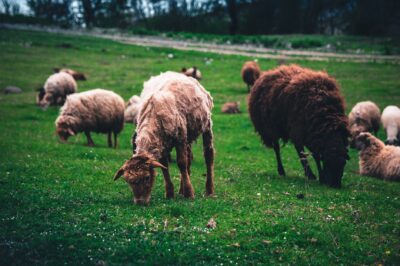
These are farm animals which possess four stomach compartments (complex stomach) or rumen and hence, they can ruminate or chew the cud. The four stomach compartments are rumen (paunch), reticulum (honeycomb), omasum (psalterium) and abomasum (true stomach).
The rumen (pounch): It has several tongue-like projections called papillae. It also has a soft towel-like appearance. It is the largest and the first compartment of the stomach.
Reticulum (honeycomb): This is lined with a mucosal layer which is formed into hexagonal chamber that looks like honeycomb. It is the second compartment.
Omasum (manypiles): The omasum is the third and smallest compartment. It has several “leaves” or laminae/layers.
Abomasum: This is the only glandular stomach. It is synonymous with simple stomach of monogastric animals. The abomasum is the fourth and last compartment of the stomach.
Functions of the first compartment (the rumen) of the stomach of a ruminant are:
(i) Fermentation brought about by micro-organisms takes place in the rumen.
(ii) It is used for temporary storage of feed before regurgitation for proper rechewing.
(iii) Volatile fatty acids and other gases are produced in the rumen as a result of fermentation.
(iv) Absorption of volatile fatty acids takes place through the walls of the rumen.
(v) Some vitamins, e.g. vitamin B, are produced in the rumen.
(vi) Breakdown of cellulose takes place in the rumen.
Examples are the cattle, sheep and goat. They are all herbivores.
Digestion in Ruminants
Ruminants like cattle, sheep and goat. They are all herbivores.
Examples are the cattle, sheep and goat. They are all herbivores. Ruminants feed on grasses, legumes, roughages and concentrates because of the complex nature of their stomach.
The digestion in ruminant can be explained properly with the aid of the diagram in (Figure 29.2) below.
Digestive tract of ruminant, e.g. cattle.
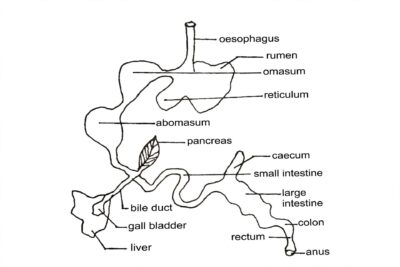
When a ruminant animal like a cow wants to feed, it cuts the grass or forage with its teeth and swallows it with minimal chewing and swallows it from the mouth through the gullet passes to the rumen where the grass is stored. In the rumen, the grass is acted upon by micro-organisms like bacteria and protozoa which digest the cellulose and synthesize some amino acids needed by the animal from non-protein nitrogenous substances.
When the rumen has limited filling the ruminant stops feeding and lies down quietly. By a peristaltic movement of the wall, the grass passes from the rumen to the reticulum from where it re-enters the oesophagus (regurgitation) back to the mouth. The food is now chewed properly (chewing the cud) and with semi-liquid teeth which is called a semi-liquid cud (now called bolus). This liquid cud now moves to the omasum from where it passes to the abomasum (the true stomach).
In the abomasum, enzymes digest. Which act on the food. Further digestive process. Absorption of the food takes place. The digested food passes into the blood though the villi in the small intestine while the undigested food passes through the intestine where water is removed and passes through the anus as dung or faeces.
Digestion in Non-ruminant
The non-ruminant does not chew the cud and therefore cannot digest fibre properly. The digestion proper in a non-ruminant takes place mainly in the duodenum with the aid of the digestive enzymes.
Digestion of food takes place in four areas:
(i) Mouth: In the mouth, the food is chewed and mixed with saliva which contains an enzyme called ptyalin. The food is broken into small pieces. The food is swallowed and moves by peristaltic movement to the stomach.
(ii) Stomach: In the stomach, two enzymes act on the food. Rennin present helps to curdle milk while pepsin converts proteins to peptones under the influence of an acid medium. The thick liquid called chyme now enters the duodenum.
(iii) Duodenum: The digestion also takes place here. Digestion also takes place here and they act on different food stuffs:
(a) Amylase: this enzyme converts starch to maltose.
(b) Lipase: converts fat and oil to fatty acids and glycerol.
(c) Trypsinogen: converts protein and peptones to polypeptides. These enzymes are secreted by the pancreas. The digestion of fats and oil is aided by bile which is secreted by the liver and stored in the gall bladder. The bile helps in the emulsification of fats. At the end of digestion in the duodenum, the food (now in liquid form) called chyle passes to the ileum or small intestine.
Digestive System of Farm Animals (Pig)
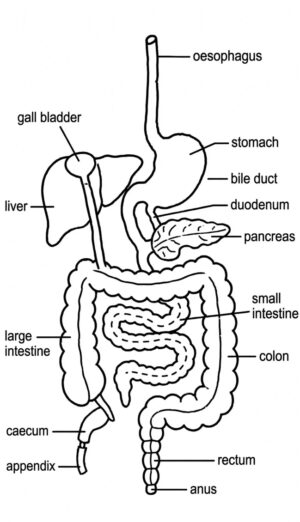
(iv) Small Intestine: The wall of the small intestine secretes many enzymes which complete the process of digestion.
The enzymes are:
(a) Lipase which converts fats and oil to fatty acids and glycerol. (b) Erepsin converts polypeptides to amino acids. (c) Maltose converts maltose to glucose. (d) Sucrase converts sucrose to glucose and fructose. (e) Lactose converts lactose to glucose and galactose.
The end product in the digestion include the conversion of: (i) protein to amino (ii) starch to glucose (iii) fats and oil to amino acids.
These end products (amino acids, glucose and fatty acid and glycerol) are absorbed in the small intestine by a structure called the villi. The undigested food materials are passed to the large intestine from where they are ejected through the anus as faeces or dung.
The digestion of food in rabbit (a non-ruminant) is just like the pig except that rabbit can feed properly on grasses which are digested in the large caecum which contains micro-organisms like bacteria and protozoa.
Digestion in Domestic Fowl
The domestic fowl is a monogastric animal and has a simple stomach. Digestion in fowl can be explained properly with the help of the diagram here
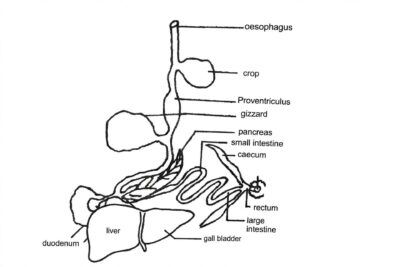
The fowl has no teeth but the food is picked up by the beak. This food then passes on to the crop through the oesophagus. This food is stored temporarily in the crop where it is moistened and fermented by some bacteria. The food now passes on to the proventriculus where digestive enzymes are secreted on the food.
The proventriculus is often regarded as the glandular stomach because it secretes digestive enzymes on the food like pepsin and amylase.
From the proventriculus, the food moves to the gizzard where grinding takes place. With the aid of small stones or grits, the food is ground by the gizzard. From the gizzard, the food now moves to the duodenum and small intestine where further digestion and absorption take place while the undigested food materials are removed from the tract as faeces.
Differences Between Monogastric and Ruminant Animals
| Monogastric Animals | Ruminant Animals |
|---|---|
| Possess one stomach compartment. | Possess four stomach compartments. |
| Cannot digest cellulose and fibre properly. | Can digest cellulose and fibre properly. |
| Cannot chew the cud. | Can chew the cud. |
| Digestion is aided by bacteria in the caecum in some animals, e.g., rabbit. | Digestion is aided by bacteria in the rumen, e.g., cattle, sheep and goat. |
| They are mostly omnivores. | They are herbivores. |
| They cannot synthesize their own protein. | They can synthesize protein from non-protein nitrogen. |
| They do not regurgitate food. | They regurgitate food. |
| Presence of villi in the small intestine. | Presence of papillae in the rumen. |
Importance of Digestive System of Farm Animals
- It aids the ingestion of feed.
- It aids the digestion of feed.
- It ensures the absorption of digested feed.
- It helps in ejection of undigested feed.
- It aids the secretion of productive hormones and digestive enzymes.