Reproduction in Paramecium: Types, Process, and Importance in biology.
Reproduction in Paramecium
Living organisms reproduce to ensure the continuation of their species. Even simple unicellular organisms, which consist of only one cell, have developed effective methods of producing new individuals. Paramecium, a microscopic freshwater organism belonging to the group of protozoans, reproduces through both asexual and sexual methods.
The main method of reproduction in Paramecium is binary fission, where one cell divides to form two genetically identical daughter cells. Under certain conditions, Paramecium also undergoes conjugation, a process that involves the exchange of genetic material between two organisms.
Understanding reproduction in Paramecium helps scientists and students learn how single-celled organisms survive, multiply, and maintain genetic diversity.
What Is Paramecium?
Paramecium is a unicellular eukaryotic organism commonly found in freshwater environments such as ponds, lakes, and slow-moving streams. It belongs to the group called ciliates because its body surface is covered with tiny hair-like structures called cilia.
The cilia help Paramecium move through water and also assist in collecting food particles.
Although Paramecium consists of only one cell, that single cell performs all life processes, including:
- Nutrition
- Movement
- Respiration
- Excretion
- Reproduction
Unlike multicellular organisms that produce offspring using specialized reproductive organs, Paramecium reproduces using the activities of its single cell.
Types of Reproduction in Paramecium
Paramecium reproduces in two main ways:
| Type of reproduction | Description |
|---|---|
| Asexual reproduction | Production of new individuals without the exchange of genetic material |
| Sexual reproduction | Exchange of genetic material between two Paramecium cells |
The two major reproductive methods are:
- Binary fission
- Conjugation
Asexual Reproduction in Paramecium: Binary Fission
Binary fission is the most common method of reproduction in Paramecium. It is an asexual process, meaning only one parent organism is involved.
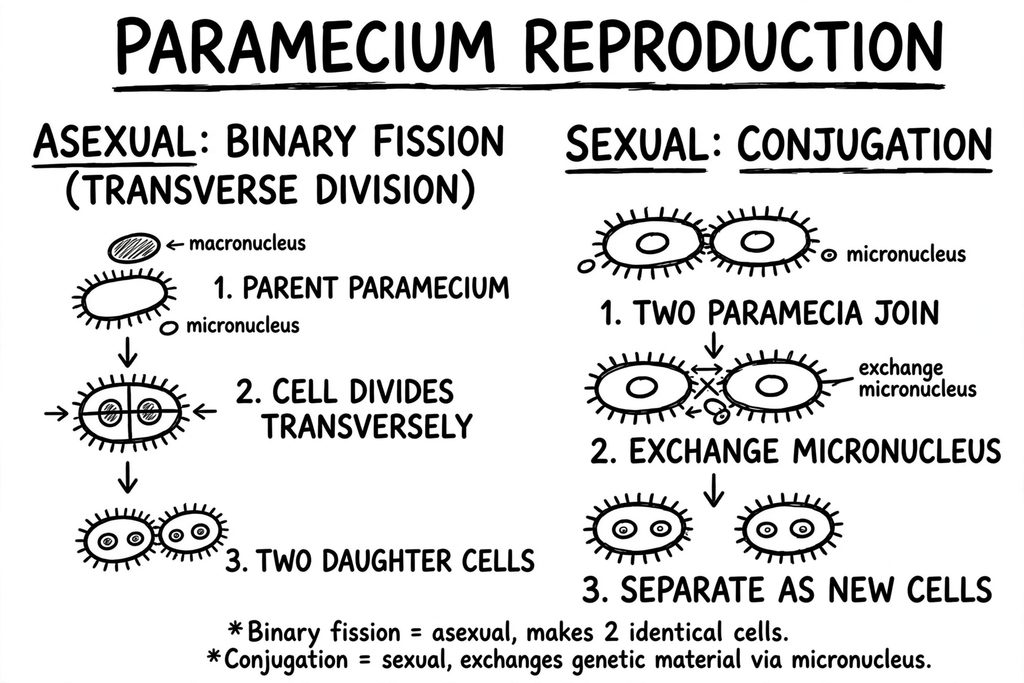
During binary fission, a single Paramecium divides into two genetically identical daughter cells.
Steps of Binary Fission in Paramecium
1. Growth of the Paramecium Cell
Before division begins, the Paramecium grows and duplicates its internal structures. This prepares the organism for separation into two new cells.
2. Division of the Nucleus
Paramecium contains two important types of nuclei:
- Macronucleus: Controls everyday activities such as metabolism, growth, and movement.
- Micronucleus: Contains genetic information and plays an important role during reproduction.
During binary fission:
- The micronucleus divides through mitosis.
- The macronucleus elongates and divides.
3. Formation of Two Daughter Cells
A constriction develops in the middle of the Paramecium cell. The cytoplasm divides, separating the organism into two new cells.
Each daughter cell receives:
- A copy of the genetic material
- A nucleus
- Necessary cell structures
The two new Paramecium cells grow and develop into independent organisms.
Characteristics of Binary Fission in Paramecium
- It involves only one parent organism.
- It occurs rapidly under favorable conditions.
- The offspring are genetically identical to the parent.
- It increases the population quickly.
- It does not create much genetic variation.
Sexual Reproduction in Paramecium: Conjugation
Although Paramecium mainly reproduces through binary fission, it can also undergo conjugation.
Conjugation is a sexual process where two Paramecium cells temporarily join together and exchange genetic material.
Unlike binary fission, conjugation does not immediately produce more individuals. Instead, it increases genetic variation and helps improve the survival ability of the population.
Steps of Conjugation in Paramecium
1. Pairing of Two Paramecium Cells
Two compatible Paramecium cells come together and attach along their oral grooves.
A temporary connection forms between them.
2. Division of the Micronucleus
The micronucleus undergoes division to produce new nuclei.
Some of these nuclei break down, while others continue to participate in genetic exchange.
3. Exchange of Genetic Material
The two Paramecium cells exchange genetic material through the connecting bridge between them.
This results in a combination of genetic information from both organisms.
4. Separation of the Cells
After exchanging genetic material, the two Paramecium cells separate.
They continue living as genetically modified individuals.
Difference Between Binary Fission and Conjugation in Paramecium
| Binary Fission | Conjugation |
|---|---|
| Asexual reproduction | Sexual reproduction |
| One parent organism involved | Two organisms involved |
| Produces two new cells | Does not immediately produce new individuals |
| Offspring are genetically identical | Produces genetic variation |
| Common under favorable conditions | Occurs during unfavorable conditions or when genetic exchange is needed |
Role of the Nucleus in Paramecium Reproduction
The nucleus plays a very important role in reproduction.
Macronucleus
The macronucleus controls normal cell activities, including:
- Growth
- Metabolism
- Movement
- Daily functioning
Micronucleus
The micronucleus is involved in:
- Genetic inheritance
- Reproduction
- Exchange of genetic material during conjugation
The presence of two types of nuclei allows Paramecium to carry out both normal activities and reproductive processes efficiently.
Factors Affecting Reproduction in Paramecium
Several environmental factors influence how quickly Paramecium reproduces.
1. Food Availability
When enough food is available, Paramecium can reproduce rapidly because it has enough energy for cell division.
2. Temperature
Moderate temperatures usually support faster reproduction, while extreme temperatures may slow growth or cause death.
3. Water Conditions
Clean freshwater with suitable conditions supports healthy reproduction.
4. Population Density
When too many Paramecium organisms occupy the same area, competition for food and space may affect reproduction.
Importance of Reproduction in Paramecium
Reproduction is essential because it allows Paramecium to:
- Maintain its population.
- Replace old or damaged individuals.
- Colonize new environments.
- Pass genetic information to new generations.
- Increase genetic diversity through conjugation.
Although Paramecium is a simple organism, its reproductive processes demonstrate important biological principles that also occur in more complex organisms.
Examples of Reproduction in Paramecium
1. Examples of Asexual Reproduction: Binary Fission
This happens when conditions are favorable.
- Example 1: In a pond during warm weather with plenty of bacteria to feed on, one Paramecium splits into 2 identical daughter cells. Those 2 then split again, leading to a rapid increase in population within days.
- Example 2: In laboratory cultures where food and temperature are controlled, Paramecium reproduce by binary fission every 2-3 hours. This is why scientists use them to study cell growth.
2. Examples of Sexual Reproduction: Conjugation
This happens when conditions are unfavorable or to create genetic variation.
- Example 1: When a pond begins to dry up or food becomes scarce, two Paramecia of different mating types come together, exchange genetic material through conjugation, then separate. The new cells are better able to survive the harsh condition.
- Example 2: After conjugation, each Paramecium later divides by binary fission to produce 4 new cells with mixed traits from both parents. This helps the species adapt to environmental changes.
Simple way to remember:
- Binary Fission example: Population boom in a clean, warm pond
- Conjugation example: Survival strategy when the pond water gets polluted or cold
Common Questions About Reproduction in Paramecium
How does Paramecium reproduce?
Paramecium mainly reproduces through binary fission, where one cell divides into two identical daughter cells. It can also reproduce sexually through conjugation.
Is reproduction in Paramecium sexual or asexual?
Paramecium can reproduce both asexually through binary fission and sexually through conjugation.
What is binary fission in Paramecium?
Binary fission is the process where a single Paramecium cell divides into two genetically identical daughter cells.
Why does Paramecium undergo conjugation?
Paramecium undergoes conjugation to exchange genetic material and increase genetic variation within the population.
Does conjugation increase the number of Paramecium?
No. Conjugation mainly changes genetic information and does not immediately produce new individuals.
Summary
Paramecium is a unicellular organism that reproduces through both asexual and sexual methods. The most common method is binary fission, where one cell divides into two identical daughter cells. Under certain conditions, Paramecium performs conjugation, allowing two cells to exchange genetic material.
Binary fission helps Paramecium increase its population quickly, while conjugation provides genetic variation that can improve survival. These reproductive processes show that even simple organisms have complex and effective ways of continuing their species.
Related Articles