Introduction
The movement of a bus, a ball rolling across the ground, a magnet attracting iron objects, and a fruit falling from a tree all involve forces. Even when an object remains still, forces may be acting on it. Understanding the types of forces in physics helps us explain why objects move, stop, change direction, or change shape.
Force is an important concept in physics because it helps explain motion and many everyday activities. Some forces act when objects touch each other, while others act over a distance without direct contact. In this lesson, you will learn the meaning of force, its effects, how it is measured, the different types of forces in physics, their formulas, and their applications in everyday life.
What Is Force in Physics?
Force is a push or pull that can change or tend to change an object’s state of rest or motion, direction, speed, or shape.
For example, pushing a table applies a force that may move it across the floor. Applying the brakes to a moving bicycle produces a force that slows it down. A magnet can also attract an iron nail without touching it.
Force is a vector quantity, meaning it has both magnitude and direction. A force of 10 newtons acting towards the right is different from a force of 10 newtons acting towards the left.
Historical Background
The study of force and motion is closely associated with Sir Isaac Newton, who published his laws of motion in 1687. His work helped explain how forces affect the motion of objects and became an important foundation of classical mechanics.
Formula, Unit and Measurement of Force
Force can be calculated using Newton’s second law of motion.
Formula of Force
F = ma
Where:
- F = resultant force, measured in newtons (N)
- m = mass of the object, measured in kilograms (kg)
- a = acceleration, measured in metres per second squared (m/s²)
Example
A 2 kg object accelerates at 3 m/s². Calculate the resultant force acting on it.
Using the formula:
F = ma
F = 2 × 3
F = 6 N
Therefore, the resultant force acting on the object is 6 newtons.
This formula applies to the resultant force, which is the overall force after all the forces acting on the object have been considered.
How Is Force Measured?
Force is measured using an instrument called a spring balance or force meter. The instrument contains a spring that stretches when a force is applied. The amount of stretching can be used to determine the force.
A spring balance can also measure the weight of an object because weight is a force caused by gravity.
Units of Force
The common units of force include:
- Newton (N): The SI unit of force.
- Dyne: A unit used in the centimetre-gram-second (CGS) system.
- Kilogram-force (kgf): A gravitational unit of force.
One newton is equal to 100,000 dynes.
Effects of Force
Force can affect an object’s motion or shape in several ways. The main effects include the following.
1. Force Can Start Motion
A football resting on the ground begins to move when a player kicks it. The applied force changes the ball from rest to motion.
2. Force Can Stop Motion
A moving bicycle slows down and eventually stops when the brakes are applied. The braking force opposes the bicycle’s motion.
3. Force Can Change Speed
When a car accelerates, its speed increases. When the driver applies the brakes, its speed decreases. These changes occur because of the forces acting on the vehicle.
4. Force Can Change Direction
A moving ball can change direction when a player kicks it from the side. Similarly, turning a steering wheel changes the direction in which a car travels.
5. Force Can Change Shape or Size
Squeezing a sponge, stretching a rubber band, or compressing a spring changes its shape. Some materials return to their original shape when the force is removed, while others remain deformed.
Types of Forces in Physics
The different types of forces in physics are commonly grouped into two main categories according to whether physical contact is required.
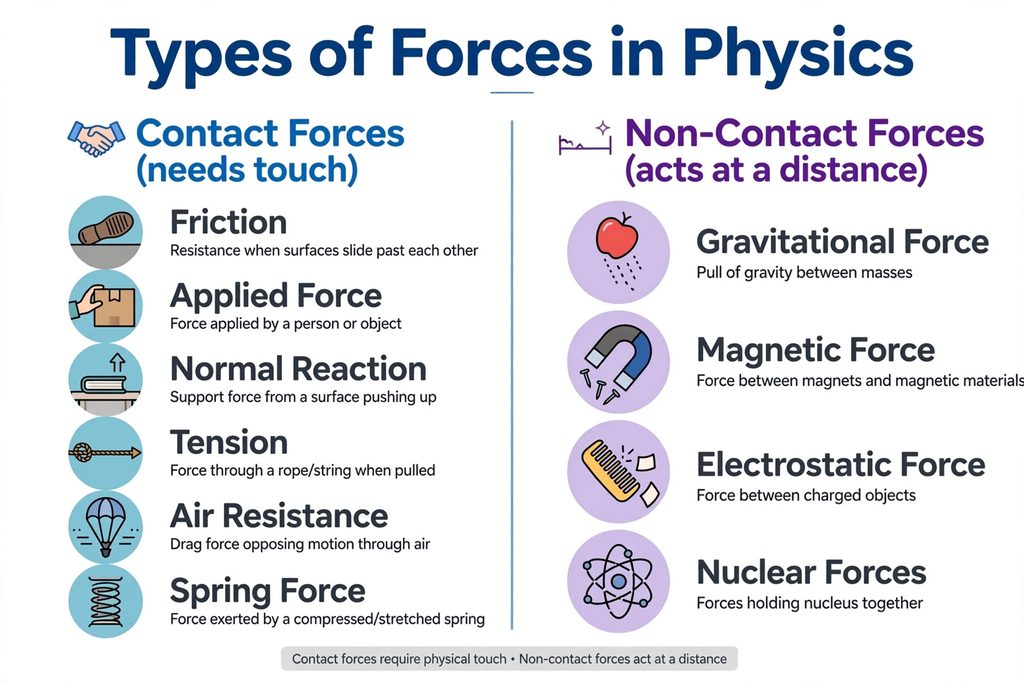
1. Contact Forces: These act when two objects or surfaces are in physical contact.
2. Non-Contact Forces: These act between objects without requiring direct physical contact.
Both categories help explain how objects interact in everyday situations.
Contact Forces
Contact forces occur when two objects touch or interact through a physical connection. Examples include friction, tension, normal reaction, and air resistance.
1. Frictional Force
Friction is a force that opposes relative motion, or the tendency for relative motion, between surfaces in contact.
Friction is important in everyday life because it allows us to walk without slipping, grip objects, write with a pen, and stop vehicles using brakes.
Types of Friction
- Static friction: Prevents surfaces from beginning to slide against each other.
- Sliding friction: Acts when one surface slides over another.
- Rolling resistance: Opposes the rolling motion of an object, such as a tyre moving along a road. It is often called rolling friction in introductory physics.
Advantages of Friction
- It enables people to walk without slipping.
- It allows vehicle brakes to slow down and stop vehicles.
- It helps us hold objects and write on paper.
- It allows tyres to grip the road.
Disadvantages of Friction
- It causes wear and tear in machine parts, tyres, and shoe soles.
- It converts some useful mechanical energy into heat.
- It makes moving objects harder to push or pull.
2. Applied Force
An applied force is a force exerted directly on an object by a person or another object.
For example, pushing a desk, pulling a wheelbarrow, kicking a football, and pushing soil with a bulldozer all involve applied forces.
An applied force does not always make an object move. If the other forces balance it, the object may remain at rest.
3. Normal Reaction Force
The normal reaction force is the support force exerted by a surface on an object in contact with it. It acts perpendicular to the surface.
For example, a book resting on a horizontal table experiences a downward gravitational force and an upward normal reaction from the table.
If the book is at rest and no other vertical forces act on it, the normal reaction balances its weight.
4. Tension Force
Tension is the pulling force transmitted through a stretched rope, string, cable, or chain.
Examples include a rope used to draw a bucket from a well, a cable supporting a load on a crane, and a string pulling a suspended object.
In an ideal light string passing over an ideal pulley, the tension is the same throughout the string. In real situations, friction, the mass of the rope, and other factors can affect the tension.
5. Air Resistance and Water Resistance
Air resistance and water resistance are forms of drag. They oppose an object’s motion relative to the surrounding fluid.
Air resistance acts when an object moves through air, while water resistance acts when an object moves through water.
Examples include a parachute descending through the air, a cyclist moving against the wind, and a boat travelling through water.
Drag generally increases as an object’s speed relative to the fluid increases, although the exact relationship depends on the object’s shape and the flow conditions.
6. Spring Force or Elastic Force
A spring exerts a force when it is stretched or compressed. This force tends to return the spring to its natural length.
Within the elastic limit, the force exerted by an ideal spring follows Hooke’s law.
Formula:
F = −kx
Where:
- F = restoring force
- k = spring constant, measured in newtons per metre (N/m)
- x = displacement from the spring’s natural length
The negative sign indicates that the restoring force acts in the direction opposite to the displacement.
Examples include springs in pens, mattresses, and vehicle suspension systems.
Non-Contact Forces
Non-contact forces act without direct physical contact between the interacting objects. They are often described as field forces because objects can influence each other through gravitational, magnetic, or electric fields.
1. Gravitational Force
Gravitational force is the attractive force between objects that have mass. Earth’s gravity pulls objects towards its centre, which explains why an unsupported object falls towards the ground.
Examples include a fruit falling from a tree, rain falling towards the ground, and the Moon’s gravitational influence on ocean tides.
Formula for Universal Gravitation
F = Gm₁m₂/r²
Where:
- F = gravitational force between two objects
- G = universal gravitational constant
- m₁ and m₂ = masses of the two objects
- r = distance between their centres
Near Earth’s surface, the weight of an object can be calculated using:
W = mg
Where W is weight, m is mass, and g is the acceleration due to gravity.
For example, a 5 kg object has a weight of approximately 49 N where gravitational acceleration is 9.8 m/s².
2. Magnetic Force
Magnetic force is the force produced by magnets and magnetic fields. It can attract or repel other magnets and act on suitable magnetic materials.
Like magnetic poles repel each other, while unlike poles attract each other.
Examples include a magnet attracting iron nails, a magnetic compass responding to Earth’s magnetic field, and the magnetic forces used in electric motors.
3. Electrostatic Force
Electrostatic force is the force between electrically charged objects. It can be attractive or repulsive.
Opposite charges attract, while like charges repel.
For example, rubbing a plastic comb against dry hair can transfer electric charge to the comb. The charged comb may then attract small pieces of paper.
Lightning is another example of a large electrical discharge associated with charge separation in the atmosphere.
4. Nuclear Forces
Nuclear physics describes two additional fundamental interactions: the strong nuclear interaction and the weak nuclear interaction.
The strong interaction binds quarks together and, through its residual effect, helps hold protons and neutrons together in atomic nuclei. The weak interaction is involved in certain radioactive decay processes and reactions involving elementary particles.
These forces operate at extremely small scales inside atoms and are different from the everyday contact forces described earlier.
Balanced and Unbalanced Forces
Understanding balanced and unbalanced forces is important when studying the types of forces in physics because it explains why objects remain at rest or change their motion.
Balanced Forces
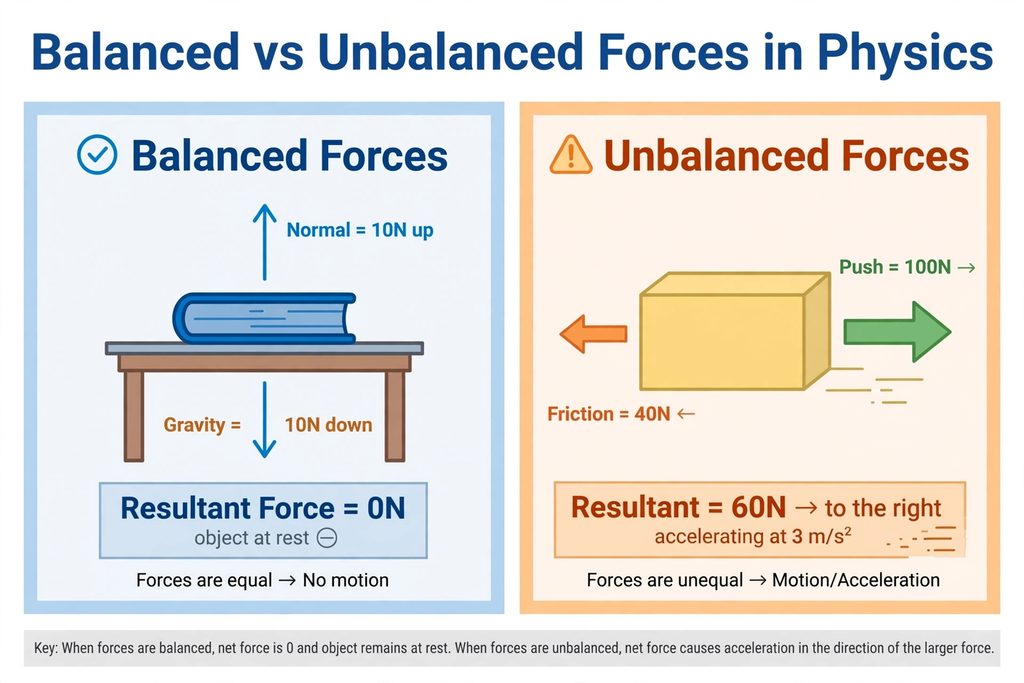
Forces are balanced when their vector sum, called the resultant force, is zero.
When the resultant force is zero, an object at rest remains at rest, while an object already moving continues with constant velocity unless another force changes the situation.
Example
A book rests on a horizontal table. Its weight acts downwards, while the table’s normal reaction acts upwards. If these forces are equal and no other vertical forces act, the resultant vertical force is zero.
Unbalanced Forces
Forces are unbalanced when their resultant is not zero. An object then accelerates, meaning its velocity changes in speed, direction, or both.
Example
A 20 kg box is pushed with a horizontal force of 100 N. Friction opposes the push with a force of 40 N.
Resultant force:
F = 100 − 40
F = 60 N
Using Newton’s second law:
a = F/m
a = 60/20
a = 3 m/s²
The box accelerates at 3 m/s² in the direction of the resultant force, assuming the forces remain constant.
Suggested Image: A diagram showing balanced forces acting in opposite directions on a stationary book and unbalanced forces acting on a box. Use arrows to show the direction and relative size of each force.
A Simple Experiment to Demonstrate Force
Aim: To observe how a force can change an object’s motion.
Materials: A small ball, a smooth tray, and a flat surface.
Procedure
- Place the ball on the horizontal tray and observe it at rest.
- Raise one end of the tray slightly.
- Observe the ball as it begins to roll down the slope.
- Increase the slope carefully and observe any change in the ball’s motion.
Observation
The ball begins to roll when the tray is tilted. A greater slope generally increases the component of gravitational force acting down the tray, so the ball may accelerate more.
Conclusion
The experiment demonstrates that an unbalanced force can change an object’s motion. The ball’s acceleration also depends on factors such as friction and the way it rolls.
Applications of Forces
The types of forces in physics can be seen in transport, agriculture, sports, construction, and many ordinary activities.
1. Transportation
Friction between tyres and the road helps vehicles grip the surface, while friction in braking systems helps slow them down. Air resistance also opposes the motion of moving vehicles.
2. Agriculture
Farmers use applied force when digging soil with a hoe or pulling equipment. Tractors use forces to move machinery and agricultural implements through the soil.
3. Sports
A player applies force when kicking a football. Friction between footwear and the ground helps the player maintain grip, while air resistance affects the movement of a ball through the air.
4. Construction
Tension in cables helps support suspended loads and certain structures. Gravitational forces must also be considered when designing buildings, bridges, and foundations.
5. Everyday Activities
Squeezing a sponge changes its shape, pulling a bucket from a well involves tension, and a magnet attracting iron pins demonstrates magnetic force.
Summary Table of the Types of Forces in Physics
| Type of Force | Category | Example or Main Effect |
|---|---|---|
| Frictional force | Contact | Helps vehicles brake |
| Applied force | Contact | Pushing a wheelbarrow |
| Normal reaction | Contact | Supports a book on a table |
| Tension | Contact | Pulling a bucket with a rope |
| Air or water resistance | Contact | Opposes motion through air or water |
| Spring force | Contact | Restores a stretched spring |
| Gravitational force | Non-contact | Causes objects to fall |
| Magnetic force | Non-contact | Attracts suitable magnetic materials |
| Electrostatic force | Non-contact | Attracts or repels charged objects |
| Strong nuclear interaction | Fundamental interaction | Helps bind protons and neutrons in nuclei |
| Weak nuclear interaction | Fundamental interaction | Involved in certain radioactive decays |
Common Misconceptions About Types of Forces in Physics
1. Force Is Always Needed to Keep an Object Moving
This is incorrect. An object can continue moving at constant velocity when the resultant force is zero. A resultant force is needed to change its velocity.
2. Heavier Objects Always Fall Faster
This is not generally true. In a vacuum, objects fall with the same gravitational acceleration regardless of their mass. In air, their motion may differ because of air resistance, shape, and other factors.
3. Zero Resultant Force Means No Motion
This is incorrect. Zero resultant force means there is no acceleration. An object may be at rest or moving at constant velocity.
4. Every Force Requires Direct Contact
This is incorrect. Gravitational, magnetic, and electrostatic forces can act without direct physical contact.
Revision Questions On Types of Forces in Physics
- Define force and state its SI unit.
- Write the formula for calculating resultant force using mass and acceleration.
- State five effects of force.
- Explain the difference between contact and non-contact forces, giving two examples of each.
- State three advantages and two disadvantages of friction.
- Explain the difference between balanced and unbalanced forces.
- A 5 kg box is pushed with a force of 50 N while friction acts in the opposite direction with a force of 20 N. Calculate the resultant force and acceleration.
- State the difference between mass and weight.
- What is the function of the normal reaction force on a book resting on a table?
- Explain how a stretched spring produces a restoring force.
Frequently Asked Questions On Types of Forces
1. What are the types of forces in physics?
Forces are commonly classified as contact forces and non-contact forces. Examples include friction, tension, normal reaction, gravitational force, magnetic force, and electrostatic force.
2. What is the SI unit of force?
The SI unit of force is the newton (N).
3. What is the formula for force?
Newton’s second law gives the relationship F = ma, where the resultant force equals mass multiplied by acceleration.
4. What is the difference between contact and non-contact forces?
Contact forces act through physical contact or a connection between objects. Non-contact forces can act across a distance without direct contact.
5. Is gravity a contact force?
No. Gravity is a non-contact force because objects with mass attract each other without needing to touch.
6. What is the difference between balanced and unbalanced forces?
Balanced forces have a resultant of zero, so they do not cause acceleration. Unbalanced forces have a non-zero resultant and cause acceleration.
7. Which instrument is used to measure force?
A spring balance or force meter can be used to measure force.
8. Can a force change the shape of an object?
Yes. A force can stretch, compress, bend, or otherwise deform an object.
Conclusion On Types of Forces in Physics
Force helps explain how objects move, stop, change direction, and change shape. The different types of forces in physics include contact forces such as friction, tension, and normal reaction, as well as non-contact forces such as gravity, magnetic force, and electrostatic force.
Remember that the motion of an object depends on the resultant force acting on it. Balanced forces produce no acceleration, while unbalanced forces change an object’s velocity. Understanding these ideas makes it easier to explain everyday events and solve basic physics problems.
Related Articles